Must-Visit Train Tours in the USA
Rail travel changes how the United States is experienced because the scenery is no longer background; it becomes the main event. A well-chosen train tour lets travelers watch the Rockies rise, the Pacific gleam, or the Hudson curve without airport lines, highway stress, or constant unpacking. That blend of comfort and immersion is a major reason scenic rail journeys keep attracting families, couples, solo travelers, and photographers. The tours below highlight the American train experiences most worth planning around.
Article Outline: What This Guide Covers and Why It Matters
Before comparing specific rail journeys, it helps to understand what makes a train tour truly memorable in the United States. This guide is organized around a simple idea: not every traveler wants the same kind of ride. Some people want a grand, multi-day crossing with sleeping cars and dining service. Others want a shorter heritage excursion powered by steam, vintage equipment, or a route that reaches a famous landmark in a single day. By separating these experiences into clear categories, the article becomes more useful for readers who are planning an actual trip rather than just daydreaming from a desk.
The American rail landscape is unusually varied. A long-distance Amtrak route can carry passengers across several climate zones in two or three days, while a heritage railroad may concentrate all its drama into a few hours of canyon walls, mountain grades, and historic stations. That difference matters because expectations shape satisfaction. Someone booking the California Zephyr should expect a broad, slow-moving journey with changing scenery and occasional delays, while a traveler boarding the Grand Canyon Railway is usually looking for a polished, destination-focused excursion with a strong sense of nostalgia.
This article is divided into five parts. Each section has a different purpose:
• First, an outline of the guide and the criteria used to judge a must-visit route.
• Second, a look at legendary long-distance trains that define rail travel in the American imagination.
• Third, a comparison of western and canyon-focused excursions known for dramatic landscapes and historic character.
• Fourth, an overview of coastal, eastern, and wilderness routes that offer very different scenery from the classic western icons.
• Fifth, a practical conclusion that helps readers choose the right trip based on time, budget, and travel style.
The goal is not to crown a single “best” train tour. That would be too simplistic for a country this large. Instead, the aim is to show how different routes serve different travelers. A retired couple with a week to spare may value private accommodations and sweeping views from a lounge car. A family with younger children may prefer a shorter round-trip experience with historical narration and less logistical complexity. A photographer might plan around seasonal light, while a first-time rail traveler may simply want comfort, reliability, and a route that feels iconic from the first mile. With that in mind, the next sections turn from framework to actual journeys.
Legendary Long-Distance Routes: The Big Journeys That Define American Rail Travel
If there is a category of train tour that feels almost cinematic, it is the long-distance route. These are the journeys that invite passengers to settle in, watch a continent unfold, and let the clock operate at rail pace rather than airport pace. Among the most celebrated is Amtrak’s California Zephyr, which runs between Chicago and the San Francisco Bay Area at Emeryville, covering roughly 2,400 miles in about 52 hours on the full trip. It is frequently praised as one of the most scenic train rides in North America, and for good reason. The route climbs through the Rockies, follows the Colorado River for extended stretches, crosses Utah’s rugged open spaces, and then enters the Sierra Nevada before descending toward Northern California.
Close behind in reputation is the Empire Builder, which links Chicago with Seattle or Portland in about 46 hours depending on schedule and branch. Its northern route is a different kind of spectacle. Instead of canyon drama and high-desert light, travelers get broad plains, river valleys, mountain passes, and access to Glacier National Park. The appeal here is scale. There are moments when the landscape feels almost too large for a window to hold, especially in Montana, where distance becomes part of the experience rather than just the space between stops.
The Southwest Chief deserves mention as well, especially for travelers drawn to the American Southwest. Running between Chicago and Los Angeles in roughly 43 hours, it passes through plains, high desert, and red-rock country with a strong sense of historic railroad romance. This route is less about a single scenic highlight and more about atmosphere. The transition from Midwest farmland to New Mexico mesas and Arizona expanses feels like moving through chapters of a travel memoir.
These routes differ in practical ways, and those differences matter when choosing a trip:
• California Zephyr: strongest all-around mountain and western scenery.
• Empire Builder: excellent for northern landscapes and Glacier-area access.
• Southwest Chief: ideal for desert vistas, rail history, and a classic Chicago-to-Los Angeles journey.
Travelers should also compare accommodations. Coach seats can be comfortable enough for shorter segments, but sleeper rooms make a noticeable difference on journeys lasting two nights or more. Meals are often included with sleeping-car bookings on long-distance trains, and access to lounge spaces improves the experience for passengers who value the journey itself. These trains are not the fastest way across the country, but speed is not the point. Their value lies in perspective. On a plane, America is a map. On a train, it becomes a sequence of rivers, towns, bridges, ridgelines, and weather systems that connect into one living landscape.
Western Icons and Canyon Adventures: Heritage Railways Worth Planning Around
Not every must-visit train tour needs two nights and a sleeping compartment. Some of the most memorable rail experiences in the United States are shorter heritage journeys that concentrate scenery, history, and atmosphere into a single day or an overnight package. These trains are especially appealing for travelers who want a high scenic reward without committing to a major cross-country itinerary.
The Grand Canyon Railway is among the most accessible and recognizable examples. It runs from Williams, Arizona, to the South Rim of Grand Canyon National Park, covering about 65 miles each way in roughly two hours and fifteen minutes. What makes it special is not just the destination, though arriving by rail does add a satisfying sense of ceremony to one of the country’s most famous landscapes. The experience also taps into the golden-age mood of rail tourism through restored cars, western styling, and a route that turns the approach into part of the story. For families and first-time rail travelers, it is one of the easiest scenic train experiences to understand and enjoy.
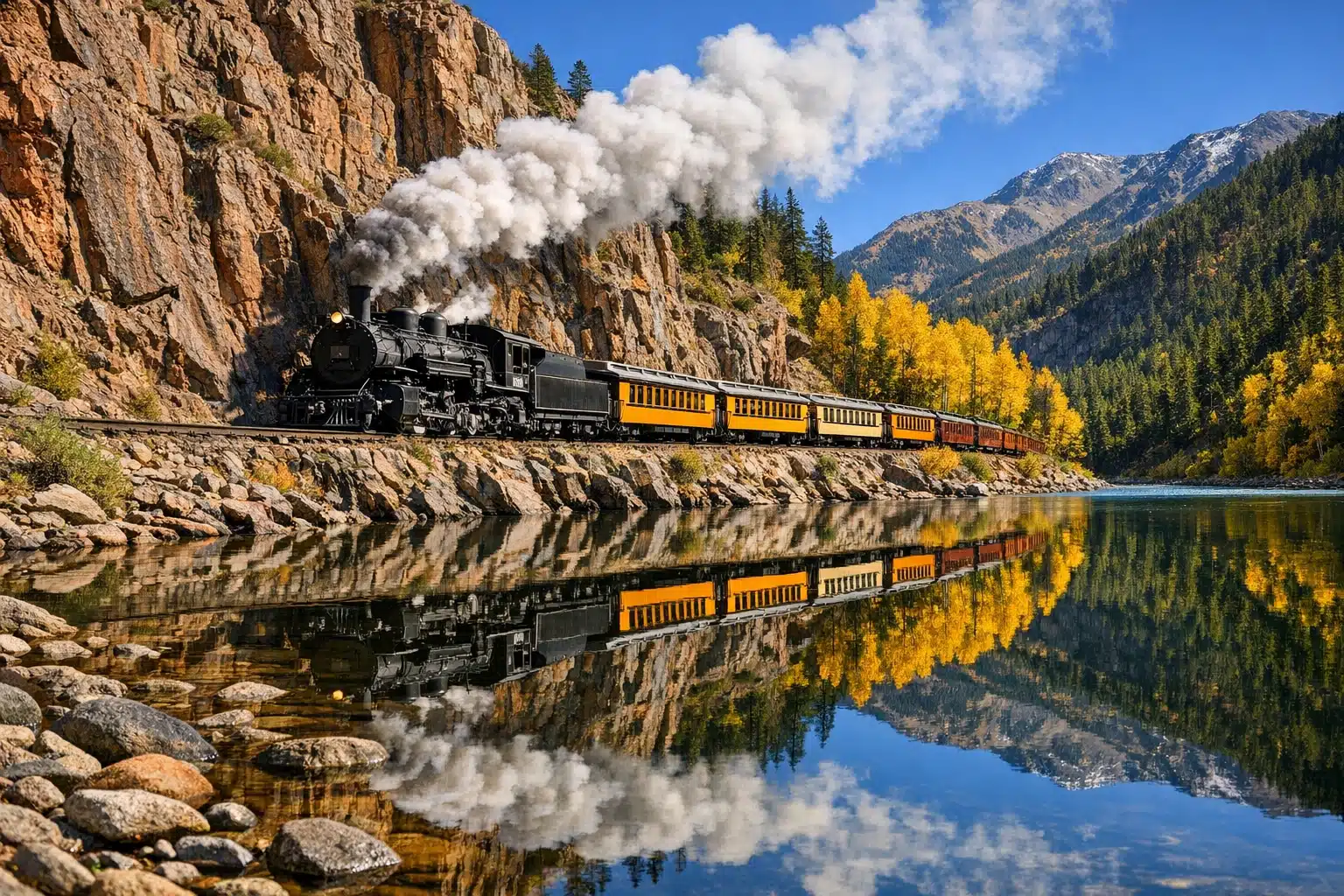
Far more rugged in character is the Durango & Silverton Narrow Gauge Railroad in Colorado. The historic line runs roughly 45 miles through the San Juan Mountains, hugging cliffs and following the Animas River. Steam locomotives, narrow-gauge track, and high-country scenery give this trip a distinct personality. It feels less like transportation and more like stepping into an older mountain West, where engineering ambition met unforgiving terrain. The route is not especially long, but its visual impact is strong from beginning to end.
Another standout is the Cumbres & Toltec Scenic Railroad, a narrow-gauge heritage line operating between Chama, New Mexico, and Antonito, Colorado. At about 64 miles, it is longer than many excursion trains and is known for steep grades, trestles, mountain meadows, and preserved steam-era operations. Rail enthusiasts often admire it for authenticity, while casual travelers respond to the scenery and the feeling that this is a working slice of history rather than a themed attraction.
For a more premium contemporary option, Rocky Mountaineer’s Rockies to Red Rocks route between Denver and Moab offers a two-day daylight journey with an overnight hotel stop. Unlike traditional overnight rail, the focus is on watching the landscape continuously rather than sleeping aboard. The service level is upscale, and the price reflects that, but it fills an important niche for travelers who want dramatic western views with a more curated travel style.
A practical way to compare these tours is this:
• Grand Canyon Railway: easiest for families and landmark-focused vacations.
• Durango & Silverton: strongest mix of mountain drama and historic atmosphere.
• Cumbres & Toltec: best for steam enthusiasts and travelers who value preserved rail heritage.
• Rockies to Red Rocks: suited to comfort-seeking travelers who want scenery without overnight rail sleeping.
What unites these tours is concentration. They deliver strong visual and emotional payoff in a manageable timeframe, making them ideal for travelers who want a train-centered day that still leaves room for the rest of a vacation.
Coastal, Eastern, and Wilderness Favorites: Scenic Routes Beyond the Usual Postcards
The American train conversation often leans heavily toward western mountains, but some of the country’s most rewarding rail journeys travel along coastlines, through forests, beside tidal inlets, or across older eastern corridors where scenery and history mingle in subtler ways. These routes may lack the blockbuster reputation of the California Zephyr, yet they often surprise travelers precisely because expectations are lower and the atmosphere is more intimate.
On the West Coast, the Coast Starlight remains one of the signature rides in the national network. Running between Seattle and Los Angeles in about 35 hours, it connects major cities while offering a broad sweep of Pacific states scenery. The appeal lies in variety: evergreen country in the Pacific Northwest, mountain views, agricultural valleys, and portions of the Southern California coast where the ocean appears close enough to seem staged. For travelers who want a long-distance trip with both urban access and natural beauty, it is one of the strongest choices in the country.
In Alaska, which absolutely belongs in any serious discussion of American rail travel, the scale changes again. The Alaska Railroad’s Coastal Classic from Anchorage to Seward takes roughly four hours and is widely appreciated for glacier views, waterways, and mountain scenery. The Denali Star, which links Anchorage and Fairbanks, offers a much longer journey of about 12 hours and gives travelers the chance to see broad wilderness, river systems, and, on clear days, views of Denali from certain vantage points. Alaska rail travel feels different from the Lower 48 because the landscapes are less interrupted. There is a sense of rawness, as if the train has entered a place where geology still sets the terms.
The East offers its own rewards. Amtrak’s Cardinal, which runs between New York and Chicago several days a week, is especially admired for its passage through the Appalachian region and the New River Gorge area of West Virginia. It is slower and less frequent than some other routes, but scenery fans often consider it one of the most attractive eastern long-distance rides. In autumn, the line can be particularly compelling.
Travelers who prefer shorter heritage experiences in the East should also note the Cass Scenic Railroad in West Virginia, where geared logging locomotives climb steep grades into mountain country. It is not a coast-to-coast spectacle, but that is part of the charm. The pace is measured, the machinery is distinctive, and the setting feels rooted in industrial and Appalachian history.
These routes prove an important point: scenic rail travel in the United States is not confined to one region or one image. Mountains are wonderful, but shoreline light, northern wilderness, and forested gorges can be equally memorable when viewed from a train window.
Choosing the Right Train Tour: A Practical Conclusion for American Rail Travelers
The best train tour in the USA depends less on hype than on fit. A route that feels unforgettable to one traveler may feel too long, too rustic, too expensive, or too structured to another. That is why the smartest way to choose is to begin with your own travel style. Are you trying to make the train the centerpiece of the vacation, or are you using it to enhance a larger itinerary built around national parks, cities, or a family road trip? Once that question is answered, the right options become much easier to sort.
For travelers with several days available and a genuine interest in the journey itself, the long-distance classics stand out. The California Zephyr is often the strongest all-around recommendation for dramatic scenery, while the Empire Builder and Coast Starlight offer equally compelling alternatives with different geographic personalities. These trips reward patience, and they are best approached with flexibility, comfortable clothing, and realistic expectations about timing. Rail travel can be wonderfully relaxing, but it operates on a different rhythm than air travel.
For visitors who want scenic impact in a shorter format, heritage and destination railroads are often the better match. The Grand Canyon Railway is approachable and family-friendly. Durango & Silverton and Cumbres & Toltec are especially appealing for travelers who enjoy history, steam power, and mountain terrain. Rocky Mountaineer’s Rockies to Red Rocks is a strong premium choice for those who want service and scenery wrapped into a more curated package.
A useful way to narrow the field is to rank your priorities:
• Choose scenery first if your goal is photography, relaxation, or a memorable honeymoon-style trip.
• Choose route length first if you are fitting rail travel into a wider vacation schedule.
• Choose comfort level first if sleeping arrangements, dining, and onboard space will shape your enjoyment.
• Choose destination first if the train is part of a larger visit to places such as Glacier, the Grand Canyon, Moab, or Alaska.
For the target audience of this guide, namely travelers looking for meaningful, experience-rich vacations rather than just transportation, train tours remain one of the most rewarding ways to see the country. They encourage slower observation, reveal landscapes that highways often rush past, and turn movement itself into a memorable part of the trip. If that sounds like your kind of travel, the routes in this guide are not just worth noting. They are worth planning for.