10 Day Trips to Japan for Seniors
Why Japan Works So Well for Senior Day Trips
Japan is one of the easiest countries in the world to explore by rail, and that matters even more when comfort, clear signage, and manageable walking distances rise to the top of the travel checklist. For seniors, a good day trip is not about racing from landmark to landmark; it is about choosing places that reward a gentler tempo, offer dependable transport, and still leave room for tea, benches, gardens, and a bit of wonder. These ten options aim for exactly that balance.
Day trips are especially relevant for older travelers because they reduce the strain of constant hotel changes. Japan’s main cities such as Tokyo, Kyoto, Osaka, Hiroshima, and Fukuoka are connected to nearby cultural sites by frequent trains, and many stations provide elevators, escalators, clean restrooms, and staffed information counters. That said, accessibility can vary once you leave a major hub. A destination may be easy to reach but still include stone steps, uneven paths, or crowded bus transfers. Choosing wisely can make the difference between a pleasant outing and an exhausting one.
This article is organized with practicality in mind. The outline is simple:
• Section 1 explains what makes a senior-friendly day trip in Japan.
• Section 2 covers four strong options from Kyoto and Osaka.
• Section 3 compares three classic outings from Tokyo and Yokohama.
• Section 4 looks at western Japan favorites with a calmer atmosphere.
• Section 5 helps you match the right trip to your energy level, interests, and travel season.
Before choosing any excursion, consider four factors. First, total transit time matters more than distance on a map. A place that takes 40 minutes by direct train can feel easier than one that takes 25 minutes with two transfers and a long walk between platforms. Second, think about terrain. Temple towns can be charming, but slopes and stairs are not always obvious in photos. Third, build in recovery time. A scenic café, museum bench, or shaded garden can transform a long day into an enjoyable one. Finally, avoid peak commuting hours when possible, especially on weekdays in Tokyo and Osaka.
If Japan were a stage set, day trips would be the scenes between the spotlight moments: a deer crossing a path in Nara, tea drifting through the air in Uji, sea light flickering around Miyajima. The goal is not to collect as many stops as possible. It is to return in the evening feeling enriched rather than worn out.
Four Excellent Day Trips from Kyoto and Osaka: Nara, Uji, Himeji, and Kobe
For seniors staying in Kyoto or Osaka, the Kansai region offers some of the best day trips in the country because travel times are short and the variety is remarkable. You can spend one day with temple treasures and friendly deer, another with green tea and riverside calm, another with a magnificent castle, and another beside the harbor. These four destinations work especially well for travelers who want cultural depth without constantly packing and unpacking.
Nara is the easiest classic choice. From Kyoto, the trip is usually around 45 minutes by train, and from Osaka it can be even shorter depending on your starting station. Nara Park is broad, green, and relatively easy to navigate at a relaxed pace. The main draw is Todai-ji, home to a giant bronze Buddha, but many visitors also enjoy simply wandering beneath tall trees while the famous deer move through the landscape almost like local officials inspecting the grounds. The key caution is that the deer can be assertive around people carrying crackers. Seniors who prefer a quieter visit should skip feeding them and focus on the temples, gardens, and museum spaces.
Uji is gentler and often overlooked in favor of bigger-name stops. Just south of Kyoto, it is well known for green tea and for Byodo-in, whose Phoenix Hall appears on the 10-yen coin. The appeal of Uji lies in rhythm. Distances are manageable, the riverside path is pleasant, and tea houses provide natural breaks in the day. Compared with Nara, Uji is calmer, less sprawling, and easier for travelers who want a half-day outing that can stretch into a full day without pressure. If you enjoy heritage with fewer crowds, Uji may be the smartest pick in Kansai.
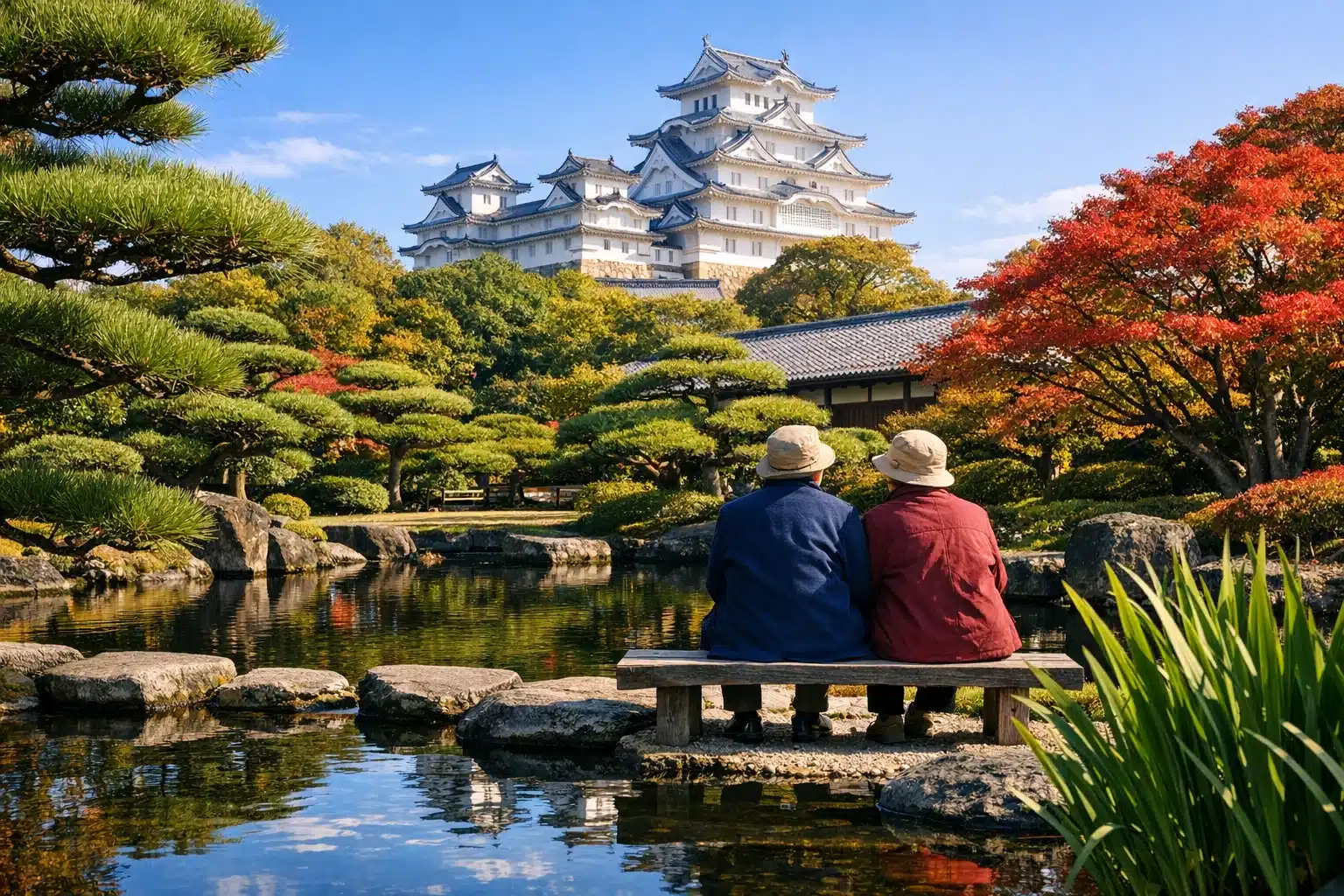
Himeji offers a very different reward: one of Japan’s finest original castles. The city is reachable in about 30 minutes by shinkansen from Shin-Osaka, while slower trains are cheaper but take longer. Himeji Castle is visually unforgettable, especially from a distance as the white keep rises above the grounds. However, this is the most physically demanding of the four once you go inside. The castle interior includes steep wooden stairs, low thresholds, and uneven footing. Seniors who want the beauty without the climb can still have a rewarding visit by viewing the exterior, exploring Koko-en Garden nearby, and enjoying a slower lunch before returning.
Kobe is the easiest urban option. From Osaka, it is often only 25 to 35 minutes away, and much of its central sightseeing is straightforward. The harbor area, Kitano district, and shopping streets offer different moods without requiring a long intercity journey. Kobe suits travelers who enjoy scenery, food, and shorter walking segments broken up by cafés. It is less monumental than Nara or Himeji, but more flexible. On a day when energy is lower, that flexibility becomes a real advantage.
In simple terms:
• Choose Nara for iconic history and open parkland.
• Choose Uji for tea culture and a softer pace.
• Choose Himeji for architectural grandeur, especially if stairs are not a major concern.
• Choose Kobe for an easygoing city day with good dining and waterfront views.
Three Rewarding Escapes from Tokyo and Yokohama: Kamakura, Nikko, and Hakone
Tokyo can be thrilling, but its scale makes many travelers crave contrast. Fortunately, three of Japan’s best senior-friendly day trips sit within reach: Kamakura, Nikko, and Hakone. Each offers a completely different atmosphere. Kamakura feels coastal and historical, Nikko is grand and spiritual, and Hakone is scenic with a touch of resort comfort. The best choice depends less on popularity and more on how much walking, elevation, and transport complexity you want in a single day.
Kamakura is usually the easiest. From central Tokyo, trains take roughly one hour, and from Yokohama the trip is shorter still. The city is known for its temples, the Great Buddha of Kotoku-in, and the old-town charm around Komachi Street. The bronze Buddha, about 11 meters tall, is one of the most recognizable religious images in Japan, yet the broader appeal of Kamakura is how flexible the day can be. You can focus on just two or three sites, pause for lunch near the station, and still feel you have seen something special. Terrain varies by temple, so it helps to avoid overly ambitious plans. Compared with Nikko and Hakone, Kamakura is the least logistically demanding.
Nikko is richer in ceremonial grandeur but requires more stamina. The trip from Tokyo often takes about 1 hour 50 minutes to 2 hours depending on the train, and once there, buses or taxis are commonly needed to connect the main sights. Toshogu Shrine, part of the UNESCO World Heritage site, is dazzling rather than serene, filled with carving, color, and detail. For travelers who love craftsmanship and Japanese history, Nikko can be the most memorable of the Tokyo-area outings. Still, it is important to be realistic. There are steps, inclines, and larger distances between some attractions. Seniors who move comfortably but do not enjoy rushing may want to focus on the shrine area only, rather than adding Lake Chuzenji or Kegon Falls on the same day.
Hakone sits somewhere between the two in spirit but not in logistics. It is famous for mountain views, museums, hot springs, Lake Ashi, and, on a clear day, glimpses of Mount Fuji. From Shinjuku, the Romancecar can make the journey easier, while other routes often involve a change at Odawara. Hakone’s challenge is not distance so much as transfers. Ropeways, buses, cable cars, and boats create a scenic network, but that network can feel tiring if the weather is poor or the queues are long. On the other hand, Hakone can be wonderfully comfortable if planned selectively: one museum, one lakeside stretch, a good lunch, and an early return.
A practical comparison looks like this:
• Kamakura is best for simplicity and flexibility.
• Nikko is best for ornate heritage and dramatic atmosphere.
• Hakone is best for scenic variety and a more resort-like day.
If your ideal outing includes fewer decisions, choose Kamakura. If you want a deeper historical impression and do not mind a longer day, choose Nikko. If you dream of mountains, mist, and the possibility of seeing Fuji beyond the clouds like a painting slowly appearing, Hakone is the one to circle on your map.
Western Japan Favorites: Kurashiki, Miyajima, and Dazaifu
Not every senior itinerary begins in Tokyo or Kyoto, and that is good news, because western Japan offers several day trips that combine beauty with a more breathable pace. Kurashiki, Miyajima, and Dazaifu are excellent examples. They differ in style, but all three are appealing for travelers who value atmosphere as much as checklists. These destinations also tend to feel less overwhelming than the busiest headline attractions in the country, which can make them especially attractive for older visitors.
Kurashiki is one of the easiest and most rewarding short outings in the region. From Okayama, the train ride is usually around 15 to 20 minutes, making it ideal for travelers who want a low-stress day. The Bikan Historical Quarter is known for white-walled storehouses, willow-lined canals, and a layout that is relatively simple to understand. Much of the pleasure comes from strolling slowly, not covering a huge area. The Ohara Museum of Art adds cultural substance, and cafés in restored buildings make excellent rest stops. Compared with Miyajima, Kurashiki is flatter and easier to do in unpredictable weather. Compared with Dazaifu, it feels more picturesque and art-focused.
Miyajima, reached from Hiroshima by train and ferry, is one of Japan’s most famous scenic islands. Transit is still manageable for a day trip, often taking about 30 minutes by train plus a short ferry ride from Hiroshima Station depending on connections. Itsukushima Shrine and the great torii gate are the stars, and the changing tide alters the mood of the entire visit. At high tide, the gate appears to float; at low tide, visitors can walk out across the sand nearby. That shifting scenery gives Miyajima a theatrical quality, as if the stage crew changes the set between acts. For seniors, the key question is energy. The area near the shrine is quite manageable, but the island also offers steeper routes and ropeway access toward Mount Misen, which may be unnecessary for a comfortable day.
Dazaifu, from Fukuoka, is perhaps the most straightforward of the three. The trip commonly takes 30 to 40 minutes, and the route from station to Dazaifu Tenmangu Shrine is lined with shops, snacks, and places to pause. The shrine is associated with learning and is especially popular among students, but the setting appeals well beyond that theme. Nearby, the Kyushu National Museum adds an excellent indoor option, which is useful on hot, wet, or crowded days. Seniors who enjoy cultural sites but prefer a compact layout often find Dazaifu very satisfying.
These three can be compared simply:
• Kurashiki is best for canals, art, and gentle strolling.
• Miyajima is best for scenery and atmosphere, especially if ferry rides sound enjoyable.
• Dazaifu is best for convenience, compact sightseeing, and an easy cultural day from Fukuoka.
If your travel style leans toward quiet texture rather than constant motion, western Japan may end up providing some of your favorite memories.
Choosing the Right Trip for Your Pace: Final Thoughts for Senior Travelers
By this point, the most useful question is not which day trip is the most famous, but which one fits your pace. For senior travelers, the right choice often depends on energy level, walking comfort, weather tolerance, and personal interests. A traveler who loves gardens and tea houses may enjoy Uji more than Nikko. Someone fascinated by castles may happily accept the effort of Himeji. Another person may discover that Kobe or Kurashiki provides exactly the kind of unhurried satisfaction that turns a good vacation into a memorable one.
Here is a practical way to sort the ten options:
• Easiest overall for a relaxed day: Uji, Kobe, Kurashiki, Dazaifu.
• Best for major historical impact: Nara, Himeji, Nikko.
• Best for scenery and atmosphere: Hakone, Miyajima, Kamakura.
• Best for half-day flexibility: Uji and Kobe.
• Best when you want one standout sight without too many moving parts: Nara, Kurashiki, Dazaifu.
Season matters as well. Spring can make Nara, Uji, and Dazaifu especially attractive thanks to blossoms and milder temperatures. Summer favors destinations where you can duck indoors or enjoy breezier waterfront stretches, such as Kobe, Hakone, and Kurashiki. Autumn transforms Nikko and Himeji into strong contenders for travelers who enjoy foliage and crisp air, though crowds rise accordingly. Winter can be excellent for city-based trips such as Kobe and Dazaifu, when you may find clearer skies and calmer sightseeing conditions.
Mobility planning can improve any of these outings. Booking reserved train seats on longer routes reduces stress. Starting early, but not too early, helps you avoid both rush-hour crowds and late-afternoon fatigue. Taxis can be worth the cost in places like Nikko and Hakone if they allow you to conserve energy for the highlights. It is also smart to keep a shorter “Plan B” in mind. If the weather turns or your legs feel heavier than expected, a slower lunch and one excellent sight can be more rewarding than forcing a full itinerary.
The heart of senior travel in Japan is not speed; it is selectivity. The country offers enough beauty that you do not need to chase all of it at once. Choose the trip that fits the day you are having, not the one a guidebook insists you must conquer. If you do that, these ten excursions can offer something rare and valuable: the sense that travel is still expansive, still surprising, and still entirely yours to enjoy at your own pace.