Three-Day Cruises from Lake Erie to Mackinac: Planning Tips and Route Highlights
Few short trips feel as layered as a three-day cruise from Lake Erie to Mackinac. In a compact window, travelers can move from broad open water to narrow river passages, pass working port cities, and finish near one of the most recognizable islands in the Great Lakes. That mix of scenery, navigation, and regional history makes the route especially appealing to travelers who want more texture than a standard weekend escape. It is also a journey worth understanding before booking, because the itinerary sounds simple on paper but depends on vessel type, weather, and departure point.
Outline: This article first explains the geography that makes this route possible, then follows the waterway highlights from Lake Erie to the Straits of Mackinac. It next compares the cruise formats most likely to cover the trip in three days, including the tradeoffs between small-ship comfort and schedule flexibility. After that, it breaks down seasonality, budget, packing, and booking details. The final section focuses on arriving well at Mackinac and deciding whether this compact Great Lakes voyage fits your travel style.
Understanding the Route: Why a Three-Day Great Lakes Cruise Works
At first glance, a cruise from Lake Erie to Mackinac sounds almost too ambitious for three days. The key to understanding it is geography. Mackinac sits at the Straits of Mackinac, the narrow meeting point between Lake Michigan and Lake Huron, while Lake Erie feeds northward through the Detroit River, Lake St. Clair, and the St. Clair River before vessels enter Lake Huron. In other words, this is not a straight shot across one body of water. It is a linked inland marine corridor, and that is exactly what gives the trip its charm.
Lake Erie is the shallowest of the Great Lakes and often the warmest in summer, but it can still produce choppy conditions when wind lines up over open water. A cruise beginning on the western side of Lake Erie, from an area near Toledo or Sandusky for example, has a different rhythm from one beginning farther east near Cleveland or Erie, Pennsylvania. Western departures reduce some of the open-lake distance and allow more time for the inland river stretches. Eastern departures give travelers a stronger sense of Lake Erie itself, but they also make scheduling tighter. That difference matters if you are trying to fit scenic sailing, meals, and even a short port stop into only three days.
In practical terms, most true three-day itineraries on this route are niche offerings rather than mass-market sailings. Some are stand-alone short cruises, while others are segments of longer Great Lakes journeys sold separately. That is why researching the exact departure port, sailing hours, and final docking point is so important. “Mackinac” might mean Mackinac Island, Mackinaw City on the mainland, or a nearby anchorage with ferry transfer depending on the operator.
A useful way to think about the trip is to break it into three travel moods:
• open-lake cruising on Erie or Huron
• transit through active waterways lined with cities, marinas, and freighters
• a storybook finish near Mackinac, where history and landscape take over
This variety is the route’s biggest strength. Travelers who usually find short cruises too shallow in experience often appreciate this one because the scenery keeps changing and the navigation itself becomes part of the attraction. You are not simply drifting toward a beach stop. You are moving through one of North America’s most important freshwater corridors, where industry, commerce, ecology, and tourism all share the same water.
Route Highlights from Lake Erie to the Straits of Mackinac
The route from Lake Erie to Mackinac is full of visual contrasts, and that is one reason it stays memorable even when the trip is brief. A typical sailing begins with the wide, horizontal feeling of Lake Erie, where the horizon can look almost oceanic in fair weather. Depending on the point of departure and the exact line of travel, you may pass near low islands, working harbors, breakwalls, and shoreline communities shaped by shipping, fishing, and summer tourism. The atmosphere here can shift quickly: one hour the lake appears polished and reflective, the next it carries a steel-gray mood that feels distinctly northern.
As the vessel approaches the Detroit River system, the scenery tightens and becomes more animated. This stretch has a very different personality from open water. Freighters, pleasure craft, bridges, industrial shorelines, and city views all create a sense of motion. If the itinerary passes the Detroit and Windsor corridor, travelers get one of the most interesting urban scenes on the route. It is a reminder that Great Lakes travel has never been only about wilderness. These waters helped build regional trade, manufacturing, and migration patterns for generations.
From there, Lake St. Clair often acts as a visual reset. It is smaller and more intimate than Erie or Huron, but it adds variety and a pause between river passages. The St. Clair River then brings another scenic change, often with clear blue-green water, waterfront homes, small marinas, and frequent commercial traffic. This is a favorite segment for many first-time Great Lakes cruisers because the ship seems to glide through a living map rather than a blank expanse of water.
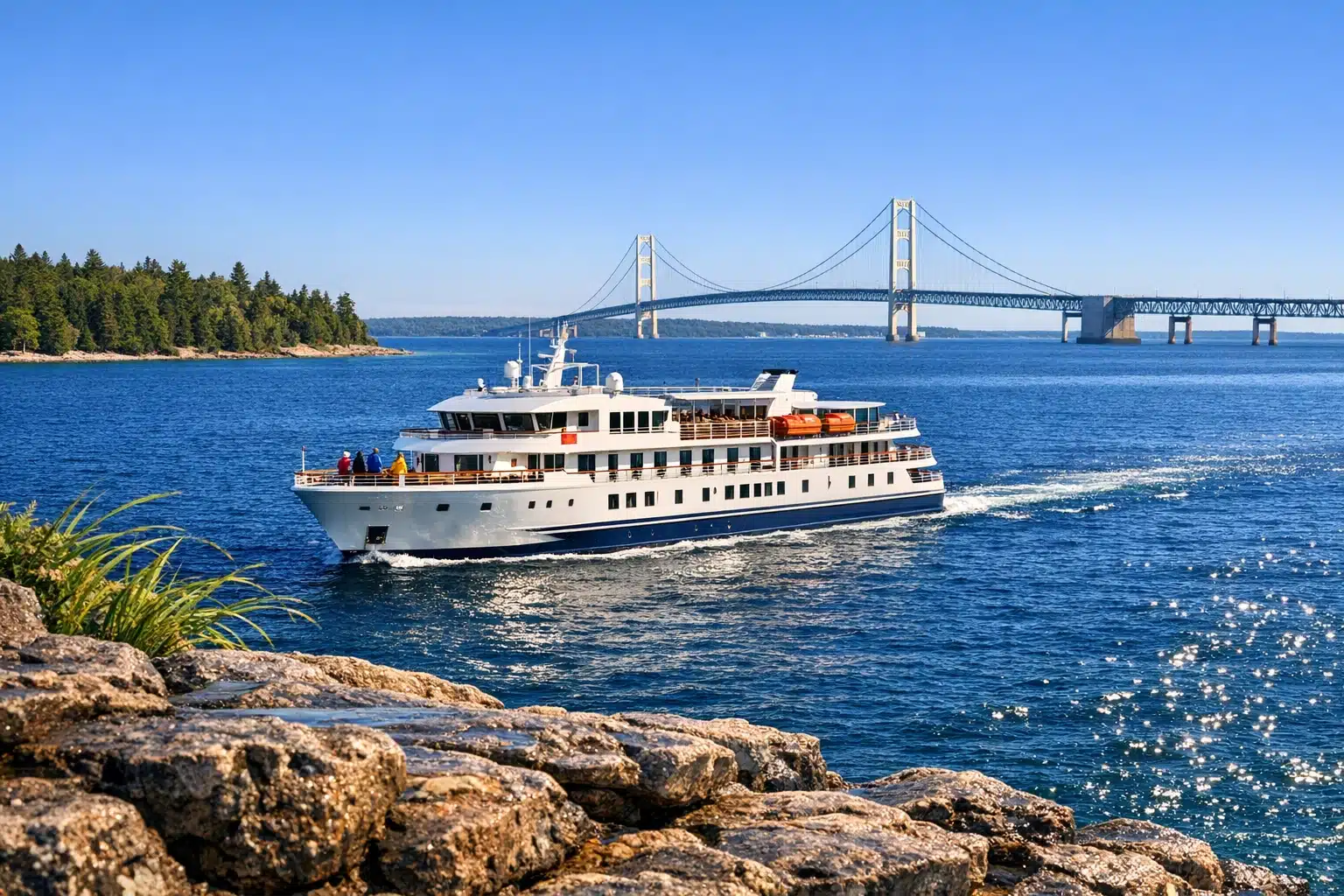
Once on Lake Huron, the journey opens up again. Weather and routing will shape what you see, but the sense of scale returns. As Mackinac draws closer, the mood changes one last time. The Mackinac Bridge appears like a long blue gate across the horizon, and the shoreline begins to carry more of the wooded, northern feel many travelers associate with Michigan vacations.
Some of the route’s strongest visual moments are simple ones:
• sunrise over open water on Erie or Huron
• watching commercial ships share the same channels
• passing from industrial waterfronts to quieter northern shorelines
• the first sight of the Mackinac Bridge
• arrival near an island where bicycles and horse-drawn carriages matter more than traffic lights
That final contrast is what gives the route narrative power. A traveler can begin in a port shaped by industry and finish at a destination famous for Victorian architecture, state park land, and a slower pace. In only three days, the Great Lakes reveal themselves as both working waters and a place of leisure, and that dual identity is part of what makes this cruise feel richer than its short length suggests.
Choosing the Right Cruise Style: Small Ships, Segments, and Schedule Tradeoffs
If you are shopping for a three-day cruise from Lake Erie to Mackinac, the first important truth is that availability may be limited in any given season. This is not a route dominated by giant ocean-style ships with weekly departures. Great Lakes cruising is generally a small-ship market, and many sailings are designed around specialty itineraries, regional exploration, or luxury travel rather than mass turnover. That is not a drawback, but it does mean you need to match your expectations to the market.
In broad terms, travelers are most likely to encounter three formats. The first is a short segment carved out of a longer Great Lakes itinerary. This can be attractive because the vessel is already designed for the region, and the cruise line often has shore operations, guides, and onboard lectures in place. The downside is flexibility. Dates may be fixed, cabin categories may sell out quickly, and embarkation logistics can be more complicated than they would be on a standard round-trip cruise.
The second format is a dedicated short cruise or specialty sailing. These may be marketed around fall color, culinary themes, regional history, or a compact luxury getaway. The benefit is focus: the itinerary is built as a short experience from the start. The risk is scarcity. Fewer departures mean less room for price comparison, and cancellation policies deserve close attention.
The third option, usually for a different budget level, is a private or semi-private yacht-style charter. This gives the greatest control over pace, meals, and stopovers, but it also shifts more responsibility to the traveler. Charter guests may need to think about provisioning, weather backups, docking fees, crew standards, and insurance in a way typical cruise passengers do not.
When comparing options, ask practical questions instead of relying only on brochure language:
• Is Mackinac the actual final dock, or is a transfer required?
• How many hours are spent underway versus in port?
• Are excursions included or priced separately?
• Does the fare cover beverages, gratuities, and transfers?
• What is the cancellation and weather-delay policy?
Ship size also matters. Smaller vessels can create a more intimate experience, with easier boarding and a stronger sense of connection to the waterway. They may also provide lectures on regional ecology or history that deepen the journey. On the other hand, travelers used to large-ship entertainment should expect a quieter atmosphere. The Great Lakes product is usually more about scenery, interpretation, and regional immersion than casinos, elaborate productions, or endless dining venues. For many travelers, that is precisely the point. This route rewards curiosity more than spectacle.
Planning Essentials: Best Season, Budget Expectations, Packing, and Booking Advice
Good planning turns this trip from an appealing idea into a smooth experience. The Great Lakes cruise season generally runs from late spring into early fall, with some operators emphasizing summer comfort and others highlighting September or early October for cooler air and changing leaves. Each part of the season has a different personality. Early summer can bring fresh temperatures and fewer crowds in some ports. High summer offers longer daylight and a lively vacation atmosphere. Early fall often delivers crisp mornings, richer color along the shoreline, and fewer family travelers, though weather can become less predictable.
Budgeting deserves special attention because Great Lakes cruises often cost more per night than mainstream ocean cruises. The market is smaller, port operations can be complex, and many operators bundle features that are optional elsewhere. Four-figure total fares are common for short premium sailings, especially if meals, beverages, guided excursions, and hotel-style service are included. That does not automatically make the trip overpriced; it simply means travelers should compare value rather than headline fare alone. A cabin with included transfers and shore programming may end up more convenient than a lower fare with many extras added later.
Before booking, review the full trip cost:
• cruise fare
• port taxes or fees
• pre-cruise hotel if embarkation is early
• post-cruise transport from Mackinac back to your home airport or car
• gratuities
• optional excursions and travel insurance
Packing for this route is a lesson in layers. Even in summer, mornings and evenings on deck can feel cool, especially on Lake Huron. Wind-resistant outerwear, comfortable walking shoes, sunglasses, and a compact rain layer are smart basics. If you are sensitive to motion, pack seasickness remedies even if the itinerary includes calmer river passages. Erie and Huron can both change personality quickly, and it is far better to have relief on hand than to search for it after boarding.
Documentation is another detail that travelers sometimes overlook. If your itinerary includes any Canadian port call or cross-border handling, verify identification requirements well in advance. A government-issued photo ID may be enough for some domestic arrangements, but a passport or other compliant document can become necessary depending on the route. Read the operator’s instructions carefully instead of assuming the trip is entirely domestic from start to finish.
Finally, book with realism. Short Great Lakes cruises appeal to travelers who like limited planning stress, yet the route itself rewards early organization. Reserve sooner if you want a specific cabin category, accessible room features, or coordinated flights. Build buffer time on both ends of the trip. A one-night hotel stay before embarkation can feel like a needless extra when you book, but it often becomes the easiest money you spend if traffic, weather, or airline delays interfere. On a three-day cruise, lost hours matter more because the experience is compact. Protecting the beginning and end of the trip is part of protecting the whole trip.
Conclusion: Making the Most of Mackinac and Deciding if This Cruise Fits You
Arriving near Mackinac is the payoff that gives this route its signature finish. Whether your vessel docks directly at Mackinac Island, uses nearby tender service, or concludes in Mackinaw City with a transfer, the destination changes the tone of the trip immediately. Mackinac Island is famous for its ban on most motor vehicles, its historic architecture, and its unusual blend of resort polish and slower rhythm. Horse-drawn carriages, bicycles, waterfront promenades, and old-fashioned storefronts create a feeling that many travelers find both nostalgic and refreshing. More than 80 percent of the island is preserved as state park land, which means the built environment never fully overwhelms the landscape.
If you have even a few hours after arrival, use them wisely. Rather than rushing from one famous sight to another, choose a short set of experiences that match the mood of the voyage. A waterfront walk, a visit to Fort Mackinac, a bicycle ride around part of the island, or time spent simply watching ferries move through the harbor can be more satisfying than trying to “complete” the island in a hurry. Mackinac rewards attention to pace. After three days of moving through interconnected waterways, the destination feels best when you let it breathe.
This kind of cruise is especially well suited to several audiences:
• travelers who want a short but distinctive Great Lakes introduction
• couples looking for a scenic trip without committing to a weeklong sailing
• history enthusiasts interested in shipping routes, frontier-era sites, and regional identity
• photographers who enjoy changing light, bridges, harbors, and layered shorelines
• repeat Midwest travelers ready to see familiar geography from the water instead of the highway
It may be less ideal for travelers who want nonstop nightlife, many long beach days, or highly predictable tropical-style weather. The route’s appeal lies in movement, transitions, and regional character. It is a cruise for people who enjoy noticing how landscapes change and how water connects cities, economies, and vacation places that can seem unrelated on a map.
For the right traveler, that is exactly why a three-day cruise from Lake Erie to Mackinac stands out. It compresses a surprising amount of Great Lakes identity into a manageable timeframe: open water, busy channels, northern scenery, and a memorable island finale. If you want a trip that feels compact without feeling thin, this route deserves a serious look. Plan it with care, choose the itinerary details closely, and Mackinac can feel less like the end of a short cruise and more like the perfect final chapter of a well-shaped freshwater journey.