 Artificially generated image
 Top 10 Seaside Towns To Live In The UK
What Makes a Great Seaside Town to Live In?
Choosing a seaside town is about far more than postcard views. The right place has to work in January as well as July, balancing housing costs, transport, schools, healthcare, jobs and the little routines that make ordinary life feel easy. Across the UK, coastal towns offer strikingly different answers: some are energetic commuter hubs, some are creative enclaves, and others deliver quiet streets with sea air on the side. This guide looks at ten of the strongest options and explains who each one suits best.
The appeal of coastal living in the UK is easy to understand. For many buyers and renters, the sea represents breathing room: longer walks, brighter horizons, and a daily setting that feels less compressed than inland cities. Yet the smartest move is to separate beauty from practicality. A charming harbour can lose some shine if the nearest major hospital is difficult to reach, train services are weak, or year-round amenities shrink once summer visitors go home.
That is why this list looks beyond scenery. The towns featured here were selected for a mix of factors that matter to long-term residents, not just weekend visitors. Those factors include:
- Transport links to larger employment centres
- Range of housing, from family homes to flats and downsizing options
- Access to schools, medical services and everyday shops
- Local character, walkability and community life
- How well the town functions outside the tourist season
- Natural setting and lifestyle quality
Some coastal places score highly because they are economically dynamic. Brighton and Hove, for example, offer city-scale convenience with a beach attached. Others make the list because they achieve something rarer: they remain deeply attractive without feeling entirely designed for visitors. Whitstable, Deal and Tynemouth each have that lived-in quality. Meanwhile, places like St Ives and Salcombe are spectacularly beautiful, but they demand more compromise on price, seasonality or transport.
To keep the article clear, the next sections follow a simple outline before expanding into comparisons:
- Section 2 covers Brighton and Hove, plus Whitstable
- Section 3 looks at St Ives and Southwold
- Section 4 compares Tenby and Tynemouth
- Section 5 rounds out the list with Deal, Lymington, Salcombe and North Berwick, then closes with a practical conclusion
There is no single “best” seaside town for everyone. A remote worker with a healthy budget may love Cornwall, while a family with teenagers may value rail links and sixth forms more than perfect sunsets. Think of this top 10 as a decision-making tool rather than a rigid league table. The strongest choice is the one that fits your budget, your commute, and the kind of daily rhythm you want once the novelty of the waves becomes normal life.
1 and 2: Brighton and Hove, then Whitstable
If you want a seaside town that behaves like a real city, Brighton and Hove are hard to beat. Strictly speaking, this is a city rather than a small town, but it belongs near the top of any UK coastal living list because it solves a problem many beach locations cannot: it offers sea views without cutting you off from jobs, culture or transport. Trains to London are frequent, with journey times often around the hour mark depending on the service, and that keeps Brighton firmly in play for hybrid workers and commuters. The local economy is broad too, with strong sectors in education, digital business, hospitality and the creative industries.
Living here means accepting trade-offs. Property prices and rents are high by national standards, parking can be a headache, and the town’s popularity means summer crowds are part of the package. Yet for many households, those compromises are outweighed by depth of amenities. Brighton and Hove have theatres, independent shops, schools, hospitals, universities and a large restaurant scene. In lifestyle terms, it offers something few coastal places do: you can have the beach, a lively social life and professional opportunity in one postcode.
Whitstable, by contrast, is smaller, calmer and more intimate. Sitting on the Kent coast, it has become one of the most talked-about places for buyers who want charm without total isolation. Its working harbour, oyster heritage and attractive high street give it genuine character, while rail services to London keep it viable for occasional commuters. It feels more village-like than Brighton, but not sleepy. There is a strong independent streak here, visible in cafés, galleries and local food businesses.
Where Brighton feels urban and energetic, Whitstable feels edited down to the essentials. That can be a blessing. Daily life is walkable, the coast is woven into the town rather than separated from it, and there is a sense that people live here because they genuinely want this scale of life. Families often like the balance: enough services nearby, but less sensory overload than a larger city.
- Choose Brighton and Hove if you want jobs, nightlife and fast rail links
- Choose Whitstable if you want style, community and a gentler pace
- Brighton suits buyers comfortable with a busier, pricier environment
- Whitstable suits movers looking for charm with reasonable access to London
In simple terms, Brighton and Hove are for people who do not want coastal living to reduce their options. Whitstable is for those who want the coast to reshape their lifestyle, but not erase convenience. Both deserve a place near the top, though they answer very different versions of the same question.
3 and 4: St Ives and Southwold for Beauty, Culture and Quiet Confidence
St Ives is one of those places that can make even a practical house-hunter briefly forget spreadsheets. The light is famous, the beaches are extraordinary, and the town’s artistic history still shapes its mood. In visual terms, it is among the most striking coastal locations in the UK. That alone explains why it features on so many relocation wish lists. Yet St Ives is not simply a pretty backdrop. It has a strong identity built around art, tourism, hospitality and small-scale local business, and its branch rail connection via St Erth gives it at least some public transport resilience in a county where distance is always part of the conversation.
For the right buyer, St Ives can feel like a daily privilege. Morning swims, narrow streets, sea-facing cafés and a creative atmosphere are not marketing inventions here; they are part of the texture of place. However, the town also illustrates why coastal living needs careful thought. Cornwall’s distance from the South East means longer travel times, and high demand for homes in prime seaside spots can push prices beyond what local wages easily support. Seasonal tourism can also change the pace of life dramatically. In winter, the town becomes quieter and more reflective; some people love that, others find it limiting.
Southwold offers a different kind of coastal appeal. On the Suffolk coast, it has long been admired for its handsome architecture, orderly seafront, pier, common and gently upscale atmosphere. It is less bohemian than St Ives and less hectic than Brighton. Instead, Southwold feels composed. The town has a strong sense of continuity, and that matters to buyers who value a place that seems to know exactly what it is. Its shops, pubs and cultural life are appealing without feeling overblown.
The challenge with Southwold is access. It does not have the same direct rail convenience as towns closer to London, and that makes it better for retirees, remote workers and buyers who do not need frequent big-city travel. In return, it offers calm, elegance and a high quality of everyday environment. If St Ives is all drama and shimmer, Southwold is steadier: dunes, pastel houses, open skies and a rhythm that rarely hurries.
- St Ives stands out for scenery, art and emotional pull
- Southwold stands out for poise, order and long-term liveability
- St Ives is stronger if natural beauty is your main priority
- Southwold is stronger if you want refinement and a quieter social tempo
These two towns prove that “best” does not always mean busiest. Sometimes the strongest place to live is the one that gives you room to hear yourself think.
5 and 6: Tenby and Tynemouth Show Two Very Different Ways to Get Coastal Life Right
Tenby, on the Pembrokeshire coast in Wales, earns its place through a combination of beauty, heritage and unusual completeness for a town of its size. The pastel houses, medieval walls and sandy beaches create instant appeal, but Tenby also works well as a lived place because it remains compact and functional. It sits within reach of some of the UK’s most impressive coastal landscapes, including the Pembrokeshire Coast National Park, and that gives residents immediate access to walking, water sports and a slower outdoor rhythm. For buyers who want a life with more horizon and less noise, Tenby makes a compelling case.
As with many destination towns, there are practical limitations. Employment options are narrower than in larger coastal centres, and transport is more modest. That means Tenby is best suited to retirees, remote workers, hospitality professionals or people whose lifestyle does not depend on constant access to a large city. Families may still find it attractive because of the safety, setting and community feel, but they should examine schooling and year-round services carefully before making the leap.
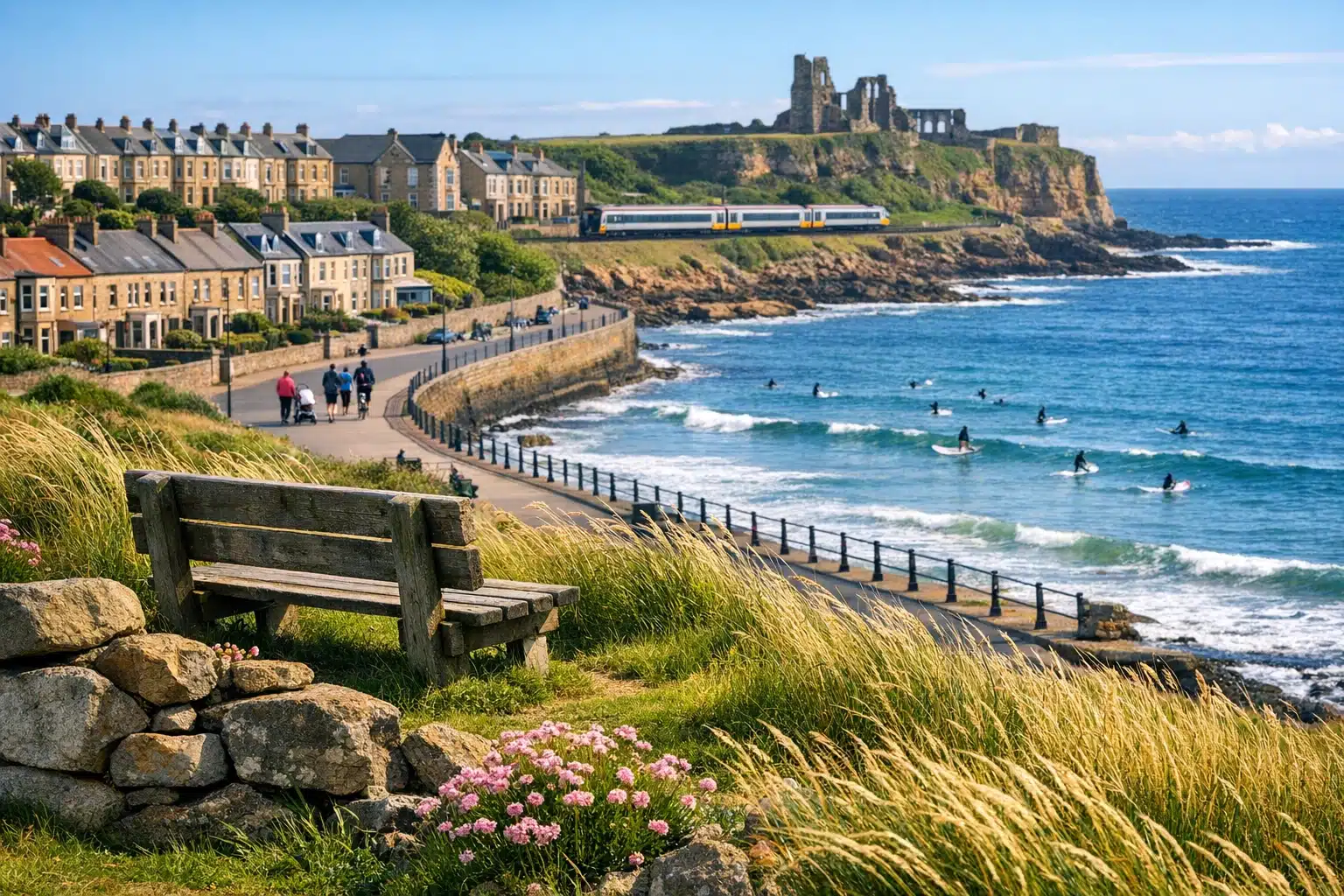
Tynemouth, near Newcastle, is almost the mirror image of Tenby in strategic terms. It delivers classic seaside atmosphere, but with the infrastructure of a large urban region nearby. The town is served by the Tyne and Wear Metro, which is a major advantage in daily life. Residents can reach Newcastle for work, culture, universities and healthcare without giving up beach access, surf culture or a distinctive high street. That is a powerful blend, and one reason Tynemouth has become increasingly attractive to professionals and families.
What makes Tynemouth especially convincing is balance. It has independent businesses, strong food and drink options, attractive streets and an active community scene, yet it does not feel preserved behind glass. It feels used, inhabited and structurally connected to a wider economy. Compared with some southern seaside hotspots, value can also look stronger, though demand has risen as more buyers notice the town’s advantages.
The comparison is revealing:
- Tenby is ideal if you want scenery, heritage and a gentler pace
- Tynemouth is ideal if you want coastal character with metropolitan support nearby
- Tenby suits life-stage moves, especially downsizers and flexibility-rich households
- Tynemouth suits working families and buyers who want resilience in everyday logistics
If coastal daydreams and practical living were placed on a set of scales, Tenby weights the scenic side a little more heavily. Tynemouth keeps the two pans closer to level. Both belong in the top 10 because each solves the question of seaside living in a coherent, believable way.
7 to 10: Deal, Lymington, Salcombe and North Berwick — Plus the Final Decision
Deal has quietly built one of the strongest reputations on the Kent coast, and for good reason. It combines historic charm, a distinctive seafront and increasingly attractive food and retail options with workable rail links to London. The old streets and Georgian architecture give it visual warmth, while the everyday experience feels less performative than in some polished coastal hotspots. It is especially appealing to buyers who want community and style without moving somewhere that seems to exist only for visitors. Compared with nearby alternatives, Deal often feels more grounded.
Lymington, on the edge of the New Forest and facing the Solent, offers a more affluent and sailing-oriented version of coastal life. Its marina, Georgian high street and ferry links to the Isle of Wight create an atmosphere that is polished yet still liveable. For retirees, professional households and anyone drawn to boating or access to both coast and countryside, it is a very strong candidate. The downside is predictably cost: Lymington’s popularity and setting can make entry prices steep. Still, few places blend market-town convenience, water access and landscape quality so neatly.
Salcombe is one of the most beautiful and aspirational names in coastal Britain. The estuary setting is exceptional, and the town has a clean, high-end appeal that attracts second-home interest as well as full-time residents. To live there is to place lifestyle front and centre: sailing, water views, boutique shops and a distinctly premium atmosphere. That beauty comes with trade-offs, notably high housing costs and a seasonal economy that can feel stretched in summer and hushed in winter. For buyers with flexibility and budget, Salcombe is wonderful. For others, it may be a place to admire rather than force.
North Berwick rounds out the list with admirable strength. Located on Scotland’s east coast, it offers beaches, golf, schools, a busy high street and one crucial advantage: a rail connection to Edinburgh that makes commuting realistic, often in well under an hour. That places it in the rare category of seaside towns that feel genuinely residential rather than recreational. It has broad appeal across age groups, from families to downsizers, and the East Lothian setting adds further quality of life.
If you are trying to narrow the field, ask yourself a few blunt questions:
- Do you need fast access to a major city for work?
- Are you buying for schools and long-term family logistics?
- Would you rather have dramatic beauty or lower daily friction?
- Can your budget absorb a premium for prestige postcodes?
- Do you want a year-round town or a seasonal place with quieter winters?
Conclusion: Which UK Seaside Town Fits Your Life Best?
The best seaside town to live in is the one that still makes sense after the holiday feeling wears off. If you need energy, transport and work options, Brighton and Hove or Tynemouth stand out. If you want design, food culture and a manageable scale near London, Whitstable and Deal are excellent choices. If beauty is non-negotiable and you can live with higher costs or slower access, St Ives and Salcombe deliver the kind of scenery people usually only borrow for a weekend.
For quieter, more settled living, Southwold, Tenby, Lymington and North Berwick each offer a persuasive version of coastal permanence. They are places where the sea is not just something to look at, but something that shapes the day: the weather, the pace, the people and even the way the light lands on ordinary errands. That is the real test. A great seaside town should feel good not only on a sunny Saturday, but also on a windy Tuesday when you are carrying groceries home. The towns on this list all pass that test in different ways, which is exactly why they deserve a place in the UK’s top 10.