2-Night Northern Lights Cruise from Dover: Travel Guide and What to Expect
For travellers in southern England, a 2-night Northern Lights cruise from Dover offers an unusual promise: a short winter break that feels adventurous without demanding long flights, tricky connections, or a full week away. Its relevance is easy to see in a busy travel market that rewards convenience, but the magic depends on realistic expectations. The aurora cannot be summoned on schedule, so the smartest way to view this sailing is as a dark-sky mini-cruise with a real, though limited, chance of something memorable.
Article Outline
- What a 2-night Northern Lights cruise from Dover really means in practical terms
- How the itinerary usually works and what life on board feels like
- When the aurora is most likely to appear, and why weather matters as much as solar activity
- How to plan your budget, choose a cabin, and pack for cold sea conditions
- Which travellers are most likely to enjoy this format, and who should consider a longer trip instead
1. What a 2-Night Northern Lights Cruise from Dover Really Offers
The phrase Northern Lights cruise can create a vivid picture: black water, icy air, and ribbons of green light moving above the deck while passengers fall silent for once. A 2-night sailing from Dover borrows some of that romance, but it helps to understand the product clearly before booking. This is not the same as a week-long voyage to Tromso, Alta, or the Norwegian fjords. It is a short winter cruise from a convenient English port, usually designed as a mini-break with an aurora possibility rather than an aurora-focused expedition.
That distinction matters because geography sets hard limits. In two nights, a cruise ship departing Dover cannot travel deep into the Arctic zone where aurora sightings are more frequent. Most such sailings spend their time in the North Sea or waters around the east and north of Britain, depending on the operator, sea conditions, and itinerary design. The advantage is obvious: no flights, no airport queues, and no complicated logistics. The trade-off is that the ship may never reach the latitudes that give travellers the strongest probability of seeing the lights.
For many people, however, that compromise is precisely the attraction. A short cruise from Dover suits travellers who want a winter escape without using up major holiday time. It can work well for couples celebrating a birthday, first-time cruisers testing the experience, or busy professionals who like the idea of a quick change of scene. The ship itself provides much of the value. You are paying not only for the chance of an aurora but also for meals, entertainment, a cabin, sea views, and the novelty of leaving the White Cliffs behind as the coastline fades into evening.
- Big strength: simple departure from the UK
- Main weakness: far lower aurora odds than longer Arctic trips
- Best mindset: treat the lights as a bonus, not the only reason to go
Seen in that light, the cruise makes sense. It is best understood as a compact winter voyage with a dramatic theme. If the sky performs, the trip becomes unforgettable. If it does not, the experience can still feel worthwhile, provided the booking decision was based on honest expectations rather than glossy marketing alone.
2. Typical Itinerary and Onboard Experience: From Dover Departure to Late-Night Sky Watching
A 2-night cruise from Dover usually moves at a pleasantly efficient pace. Embarkation often begins in the afternoon, and the first thrill arrives early: stepping on board, finding your cabin, and feeling that faint vibration beneath the floor that tells you the ship is already preparing to leave. As Dover slips behind you, the opening hours tend to mix practical tasks with holiday excitement. There may be a safety drill, dinner service, a welcome show, and the first cautious glance at the weather forecast from passengers already hoping for clear skies.
Because the itinerary is short, cruise lines typically focus on creating a lively onboard atmosphere rather than offering a port-heavy schedule. In many cases, the ship itself is the destination. You can expect restaurants, bars, lounges, a theatre, and perhaps lectures or entertainment linked loosely to astronomy, winter cruising, or the regions associated with aurora viewing. On some sailings, crew members may provide updates if solar conditions appear favourable, although this varies by line and should never be assumed as a guaranteed service.
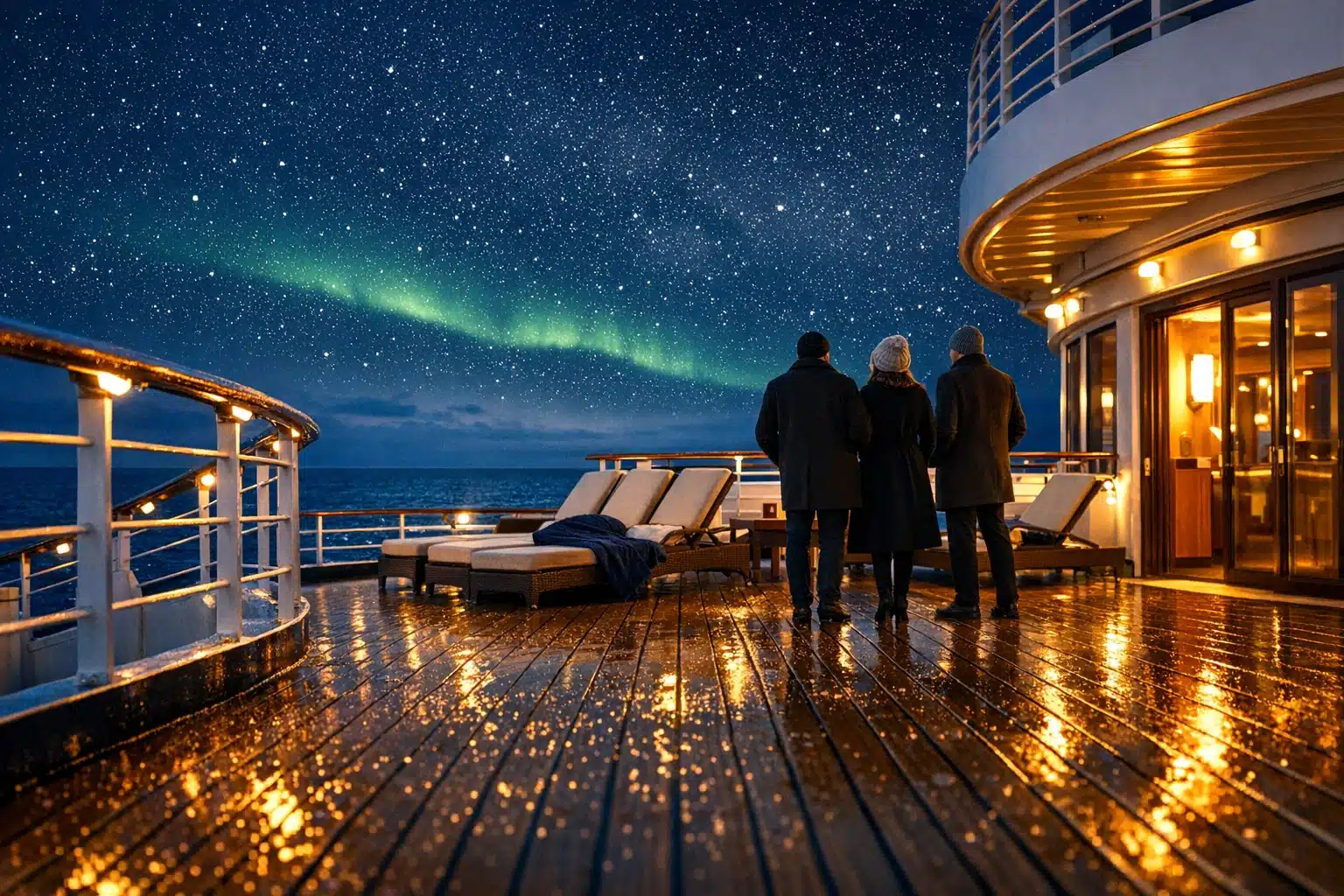
The rhythm of the trip often changes after dark. Even passengers who began the day thinking mostly about dinner reservations tend to find themselves pulled outside to scan the horizon. The upper deck becomes a stage set: wind at your collar, darkness all around, cups of coffee clutched in gloved hands, and clusters of strangers speaking more softly than usual. A sea voyage has one major advantage over land in southern England: much lower light pollution once the ship is away from coastal glare. The stars often look sharper, and even an ordinary night sky can feel cinematic.
That said, the North Sea can be lively in winter. A calm sailing is possible, but rougher conditions are not unusual, and the ship’s motion may shape your experience as much as the sky. Compared with a seven-night cruise, a two-night voyage gives you less time to settle into ship life, so it helps to be intentional.
- Arrive at Dover with documents, luggage tags, and boarding times ready
- Use the first afternoon to explore decks and locate the best outdoor viewing areas
- Check whether the ship offers any aurora alerts or bridge announcements
- Plan a flexible evening so you can step outside quickly if conditions improve
In short, expect a compact but atmospheric trip. The onboard experience is often half cosy break, half weather watch, and that combination is what gives the format its distinct charm.
3. Aurora Chances, Best Season, and the Science Behind the Hype
If you are booking this cruise primarily to see the Northern Lights, the most useful thing you can carry on board is not a camera but perspective. The aurora forms when charged particles from the Sun interact with Earth’s magnetic field and atmosphere, producing luminous displays that are most common at high latitudes. That last detail is the crucial one. Northern Norway, Iceland, and parts of Finland sit far closer to the auroral oval than Dover departure routes normally do, which is why those destinations are far more reliable for dedicated aurora trips.
A short cruise from southern England can still offer a sighting opportunity, especially during strong geomagnetic activity. On rare nights, the aurora reaches far enough south to be visible from parts of the UK, and being at sea helps because the ship leaves behind much of the urban glow that washes out faint celestial detail. Winter darkness is another advantage. From late autumn through early spring, nights are long, and a two-night cruise gives you at least a meaningful window in which conditions might align.
Yet several variables must cooperate at the same time. You need darkness, clear or broken cloud cover, sufficient solar activity, and a route far enough north to improve your chances. The challenge is that a 2-night itinerary gives you only a small number of nighttime viewing periods, and North Sea weather is famously changeable. Even if auroral activity is strong, thick cloud can erase the opportunity completely. By contrast, a longer itinerary to Arctic latitudes offers repeated nights, more northern positioning, and often more time for the crew or guides to respond to changing conditions.
That is why comparisons matter. A mini-cruise from Dover is best compared with a winter long weekend, not with a specialist aurora expedition. The difference is not subtle. On an Arctic itinerary, the lights are a central strategic target. On a short UK departure, they are more like a rare alignment of fortune and timing.
- Best general season: late October to March, when nights are longest
- Helpful condition: low light pollution once the ship is offshore
- Major obstacle: cloud cover and limited northern reach
- Best approach: monitor space weather, but do not rely on forecasts alone
The most satisfying travellers on these sailings are usually those who enjoy the possibility as much as the outcome. If the lights appear, the memory will be electric. If they stay hidden, understanding the odds in advance prevents disappointment from overwhelming the rest of the trip.
4. Planning the Trip Well: Cabins, Packing, Budget, and Booking Strategy
Good planning can make a short cruise feel smooth and indulgent rather than rushed and chilly. Because the sailing is only two nights long, every decision has a visible impact. The right cabin, sensible clothing, and a realistic budget all shape the experience more than travellers often expect. Start with the cabin choice. An inside cabin is usually the cheapest option and can be perfectly adequate for a short trip, especially if you plan to spend most of your time in lounges or on deck. An ocean-view cabin adds natural light and a stronger sense of being at sea. A balcony sounds ideal, but on a winter North Sea cruise it may not offer as much value as on a Mediterranean itinerary, since cold wind can make prolonged private viewing uncomfortable.
Budgeting also deserves a closer look than the headline fare suggests. The cruise price may include accommodation, meals in main dining areas, and entertainment, but total trip cost often rises once you add transport to Dover, port parking, drinks packages, speciality dining, Wi-Fi, and travel insurance. If you are travelling from elsewhere in the UK, an overnight hotel near the port may make embarkation day far less stressful. A bargain fare can stop feeling cheap once those extras are counted, so compare the complete figure rather than the advertising number.
Packing is where practical travellers quietly outperform optimistic ones. The deck can feel dramatically colder than the temperature listed in a weather app because of wind chill. Standing still while sky watching makes the cold more noticeable, not less.
- Pack thermal or moisture-wicking base layers
- Bring a warm hat, gloves, scarf, and a weather-resistant outer coat
- Choose shoes with grip for wet external decks
- Carry seasickness remedies if you are even slightly unsure about motion
- Take binoculars, a phone power bank, and a camera only if you know how to use it in low light
Finally, book with intention. If your true goal is simply a stylish short break, shop for value, cabin comfort, and ship atmosphere. If your main dream is the aurora, prioritise sailings in the darkest months and read the itinerary carefully to understand how far north the route is likely to go. Smart preparation does not create the lights, but it can make the overall trip feel significantly better organised, warmer, and more rewarding.
5. Is This Cruise Right for You? Final Thoughts for UK Travellers
A 2-night Northern Lights cruise from Dover works best for a specific kind of traveller, and recognising that is the key to a good decision. If you live in southern England or can reach Dover easily, the format offers undeniable convenience. You avoid flights, baggage rules feel simpler, and the whole trip can fit neatly into a long weekend. That makes it attractive for couples, time-poor professionals, curious first-time cruisers, and anyone who wants a moody winter getaway with a chance of seeing something unusual in the sky. For those travellers, the value lies in the blend of escape and ease.
It is less ideal for people whose top priority is aurora success. Photographers hoping for multiple shooting opportunities, travellers celebrating a once-in-a-lifetime Northern Lights dream, and anyone likely to feel cheated without a sighting should think carefully before choosing this option. In those cases, a longer cruise to northern Norway, or even a land-based stay in an Arctic destination, is usually the wiser investment. More nights, higher latitudes, and better local infrastructure all improve the chances. A short departure from Dover cannot compete on those terms, and it should not be judged as though it can.
What it can do brilliantly is deliver atmosphere. There is something memorable about standing on deck at night with open sea around you, knowing that the ordinary routines of home are already receding behind the stern. Even when the aurora does not appear, the voyage still offers dining, entertainment, sea air, and the small pleasure of being unreachable in the best possible way. That may sound simple, but simplicity is often what busy travellers are actually paying for.
- Best for: short-break travellers, couples, cruise newcomers, and UK-based guests who want an easy winter escape
- Less suited to: dedicated aurora hunters, serious photographers, and travellers expecting Arctic-level probability
- Strongest selling point: convenience paired with a dramatic theme
So, should you book it? If you want a compact cruise with a romantic sense of possibility, the answer may well be yes. If you want the highest practical chance of watching the Northern Lights dance overhead, choose a longer northern itinerary instead. For UK travellers who understand the balance between convenience and probability, this Dover mini-cruise can be a charming, stylish, and surprisingly memorable way to spend two winter nights at sea.