Living Room Decoration: Ideas for a Stylish and Comfortable Space
The living room is where everyday routines meet the moments people remember, so its design needs to balance function, comfort, and personality without feeling forced. A well-planned space can support conversation, reading, work, and rest while still looking calm and intentional. Because this room often sets the tone for the entire home, decoration choices matter more than many people expect. This guide explores practical ideas, design principles, and styling decisions that help turn a busy area into one that feels welcoming and easy to use.
Outline
- Understanding the room before decorating, including light, size, architecture, and daily habits.
- Planning layout and traffic flow so the space feels natural rather than crowded or disconnected.
- Choosing colors, materials, and lighting that shape mood, depth, and visual balance.
- Selecting furniture and storage that improve comfort while respecting scale and budget.
- Adding personal touches and finishing details, followed by a practical conclusion for homeowners and renters.
1. Start with the Room You Have, Not the Room in a Showroom
Many living room decoration mistakes begin in exactly the same way: someone falls in love with a sofa, a lamp, or a trend before understanding the space that must hold it. Good decoration starts earlier. It begins with observing how the room works in daylight, how people move through it, where the walls narrow, and which features already ask for attention. A fireplace, a wide window, built-in shelving, or even a dramatic view can become a natural focal point. Ignoring those elements often leads to a room that looks arranged rather than resolved.
The first practical step is to measure the room carefully. Record wall lengths, ceiling height, door swings, window placement, radiators, floor outlets, and the distance between major architectural features. Even a few inches matter. A coffee table that feels perfect in a store can become a daily obstacle in a smaller apartment. In contrast, furniture that is too small for a large room may leave the space feeling unfinished, as if the conversation stopped halfway through the design.
It also helps to define the room’s true job. Some living rooms are quiet retreats built for reading, music, and long evenings. Others are family headquarters where children play, guests gather, and the television is used every day. A room that serves multiple purposes needs layered planning, not just decorative confidence. Ask simple questions before buying anything:
- Who uses the room most often?
- What activities happen there every day?
- Does the room need to handle pets, children, or frequent guests?
- Is storage a priority, or is visual openness more important?
- Which existing pieces must stay?
Comparisons are useful here. A small city living room usually benefits from lighter visual weight, flexible furniture, and pieces that can move easily. A larger suburban family room can handle deeper seating, wider rugs, and stronger contrast in color and material. Neither approach is better; each responds to scale and use. Designers often talk about “reading the room,” and that phrase is more practical than poetic. The space already contains clues about what will work.
Another often overlooked factor is natural light. A room with strong south-facing light can absorb deeper colors without feeling gloomy. A north-facing room, which tends to receive cooler daylight, may benefit from warmer neutrals, layered textures, and thoughtful lighting in the evening. Decoration is not just about filling a room. It is about understanding its behavior across the day, then making choices that support the life unfolding inside it.
2. Layout, Traffic Flow, and Functional Zones Shape Everything Else
Once the room has been measured and understood, layout becomes the most important decision. A beautiful living room can still feel awkward if people need to squeeze past a chair, reach too far for a side table, or crane their necks to join a conversation. Good layout is not an abstract design idea. It is the physical grammar of the room, guiding how people enter, sit, move, and stay.
Start by identifying the main activity zone. In some homes, the center of the room is the television wall. In others, it is a coffee table surrounded by seating, or a fireplace that naturally draws attention. Choose one primary anchor first. Trying to make every wall the star usually creates visual noise. Once the anchor is clear, arrange seating in a way that supports both function and human comfort. Many designers recommend leaving roughly 14 to 18 inches between a sofa and a coffee table so the table remains easy to reach without crowding knees or shins. For walkways, a path of about 30 to 36 inches often feels comfortable in everyday use, though compact rooms sometimes require a little flexibility.
Conversation matters too. Chairs placed too far apart make a room feel formal and detached, while seating that is too tightly grouped can feel cramped. In a balanced layout, people can talk without raising their voices and still move easily around the arrangement. That principle is especially valuable in open-plan spaces, where living, dining, and kitchen areas need subtle boundaries. Rugs, lighting, and furniture orientation can create these boundaries without adding walls.
Consider a few common layout strategies:
-
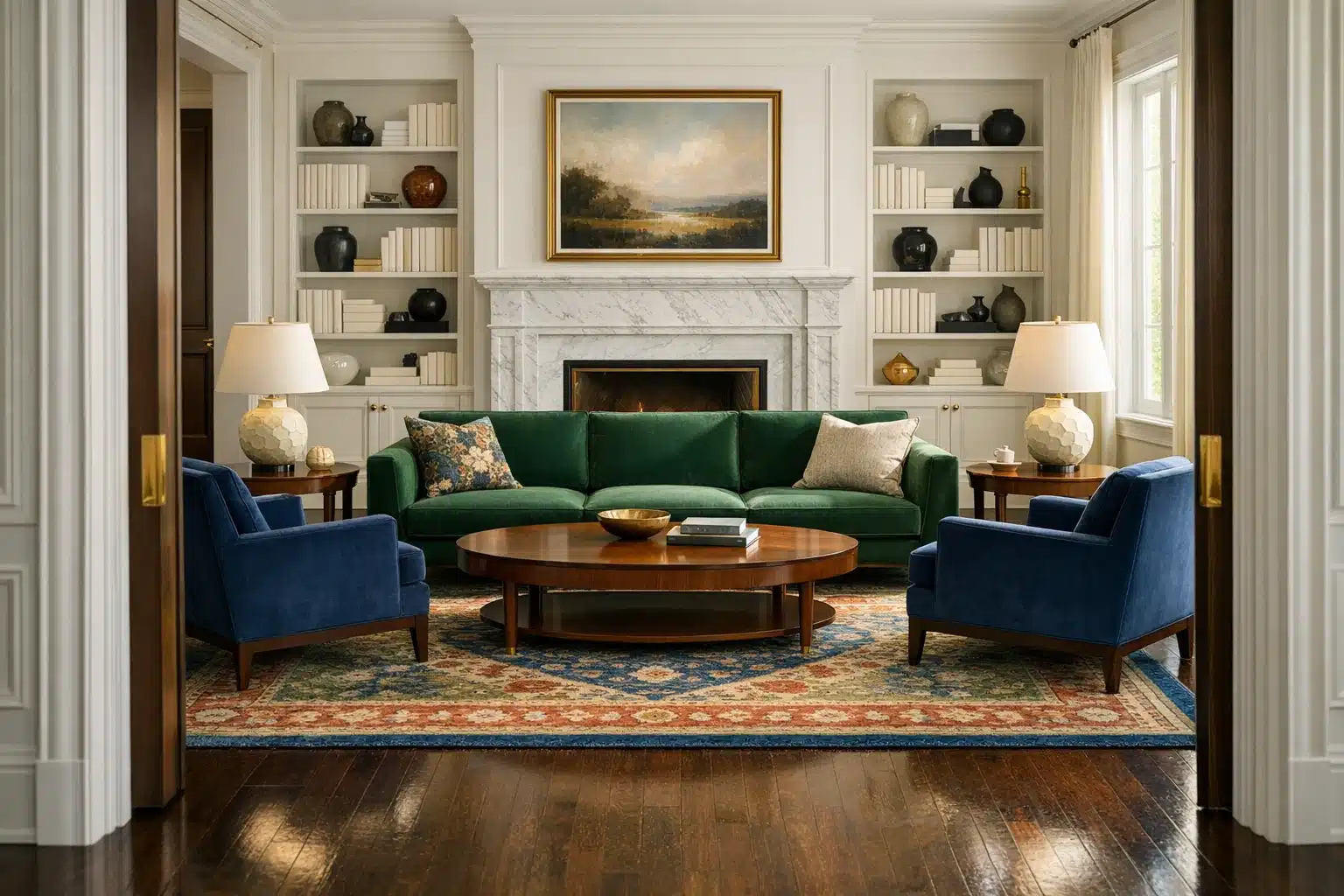
Symmetrical layouts, such as matching sofas or chairs facing each other, feel orderly and classic. They work especially well in formal rooms or spaces with a centered fireplace.
-
Asymmetrical layouts feel more relaxed and often suit modern homes, smaller spaces, or rooms where the architecture is slightly irregular.
-
Floating furniture, placed away from the walls, can make a room feel more intentional by creating a defined conversation area.
-
Wall-hugging furniture may free up the center, but it can also make the room feel less intimate if every piece sits at a distance.
Open-plan living rooms benefit from zoning. A rug can visually mark the seating area. A console placed behind a sofa can create a gentle divide while adding surface space. A floor lamp near an armchair can establish a reading corner without needing a separate room. These details matter because layout is not just about where furniture fits. It is about how the room explains itself.
There is also an emotional side to arrangement. A room with clear traffic flow feels easy. People settle in faster, conversations last longer, and the space appears more generous than its measurements suggest. That is the quiet power of layout: it makes style easier to enjoy because it removes friction from daily life.
3. Color, Materials, and Lighting Create Mood More Than Accessories Do
When people think about decoration, they often picture cushions, art, or decorative objects first. In reality, the atmosphere of a living room is shaped much earlier by color, material, and light. These elements influence whether the room feels warm or crisp, relaxed or formal, airy or grounded. Accessories can refine a mood, but they rarely rescue a room whose foundation feels visually uncertain.
Color is the obvious starting point, yet it works best when treated as part of a broader system. A soft neutral scheme can feel elegant and restful, especially when supported by variation in texture. Linen, wool, wood, matte paint, brushed metal, and woven baskets give neutral rooms dimension. Without that contrast, pale spaces may appear flat rather than calm. On the other hand, a deeper palette can create intimacy and character. Rich olive, muted navy, clay, charcoal, or warm mushroom tones often add depth, especially in larger rooms or spaces with generous daylight. Darker colors do not automatically make a room smaller; poor lighting and lack of contrast usually do more damage.
Light direction matters. Rooms with cool natural light often benefit from warmer paint undertones and bulbs in the warm white range, often around 2700K to 3000K for a comfortable residential feel. Spaces flooded with bright sunlight can handle cooler accents more easily because the daylight softens them. The goal is not to follow strict rules but to observe how the room behaves in morning, afternoon, and evening conditions.
Lighting deserves special attention because one ceiling fixture is rarely enough. Well-decorated living rooms usually rely on layers:
- Ambient lighting for overall visibility, such as ceiling fixtures or recessed lights.
- Task lighting for reading or focused activities, usually from floor lamps or table lamps.
- Accent lighting to highlight art, shelves, or architectural features.
This layered approach makes the room more flexible. Bright overhead light may help with cleaning or entertaining, while softer lamp light can shift the room into a quieter evening mood. It is the difference between a room that is simply illuminated and a room that feels inhabited.
Materials add another level of expression. Compare two otherwise similar rooms: one uses leather, marble, lacquer, and metal; the other uses boucle, oak, cotton, and ceramic. Both may be beautiful, but they speak different languages. The first often feels sharper and more urban. The second usually feels softer and more tactile. Many successful living rooms mix these voices. A sleek metal lamp beside a textured armchair, or a clean-lined sofa with a chunky knit throw, creates balance.
The best results come from restraint. Rather than using every trending finish in one place, choose a limited palette and repeat it thoughtfully. A room should feel composed, not crowded by ideas. Color, material, and lighting are the tools that make that composure possible.
4. Furniture, Storage, and Comfort Should Work as Hard as the Decor
A stylish living room loses much of its appeal if it is uncomfortable, impractical, or difficult to maintain. Furniture is where appearance and use meet most directly, so selection should be guided by proportion, durability, and real habits rather than impulse alone. The sofa is usually the largest investment and often the visual anchor of the room, which makes it worth choosing with patience. Scale matters as much as style. A low-profile sofa can make a room feel open and modern, while a traditional rolled-arm piece may suit a more classic setting. Deep seating feels luxurious for lounging, but it may not be ideal for shorter users or for formal conversation. Seat height, back support, and arm width all influence daily comfort more than many buyers expect.
Tables also deserve careful thought. A coffee table should be visually connected to the seating area, not stranded in the middle of the room like an unrelated object. Many decorators aim for a coffee table height close to the sofa seat height, often around 16 to 18 inches, because that range tends to feel natural when reaching for a drink or book. Side tables are equally important. People use living rooms more comfortably when they have a place to set down a cup, a phone, or reading glasses without leaning halfway across the room.
Storage is where design often becomes honest. Open shelving can look airy and expressive, especially when styled with books, ceramics, framed photos, and a few sculptural objects. Closed storage, however, is often more useful for remote controls, games, chargers, cables, and the small clutter that gathers quietly over time. A strong living room usually combines both. It shows a little and hides a little. That balance feels realistic.
- Ottomans with hidden storage work well in smaller spaces.
- Media units keep electronic equipment contained and reduce visual mess.
- Nesting tables add flexibility when guests visit.
- Benches or slim consoles can create extra function behind sofas or near entry points.
Textiles affect comfort more than many decorative objects. Rugs soften acoustics, improve warmth underfoot, and visually connect furniture. In many layouts, a rug feels more generous and cohesive when at least the front legs of major seating pieces rest on it. Curtains can also change the room dramatically by adding softness, controlling glare, and increasing privacy. Full-length panels usually feel more polished than short window treatments, even in simple interiors.
Durability should not be treated as the enemy of style. Families with children or pets may prefer performance fabrics, washable covers, rounded corners, and darker or patterned upholstery that disguises wear. Renters may choose modular or lightweight pieces that can adapt to future moves. Budget also matters. A useful rule is to invest more in high-contact items such as seating and rugs, then save on trend-sensitive accessories that are easier to update. Comfort is not a decorative afterthought. It is one of the reasons a room earns its beauty over time.
5. Conclusion: Personal Touches, Smart Editing, and a Living Room That Fits Real Life
The final stage of living room decoration is where personality becomes visible. After layout, color, lighting, and furniture have been handled well, styling can do its best work. This is the layer people notice up close: art leaning on a shelf, a stack of books that says something about the people who live there, a ceramic bowl collected on a trip, a plant reaching gently toward the window, or a throw that softens the edge of a structured sofa. These details should not feel random. They should feel earned, like small notes in a conversation that has already found its rhythm.
One of the most effective decorating habits is editing. A room does not need more objects simply because there is more surface area. Empty space can be useful, even elegant. A sideboard with one lamp, one tray, and one framed piece may feel stronger than the same surface crowded with ten unrelated items. This is especially true in living rooms, where visual clutter competes with the sense of rest people usually want. The goal is not minimalism for its own sake. The goal is clarity.
Artwork and mirrors can help shape the room’s character. Large-scale art often gives a stronger result than several tiny pieces scattered without connection. Mirrors can reflect light and visually expand a space, but they work best when they reflect something worth seeing, such as a window, a lamp, or a balanced part of the room. Plants are equally useful because they add movement, color variation, and a subtle feeling of life. Even one medium-sized plant can soften corners that otherwise feel too rigid.
For homeowners and renters alike, the most practical approach is to decorate in stages:
- Define how the room needs to function before shopping.
- Measure carefully and plan the layout first.
- Choose the largest furniture pieces before smaller decor.
- Build the color and material palette with restraint.
- Add lighting, textiles, and accessories slowly so the room stays balanced.
This step-by-step method helps prevent expensive mistakes and makes the room feel more personal. It also leaves space for the room to evolve. A living room should not feel frozen at the moment it is “finished.” It should adapt as habits change, family needs shift, or taste matures. The best decorated spaces are not always the most expensive or the most fashionable. They are the ones that quietly support everyday life while still offering a sense of pleasure when someone walks in, sits down, and thinks, even briefly, this feels right.
In summary, living room decoration works best when beauty grows from purpose. If you are a homeowner planning a long-term setup, focus on durable furniture, layered lighting, and timeless finishes you will still enjoy years from now. If you are a renter, prioritize flexible pieces, portable style, and updates that bring warmth without relying on major renovation. In either case, a successful living room is not built by chasing perfection. It is created by making thoughtful choices that turn the space into a comfortable, functional, and deeply livable part of the home.