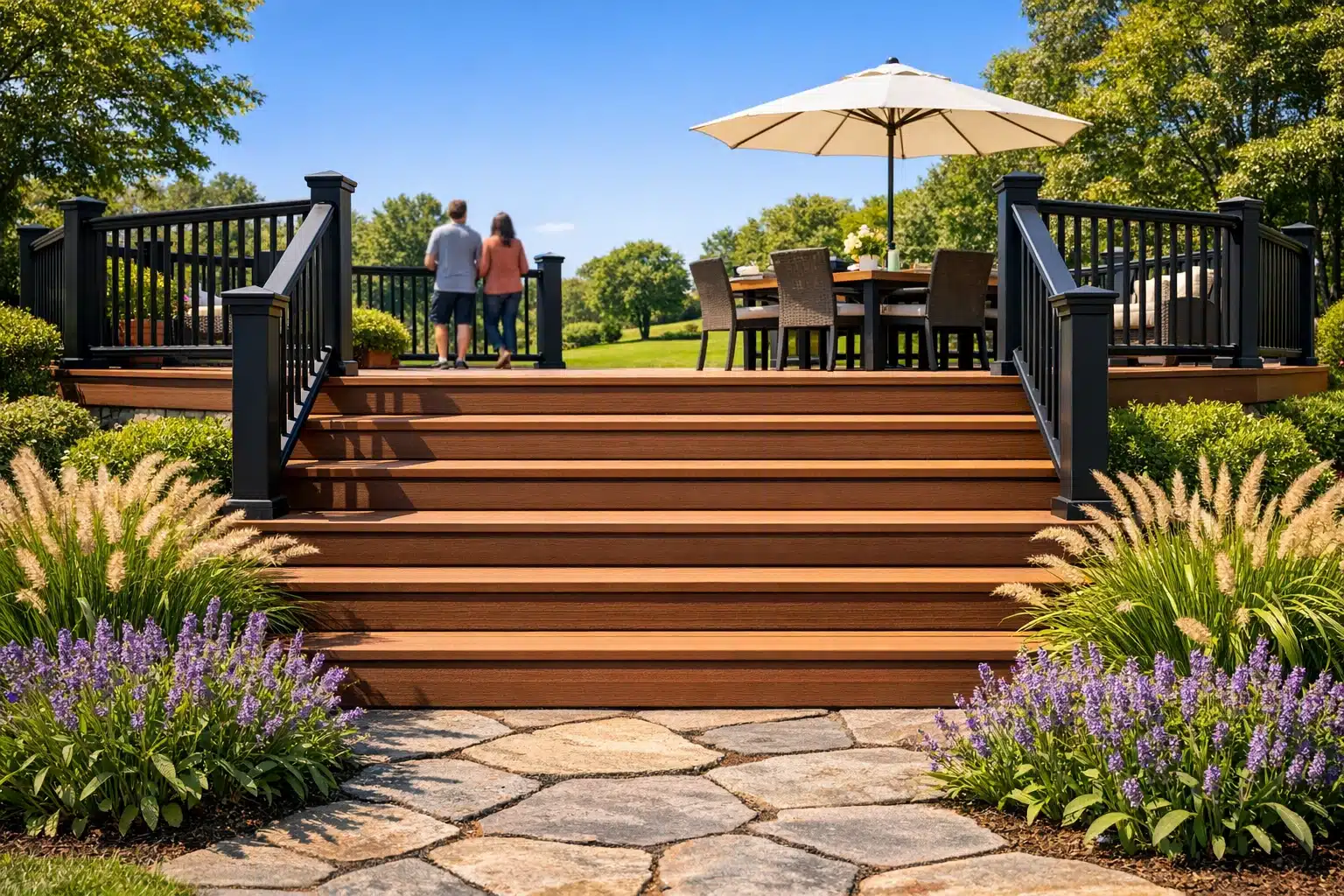
 Artificially generated image
 Composite Decking Prices: Costs, Factors, and Buying Tips
Planning a deck often starts with a dreamy picture: late coffee, bare feet on warm boards, maybe a grill humming in the background. Then the quotes arrive, and composite decking prices suddenly feel less straightforward than the glossy samples suggested. That confusion is normal, because the real cost depends on far more than the board itself. Understanding where the money goes helps homeowners compare options fairly, avoid budget surprises, and choose a deck that suits both lifestyle and long-term maintenance goals.
This article follows a practical outline so the numbers make sense in context. First, it looks at common price ranges for composite boards. Next, it explains the biggest factors that change cost from one project to another. Then it breaks down full deck budgeting, compares value across product tiers, and finishes with buying tips that can save money without sacrificing performance.
1. Typical Composite Decking Price Ranges and What They Really Mean
Composite decking prices are often advertised in a way that sounds tidy, but the real-world math deserves a closer look. Most boards are quoted by linear foot, while many homeowners think in square feet because that is how patios, rooms, and deck plans are usually measured. That difference matters. A board that looks affordable per linear foot may not feel so cheap once you convert the full order into square footage, add trim pieces, and account for the waste created by cuts, picture framing, or diagonal layouts.
In many North American markets, a broad pricing guide for the decking boards alone looks something like this:
• Entry-level composite boards: roughly $4 to $7 per linear foot
• Mid-range capped composite boards: roughly $7 to $10 per linear foot
• Premium composite or specialty lines: roughly $10 to $16 or more per linear foot
When translated into square-foot thinking, those ranges often land around:
• Budget material: about $8 to $14 per square foot
• Mid-range material: about $14 to $20 per square foot
• Premium material: about $20 to $32 or more per square foot
The exact conversion depends on board width and layout, but these figures help create a realistic starting point. For example, a standard 12-foot board that is about 5.5 inches wide covers roughly 5.5 square feet. If that board costs $48, the material rate is already near $8.70 per square foot before fasteners, fascia, and waste are counted. That is why shoppers who compare only sticker prices can feel blindsided later.
There is also a major difference between “board cost” and “deck cost.” A rectangular ground-level deck with no railing lives in a very different financial universe than an elevated structure with stairs, lighting, skirting, and custom borders. Composite products also come in different shapes, including solid-edge boards, grooved boards for hidden fasteners, and scalloped profiles that reduce weight and price. Two decks that look similar in a photo may be separated by thousands of dollars once those details show up on a contractor estimate.
The key lesson from the start is simple: treat advertised board pricing as the first chapter, not the whole book. It tells you where a product sits in the market, but it does not tell you what your finished deck will cost. To reach that number, you need to understand why pricing moves so much from one product line and one project to the next.
2. The Biggest Factors That Change Composite Decking Prices
If composite decking prices seem slippery, it is because several cost drivers are working at the same time. Some are built into the product itself, while others come from design choices or site conditions. Once you know these variables, quotes become easier to decode and sales language loses some of its magic fog.
The first major factor is construction type. Not all composite boards are made the same way. Basic boards may be uncapped or lightly protected, while better-performing products typically have a durable outer cap that improves resistance to moisture, staining, fading, and scratching. That added protection usually increases cost, but it also changes how the deck performs in everyday life, especially in full sun, near a grill, or in rainy climates.
Board profile matters too. Solid boards generally feel more substantial and are often used for stairs or high-traffic spaces, but they cost more than scalloped boards, which remove material from the underside to lower weight and price. Neither is automatically right or wrong. A simple backyard platform may work very well with scalloped boards, while a heavily used entertaining space may justify a sturdier profile.
Color and finish also play a role. Straightforward brown or gray tones are often cheaper than boards with deeper color blending, dramatic variegation, wire-brushed textures, or wider premium plank formats. In other words, the more a board tries to imitate high-end hardwood in appearance, the more the price usually climbs. That visual upgrade can be worth it, but it is still an upgrade.
Other price factors often include:
• Board length, since longer lengths may reduce seams but can cost more and affect shipping
• Fastening system, especially if hidden clips are required
• Matching fascia and trim, which are usually more expensive than field boards
• Regional freight costs, because long boards are awkward to transport
• Warranty length and product tier
• Local climate demands, such as intense UV exposure, snow load, or humidity
• Project shape, since curves, inlays, and diagonal patterns generate more labor and waste
Even timing can change the number. During peak outdoor building season, demand for installers and materials may be higher, which can tighten schedules and push labor pricing upward. A homeowner who buys in the quieter months may find better availability and sometimes more flexibility in quoting. The central point is that price is not driven by one magic lever. It is the result of product engineering, design ambition, geography, and labor conditions all pulling in different directions.
3. Looking Beyond the Boards: Total Project Cost, Installation, and Long-Term Value
One of the most common budgeting mistakes is assuming that decking boards represent the whole project. In reality, the visible walking surface is only one layer of the financial stack. The structure underneath, the accessories around it, and the labor required to build it safely can easily equal or exceed the cost of the boards themselves. That is why a homeowner may budget for “composite decking” and then discover that the full estimate lands far higher than expected.
A complete deck budget often includes several components:
• Framing lumber or metal framing
• Footings, posts, beams, and joists
• Decking boards
• Hidden fasteners or top-down screws
• Fascia boards and trim
• Stairs and stair risers
• Railings, balusters, and post caps
• Demolition and disposal of an old deck
• Permits, inspections, and engineering where required
• Labor for site prep, construction, and finish work
When these pieces are added together, installed composite deck prices can vary widely. A straightforward ground-level deck with a clean rectangular layout may fall around $25 to $45 per square foot in some markets. Once the design becomes elevated, includes railings, wraps around corners, or adds stairs and lighting, total installed pricing can move closer to $45 to $80 or more per square foot. Urban labor rates, difficult access, and premium finishes can push that number even higher.
This is where composite should be judged fairly. Its upfront price is higher than pressure-treated wood in many cases, but the long-term maintenance picture is very different. Wood may cost less at the register, yet it often asks for staining, sealing, cleaning products, sanding, and occasional board replacement over time. Composite generally needs regular cleaning and sensible care, but not the same cycle of surface treatment. For a homeowner who plans to stay in the house for years, the gap between wood and composite can narrow once those maintenance costs and labor hours are considered.
There is also a lifestyle value that does not fit neatly into a spreadsheet. Some buyers simply want fewer weekend chores and more time using the deck instead of refinishing it. That may sound soft compared with line-item accounting, but it is still part of the decision. A deck is not a stock chart; it is a lived-in part of the home. If lower maintenance matters to you, composite pricing makes more sense when viewed over the life of the structure rather than at the first moment of purchase.
4. Comparing Budget, Mid-Range, and Premium Composite Decking Options
Not every project needs the most expensive board on the display wall, and not every budget product is a smart bargain. The most useful comparison is not “cheap versus expensive” but “appropriate versus unnecessary.” Composite decking is usually easier to evaluate when broken into three value tiers: budget, mid-range, and premium. Each serves a different kind of buyer, home, and outdoor routine.
Budget composite decking is often chosen for cost control above all else. These boards may offer simpler colors, more basic grain patterns, and less elaborate surface technology. They can still be a reasonable choice for a modest platform deck, a rental property, or a backyard where the goal is durability with limited design fuss. If the project is low to the ground, easy to access, and mostly used for casual seating or occasional grilling, an entry-level product can perform perfectly well when installed correctly.
Mid-range options are where many homeowners find the sweet spot. This tier usually brings better fade and stain resistance, richer coloring, improved texture, and stronger warranties than the budget category. For families with children, pets, frequent outdoor meals, and a deck that sees real daily traffic, mid-range boards often feel like the most balanced decision. They tend to offer a better appearance-to-price ratio without crossing into luxury territory.
Premium composite decking is designed for buyers who want a more refined finish or who face harsher conditions. These boards may feature multi-tonal color blending, deeper embossing, wider or specialty plank formats, and stronger protective caps. They are often selected for high-visibility spaces such as pool decks, outdoor kitchens, waterfront homes, or showpiece backyards where the deck acts almost like an outdoor room. The visual difference can be striking, but so can the price.
A practical way to compare tiers is to ask which description fits your situation:
• Budget: simple design, tight cost ceiling, moderate use
• Mid-range: regular family use, better finish, stronger overall value
• Premium: design-driven project, difficult climate, long ownership horizon, standout appearance
Buyers should also compare what is included in the product system. One line may seem cheaper until matching fascia, stair boards, and fastening hardware are priced in. Another may cost more upfront but produce a cleaner finish with fewer visible screws and less maintenance concern. The right tier is the one that fits your climate, your budget, and your expectations once the deck is actually built and lived on. A board that saves money but leaves you disappointed in five years is not a bargain. A board that costs more than your needs justify is not value either. Good buying lives in the middle ground between those two mistakes.
5. Smart Buying Tips for Homeowners Who Want Better Value
Shopping for composite decking gets easier when you stop asking only, “What does this board cost?” and start asking, “What will this whole decision cost me over time?” That shift turns the process from impulse buying into careful planning. It also helps you spot where money is being spent wisely and where it is simply drifting away.
The first rule is to compare quotes on an equal basis. A low estimate may exclude demolition, railings, permit fees, fascia, or upgraded fasteners. Another contractor may include those items from the start, which makes the quote look higher even though it is more complete. Ask every bidder for a clear breakdown of labor, framing, decking line, fastener system, trim, stairs, and cleanup. If two proposals are not built from the same assumptions, they are not true comparisons.
It also helps to calculate waste before ordering. A simple straight deck may need roughly 10 to 12 percent extra material for cuts and future repairs, while diagonal patterns, picture frames, and multi-level layouts may need more. Ordering too little can delay the job and create color-matching issues if a later batch differs slightly. Ordering far too much ties up cash in boards that may never be used. Precision matters here more than people expect.
Other smart buying moves include:
• Bring home samples and view them in morning, noon, and evening light
• Stand on samples barefoot if heat and texture are concerns
• Ask whether the quote uses solid or scalloped boards
• Read warranty exclusions instead of noticing only the headline length
• Check who handles service claims: dealer, installer, or manufacturer
• Consider off-season scheduling if your timeline is flexible
• Reserve premium spending for features you will truly see and use
One especially useful tactic is to separate “must-haves” from “nice-to-haves.” If the budget is under pressure, keep money on the items that affect structure, safety, and long-term wear. You may be able to simplify railing style, postpone lighting, or skip decorative borders without changing how the deck fundamentally performs. That is a smarter compromise than cutting corners on framing or choosing a product tier unsuited to your climate.
Finally, remember that the best purchase is not always the lowest number or the fanciest sample. It is the option that fits the house, the way you live, and the amount of upkeep you realistically want. A good deck should feel like an invitation, not a regret dressed up in pretty grain. Buy with clear eyes, and the price will tell a much more useful story.
Conclusion for Homeowners Planning a Composite Deck
Composite decking prices make the most sense when viewed as a full project equation rather than a single shelf tag. Board tier, fastening method, railing, labor, site access, and design complexity all shape the final cost, and that is why estimates can vary so dramatically. For most homeowners, the smartest approach is to set a realistic budget, compare complete quotes carefully, and choose a product tier that matches both daily use and long-term expectations. If you want lower maintenance, steady appearance, and a deck that feels like part of the home rather than a recurring weekend task, composite can be a strong investment. The key is not chasing the cheapest option or the flashiest finish, but finding the version that gives you durable value where you will actually live: outdoors, in real weather, with real habits, year after year.