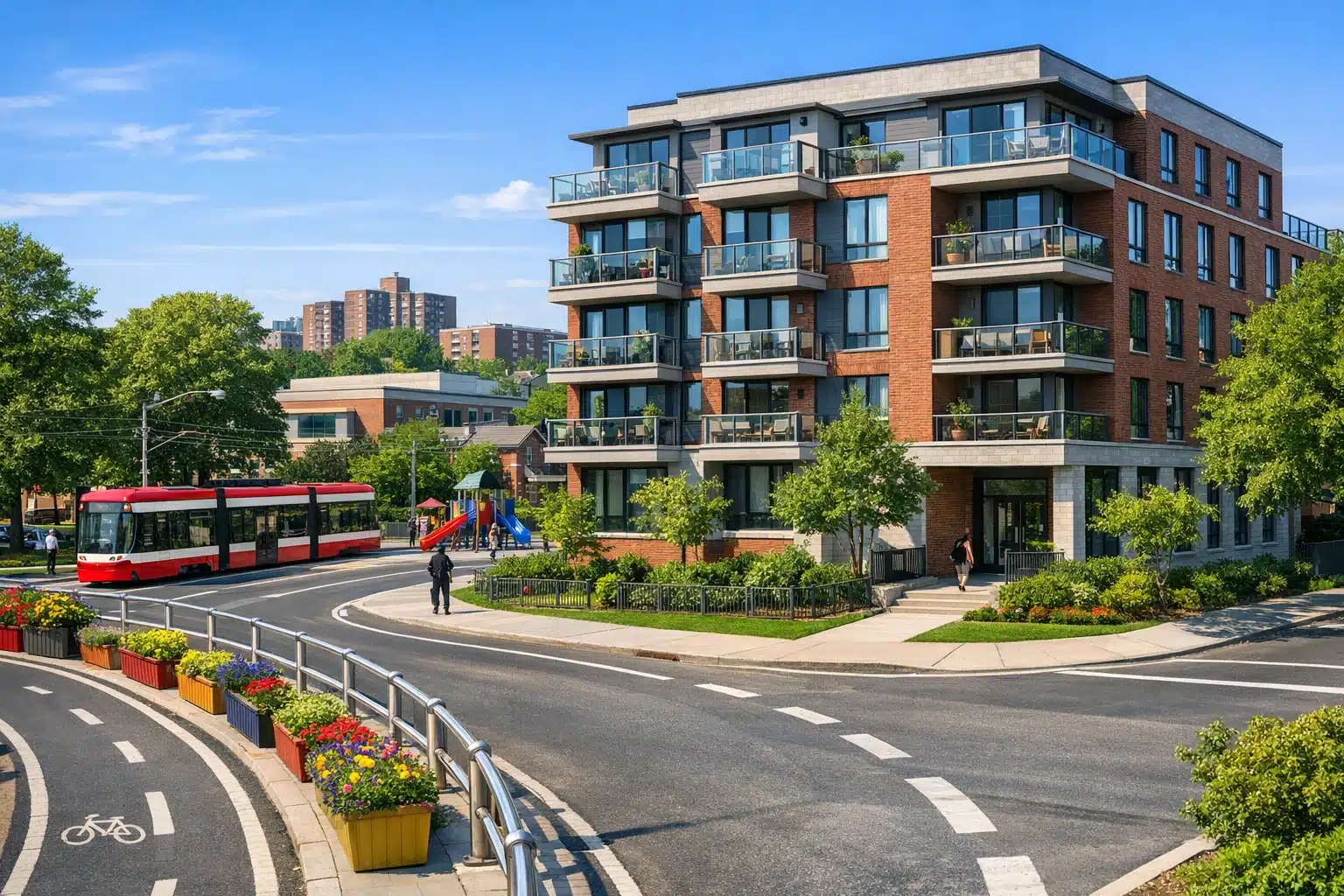
 Artificially generated image
 Toronto Community Housing Two-Bedroom Units: No-Deposit Options in 2026
Finding a two-bedroom home in Toronto is rarely simple, and families exploring Toronto Community Housing in 2026 often begin with one urgent question: is there any way to move in without a heavy upfront deposit. This article unpacks what no-deposit or low-deposit options can realistically mean, how Ontario tenancy rules shape the answer, and why provider policies must always be checked before signing anything. If the search has started to feel like a maze of wait lists, paperwork, and budget stress, the guide below turns that maze into a map.
Article Outline
- What Toronto Community Housing is, how two-bedroom units fit household needs, and what no-deposit language usually means.
- Who may qualify in 2026, how applications are typically handled, and which documents matter most.
- How deposits, rent, and move-in costs compare between community housing and the private rental market.
- How to assess a two-bedroom unit beyond the headline rent amount, including location, utilities, and family practicality.
- What steps applicants can take now to stay organized, avoid scams, and prepare for a realistic move-in path.
1. Understanding Toronto Community Housing and What “No Deposit” Can Mean in 2026
Toronto Community Housing, often shortened to TCHC, is one of the largest public housing providers in Canada and remains central to the city’s affordable housing landscape. For many households, a two-bedroom unit is not a luxury category at all; it is the practical middle ground where a parent and child, two siblings, a small family, or even a multigenerational arrangement can function with dignity. When people search for “no-deposit” options, they are usually trying to answer a very practical question: can the household secure housing without producing a large lump sum at the start.
That question matters because Toronto’s private rental market has long been difficult for renters with modest incomes. Even when a household can afford monthly rent, the move-in stage may still create a barrier. In Ontario, landlords in the private market commonly ask for a rent deposit of up to one rental period, often described as a last month’s rent deposit. By contrast, some community housing or subsidized housing arrangements may handle upfront charges differently. Depending on the provider, the unit type, and the rent program, a tenant may face a reduced deposit, no separate deposit, or a more flexible payment arrangement. The key point is that “no deposit” is not a universal promise. It is a possibility that must be confirmed through official program rules.
There is another reason the term can be confusing. Some applicants use it to mean no last month’s rent deposit, while others mean no damage deposit, no application fee, or no major cash requirement before keys are issued. Under Ontario tenancy rules, damage deposits are generally not allowed for standard residential tenancies, but other lawful charges may still arise in narrow cases, such as a refundable key deposit if it is reasonable. That is why wording matters. A family that hears “no deposit” should still ask whether there are any move-in costs at all, including utility setup, key replacement policies, parking, or tenant insurance.
Looking toward 2026, the broader context also matters. Toronto continues to face affordability pressure, and two-bedroom units are especially important because they serve households that have outgrown bachelor and one-bedroom spaces but cannot stretch into expensive market rentals. In that environment, community housing does more than offer a roof. It offers predictability. Think of it as the difference between balancing on a moving sidewalk and standing on a solid platform. The pace of change in housing policy can be slow, but for renters trying to plan school commutes, work access, and childcare, clarity about deposits and move-in costs is not a technical detail. It is the start of whether a home is reachable at all.
2. Eligibility, Household Fit, and How the Application Process Usually Works
For applicants interested in a Toronto Community Housing two-bedroom unit in 2026, the first serious step is understanding that eligibility is not based on need alone. Housing providers and city-administered affordable housing systems usually look at a mix of factors, including household size, income, legal status requirements, current housing circumstances, and whether the unit size matches occupancy standards. A two-bedroom unit is generally meant for households that genuinely need that layout, so the number of people in the household matters. If the fit between household size and unit size is off, an application may be redirected, delayed, or ruled ineligible for that particular unit category.
In practice, many applicants are entering through a centralized social or rent-geared-to-income housing application process used by the city or its designated system, while some affordable or non-profit units may also have separate processes. That means one of the most important 2026 habits is verifying which channel applies to which building. A TCHC property, a non-profit housing provider, and an affordable rental development may all sound similar in conversation, yet their rules can differ in meaningful ways. Some are tied to rent-geared-to-income formulas, some to set affordable rents, and some to mixed-income models.
Applicants should also expect paperwork. Even a household with a straightforward story can lose time if documents are incomplete or out of date. A good preparation file often includes:
- Government-issued identification for all adult household members
- Proof of income, such as employment letters, benefit statements, or pension documents
- Recent tax information if required by the program
- Documents showing household composition, including birth certificates or custody arrangements where relevant
- Immigration or status documents if the program requires them
- Any supporting records for priority categories, if applicable under current rules
One especially important point is that wait times can be long, and applicants should prepare for a process measured in months or years rather than days. That is a major difference from the private market, where speed is often possible if the money is ready. Community housing trades speed for affordability and stability. For families under pressure, that can feel frustrating, but it also explains why document accuracy, regular updates, and realistic expectations are essential. If your income changes, your family size changes, or your contact information changes, your file may need to be updated promptly. In housing systems, silence can cost time.
There may also be special priority or urgent categories under certain housing rules, including situations linked to safety risks or severe hardship, but those are usually evidence-based and narrowly administered. Applicants should never assume they qualify without reviewing official criteria. The practical lesson is simple: a strong application is part paperwork, part patience, and part precision. Like assembling a flat-pack table, it goes much faster when every piece is present before you begin.
3. Deposits, Rent Structures, and the Real Cost of Moving Into a Two-Bedroom Unit
The phrase “no deposit” sounds wonderfully clean, but real-world housing costs are rarely that tidy. For Toronto renters comparing a TCHC two-bedroom unit with a private apartment in 2026, the more useful question is not only whether a deposit exists, but how the total move-in cost is structured. In Ontario’s private rental market, tenants often need to cover the first month of occupancy and a rent deposit equal to one rental period, typically used for the last month of tenancy. That can create a sizable upfront bill before moving trucks even arrive. Community housing may reduce that pressure, especially where rents are geared to income or where the provider does not require the same kind of front-loaded payment. Still, applicants should never assume that every unit is entirely cost-free at move-in.
There are several reasons for that caution. First, a building may have lawful charges or routine setup costs that are separate from a rent deposit. Second, utility arrangements vary. Third, a household may face indirect expenses that matter just as much as formal rent. A unit can appear affordable on paper and still strain the budget if the move requires transit changes, childcare adjustments, extra laundry costs, or utility accounts not included in rent.
Here are some cost questions worth asking before accepting a unit:
- Is there a rent deposit, and if so, how much and when is it due?
- Are hydro, heat, or water included in the monthly charge?
- Is there a refundable key or fob deposit?
- Are parking, storage, or laundry charged separately?
- Is tenant insurance required or strongly recommended?
- If a deposit is required, is there any payment flexibility available?
It is also useful to understand the difference between rent level and rent timing. A rent-geared-to-income unit may have a manageable monthly amount, but the tenant should still confirm the date rent is due, how payments are made, and what happens if there is an interruption in income. Some households assume that because a program is subsidized, every administrative issue will be flexible. In reality, community housing providers still have rules, arrears procedures, and documentation requirements.
Compared with private rentals, community housing often offers one major financial advantage: predictability. The monthly obligation may be more closely aligned with a household’s actual means, and the start-up barrier may be lower. That said, predictability is not the same as zero cost. Think of it less as walking into an empty room with no wallet required, and more as stepping into a system where the biggest financial wall may be shorter and more climbable. For households with very limited savings, that difference can be decisive.
Applicants who receive social assistance, disability income, or other public benefits may also want to ask their caseworker or housing support agency whether any local housing stabilization help, charitable move-in support, or furniture bank resources are available in 2026. Availability differs by program and funding, so nothing should be treated as guaranteed. The smart approach is to budget for the essentials, then treat any additional assistance as a bonus rather than a certainty.
4. Looking Beyond the Deposit: How to Evaluate a Two-Bedroom Unit for Real Daily Life
A no-deposit or low-deposit option can open the door, but the larger question is whether the unit truly works for the household that will live there. That is where many housing searches become more human than numerical. A two-bedroom home is not just a rent figure and a floor plan. It is a morning routine, a homework table, a night shift commute, a stroller by the entrance, a parent trying to keep groceries within carrying distance, and a child asking whether the new school is far away. In other words, what looks affordable at the lease stage can become expensive in time, travel, and stress if the unit is a poor fit.
When comparing TCHC or similar affordable housing options in 2026, location deserves as much attention as monthly rent. A building close to transit, schools, grocery stores, clinics, libraries, and childcare can save both money and energy. Families often underestimate the cost of distance. A unit with lower upfront costs may still create a longer commute, more transit transfers, or extra ride-share expenses. For households with seniors, disabilities, or small children, accessibility features can be just as important as bedroom count.
Some practical evaluation points include:
- Transit access and travel time to work, school, and medical appointments
- Whether utilities are included and how that affects the total monthly budget
- Building condition, repair response process, and cleanliness of shared spaces
- Accessibility needs such as elevators, step-free entry, or bathroom layout
- Storage space, laundry access, and kitchen usability for a family-sized household
- Neighbourhood supports, including parks, community centres, and nearby food options
It is also wise to compare community housing with other affordable pathways, such as non-profit rentals, co-operative housing where available, or city-supported affordable developments. Each model has strengths. TCHC may offer a highly relevant public option, but another provider may have a better location, a different rent formula, or a more suitable building culture. Applicants should be open-minded without losing focus. The goal is not to collect as many listings as possible. The goal is to identify a home that supports stable living.
Another often overlooked issue is unit configuration. Not all two-bedroom layouts function the same way. A compact unit with little storage may feel crowded faster than a well-designed layout with clear separation between sleeping and common space. If possible, ask about room sizes, appliance condition, window exposure, ventilation, pest control history, and who to contact for maintenance. A well-run building can make an ordinary apartment feel more secure. A poorly managed one can make even a discounted unit exhausting.
In short, deposits matter because cash flow matters, but deposits are only the headline. The full story is whether the home supports everyday life without quietly draining the household in other ways. Housing decisions are rarely poetic when you are standing in line with forms, yet the right two-bedroom unit can still change the rhythm of a family’s week in a very practical, lasting way.
5. A Practical 2026 Action Plan: Preparing, Following Up, and Avoiding Costly Mistakes
If you are targeting a Toronto Community Housing two-bedroom unit with a no-deposit or low-deposit possibility in 2026, preparation is your strongest tool. Not luck, not rumours, and certainly not social media comments passed along like urban legends. The applicants who move through housing systems more effectively are often the ones who stay organized over time. A simple folder, digital or paper, can do more for your housing search than a dozen frantic phone calls made after a deadline has passed.
Start by building a realistic housing file. Include identification, income proof, household documents, contact details, and a dated log of every application step. Keep copies of submitted forms, email confirmations, letters, and notes from phone conversations. If a provider tells you a policy has changed, ask where that change is published or how it can be confirmed. Housing rules can shift, especially across years, and 2026 applicants should rely on current official sources rather than screenshots from old discussion threads.
A useful action checklist might look like this:
- Confirm whether the unit is rent-geared-to-income, affordable rental, or another housing type
- Ask directly whether any deposit or move-in charge applies
- Request a breakdown of utilities, parking, and other recurring costs
- Update application records whenever income, address, phone number, or family size changes
- Prepare a modest move-in budget even if the unit is advertised as low-cost
- Verify offers only through official provider channels
Scam prevention deserves special attention. A legitimate community housing opportunity should not involve secret fast-tracking for cash, unofficial agents demanding e-transfer payments, or pressure to hand over sensitive documents before the provider is verified. If someone claims they can guarantee placement in exchange for money, that is a warning sign, not a shortcut. Toronto’s housing pressure creates perfect conditions for bad actors, and households under stress can be easy targets. Slow down when the offer seems too convenient.
It also helps to plan for the waiting period. While your application is active, explore temporary strategies that protect your finances and keep your file strong. That may include stabilizing current housing, seeking community legal or housing support services, improving your savings buffer, or researching neighbourhoods where a future offer might arise. If you receive an offer, review it carefully and ask practical questions before accepting. A unit may look like the finish line, but the better image is a handoff point in a relay race. You still need enough information to carry the next stage well.
Above all, treat “no deposit” as one important feature, not the whole decision. The best outcome for most households is a two-bedroom home that is affordable month after month, manageable at move-in, and suitable for real daily life. In a city where housing often feels abstract until the keys are in hand, preparation is what turns possibility into something closer to a plan.
Conclusion for Toronto Families and Small Households
For renters looking at Toronto Community Housing two-bedroom units in 2026, the smartest approach is to combine hope with verification. No-deposit or low-deposit arrangements may exist in some community housing contexts, but the exact terms depend on the provider, the unit type, and the current rules in force when the offer is made. Families, caregivers, and shared households should focus not only on upfront costs, but also on eligibility, total monthly expenses, location, and long-term fit. If you keep documents current, ask precise questions, and rely on official sources, you place yourself in a much stronger position to recognize a workable housing opportunity when it appears.