 Artificially generated image
 Advantages of Polycarbonate Roofing: Durable, Insulated, and Stylish Solutions for 2026 Projects
Roofing choices shape far more than a building’s appearance. In 2026, polycarbonate roofing matters because owners want materials that handle harsher weather, help manage indoor temperatures, and still fit modern design goals without adding excessive structural weight. From patio covers to commercial canopies, it offers a practical middle ground between glass and metal. This article explains where it excels, what to compare, and how to choose wisely.
Outline
This article follows five clear steps to help readers understand the material and its practical value. First, it explains what polycarbonate roofing is, where it is used, and why it has gained momentum in 2026. Second, it compares durability and weather performance with glass, acrylic, and metal. Third, it explores insulation, daylight, and energy efficiency. Fourth, it looks at design options and project applications. Fifth, it covers installation, maintenance, cost drivers, and how to select the right system with confidence.
1. What Polycarbonate Roofing Is and Why It Matters in 2026
Polycarbonate roofing is made from a thermoplastic polymer known for being lightweight, impact resistant, and adaptable to different building forms. In plain language, it is a roofing material that can let in daylight without the fragility people often associate with glass. That simple idea has made it increasingly relevant in 2026, when project owners are trying to balance performance, cost control, visual appeal, and faster construction schedules. Whether the goal is a brighter backyard pergola, a covered walkway, a warehouse skylight band, or a retail entrance canopy, polycarbonate often enters the shortlist because it solves several problems at once.
One reason for its growing use is variety. Polycarbonate roofing is not a single product; it comes in several forms suited to different tasks. Common options include:
• Solid polycarbonate sheets, which resemble glass in appearance and are often chosen when visual clarity matters.
• Multiwall sheets, which contain internal air channels that improve thermal performance and reduce weight.
• Corrugated or profiled sheets, which work well in utility spaces, agricultural buildings, carports, and simple shelter structures.
This flexibility matters because different projects ask different questions. A homeowner may want soft natural light over a patio without summer glare turning lunch into a survival exercise. A school or clinic may care more about safety, glare control, and ease of maintenance. A commercial developer may prioritize speed of installation and predictable lifecycle cost. Polycarbonate can serve each of these needs with the right specification, sheet thickness, color, and framing system.
The 2026 angle is important as well. Building decisions are increasingly shaped by climate resilience, energy awareness, and leaner material use. Polycarbonate supports these priorities in several ways. It is significantly lighter than glass, which can reduce structural demands. Many products include UV-protective layers that help limit yellowing and surface degradation. Multiwall formats can contribute to better thermal management than single-layer transparent materials. Some systems also diffuse daylight, reducing harsh shadows and making occupied spaces feel more comfortable.
There is also an aesthetic reason for its rise. Contemporary architecture often aims for bright, open, visually calm spaces, yet budgets and practical constraints rarely disappear just because a mood board looks beautiful. Polycarbonate offers a way to introduce lightness and modern character without the cost, mass, or fragility of full glazing systems. It is not the right answer for every roof, but it has become one of the most versatile answers for projects where daylight, durability, and manageable costs need to work together rather than compete.
2. Durability and Weather Resistance: How It Compares with Glass, Acrylic, and Metal
Durability is where polycarbonate roofing earns serious attention. In many applications, the main appeal is not that it looks modern, but that it keeps working after conditions become unpleasant. Wind-driven rain, hail, falling branches, thermal movement, and repeated sun exposure can punish roof materials over time. Polycarbonate performs well in these conditions when properly installed, and that reliability is one reason it is widely used in canopies, greenhouses, industrial skylights, transit shelters, and outdoor living spaces.
Its standout characteristic is impact resistance. Polycarbonate is widely recognized as being far tougher than standard glass and generally more impact resistant than acrylic. That does not mean it is indestructible, but it does mean that in environments where accidental impact or hail is a concern, it provides a margin of safety that many owners value. In practical terms, a polycarbonate roof over a patio or school walkway is less likely to shatter into dangerous fragments if struck. That matters for family homes, public buildings, and busy work sites alike.
A comparison with common alternatives helps clarify its position:
• Glass offers excellent clarity and a premium feel, but it is heavier, often costlier to support, and more vulnerable to breakage.
• Acrylic can be clear and lightweight, yet it is generally more brittle and more prone to cracking under stress or impact.
• Metal roofing is highly durable and strong, but it does not transmit daylight and can create a darker, more enclosed atmosphere unless paired with additional skylight systems.
Weather performance also depends on surface treatment and installation detail. Many polycarbonate products include UV-resistant coatings on one or both faces. Without these layers, long-term outdoor exposure can lead to faster deterioration, discoloration, or reduced appearance quality. Buyers should never assume all sheets are equal simply because the base material shares the same name. Sheet thickness, profile design, manufacturing grade, warranty terms, and the quality of fastening systems all influence the final result.
Another strength is low weight. Because polycarbonate weighs far less than comparable glass assemblies, the supporting frame can often be lighter, simpler, or faster to erect. This can be especially useful in retrofit work, where existing structures may not be ideal candidates for heavy roofing upgrades. At the same time, lightweight materials need correct allowance for expansion and contraction. Polycarbonate moves with temperature changes more than some rigid materials, so installers must use compatible fasteners, edge clearances, and sealing details. When that step is ignored, leaks and stress cracks can follow.
Think of it this way: a roof does not prove its quality on a pleasant spring afternoon. It proves itself on the hard days, when rain hits sideways, heat builds up, or a storm tests every weak point. Polycarbonate has built its reputation in exactly those moments. It is not a miracle material, yet for impact resistance, safety, and resilient light-transmitting performance, it is one of the strongest all-rounders available in 2026.
3. Insulation, Daylight, and Energy Performance in Real Projects
Roofing influences comfort more than many people realize. A material can look attractive from the driveway and still create a room that is too hot, too dim, or too dependent on artificial lighting. This is where polycarbonate deserves a closer look, because its performance is not only about surviving weather. It is also about managing light and temperature in a way that supports everyday use. In 2026, that balance matters even more as homeowners and businesses pay closer attention to operating costs and occupant comfort.
The key distinction is between solid sheets and multiwall sheets. Solid polycarbonate behaves more like a clear protective surface. It can admit high levels of visible light, often approaching the clarity people expect from glazing, depending on finish and tint. Multiwall sheets, on the other hand, contain internal chambers that trap air and improve insulation. Those air pockets help reduce heat transfer, making multiwall options particularly useful where a space beneath the roof is occupied for long periods or where temperature moderation adds value.
Light transmission varies widely by product. Clear solid sheets can allow a high percentage of visible light through, while opal, bronze, gray, and heat-reflective finishes reduce glare and solar gain. Multiwall systems usually transmit less light than clear solid sheets, but they often spread it more evenly. That diffusion can be a major advantage. Instead of sharp shafts of brightness and hard-edged shadows, the space below feels calmer and more usable. For workspaces, garden rooms, covered decks, and entrance zones, that can improve visual comfort significantly.
From an energy standpoint, the biggest gains usually come from three linked effects:
• Reduced need for daytime electric lighting in naturally lit areas.
• Better control of solar gain through tints, coatings, and diffused finishes.
• Improved thermal performance with multiwall or advanced insulated panel systems.
Performance figures differ by manufacturer and system design, but the general principle is consistent: thicker and more sophisticated multiwall products tend to deliver better thermal resistance than simple single-layer transparent sheets. Some high-performance systems used in larger commercial or institutional projects can achieve insulation values that make them suitable for demanding building envelopes, although exact results depend on framing, seals, orientation, and climate.
This is also where buyers need nuance. More daylight is not always better. In hot climates, excessive solar gain can make a space uncomfortable unless the sheet color, ventilation strategy, and orientation are chosen carefully. In cooler climates, winter light may be welcome, but heat loss still matters. A patio cover in Arizona and a covered courtyard in northern Europe should not be specified the same way just because the product catalog looks impressive. Good roofing decisions are local decisions.
There is a quiet pleasure in well-handled natural light. It softens a breakfast corner, makes a retail entrance feel more inviting, and turns a simple passageway into a place that feels open rather than boxed in. Polycarbonate roofing can do that while supporting energy-conscious design, especially when the sheet type matches the project instead of being selected on appearance alone.
4. Style, Versatility, and Project Applications from Homes to Commercial Sites
One of the most underrated strengths of polycarbonate roofing is its design range. People often discover it while looking for a practical cover, then realize it can also shape the personality of a project. The old idea that durable materials must look purely industrial no longer fits the market. In 2026, polycarbonate systems are available in clean contemporary profiles, subtle tints, diffused finishes, and curved or flat formats that work across a wide spectrum of styles. That makes them relevant not only for utility structures, but also for architectural spaces where appearance carries real weight.
For residential projects, polycarbonate is commonly used in patio roofs, pergolas, lean-to extensions, carports, poolside shelters, garden rooms, and balcony covers. In these settings, the material often succeeds because it prevents the roof from feeling heavy or visually oppressive. A solid opaque roof can make an attached outdoor area seem darker and smaller, while a clear glass roof may bring cost, glare, and structural complications. Polycarbonate creates a useful middle path. Homeowners can choose clear sheets for openness, opal finishes for softer daylight, or tinted variants for stronger sun control and a more defined visual tone.
Commercial and institutional uses are just as broad. Polycarbonate appears in:
• Entrance canopies for offices, schools, clinics, and retail units.
• Covered walkways and transit shelters where safety and light matter.
• Warehouses and factories that need daylight through rooflights or side cladding.
• Sports and leisure facilities where impact resistance is a practical necessity.
• Agricultural structures and greenhouses that rely on light transmission and manageable costs.
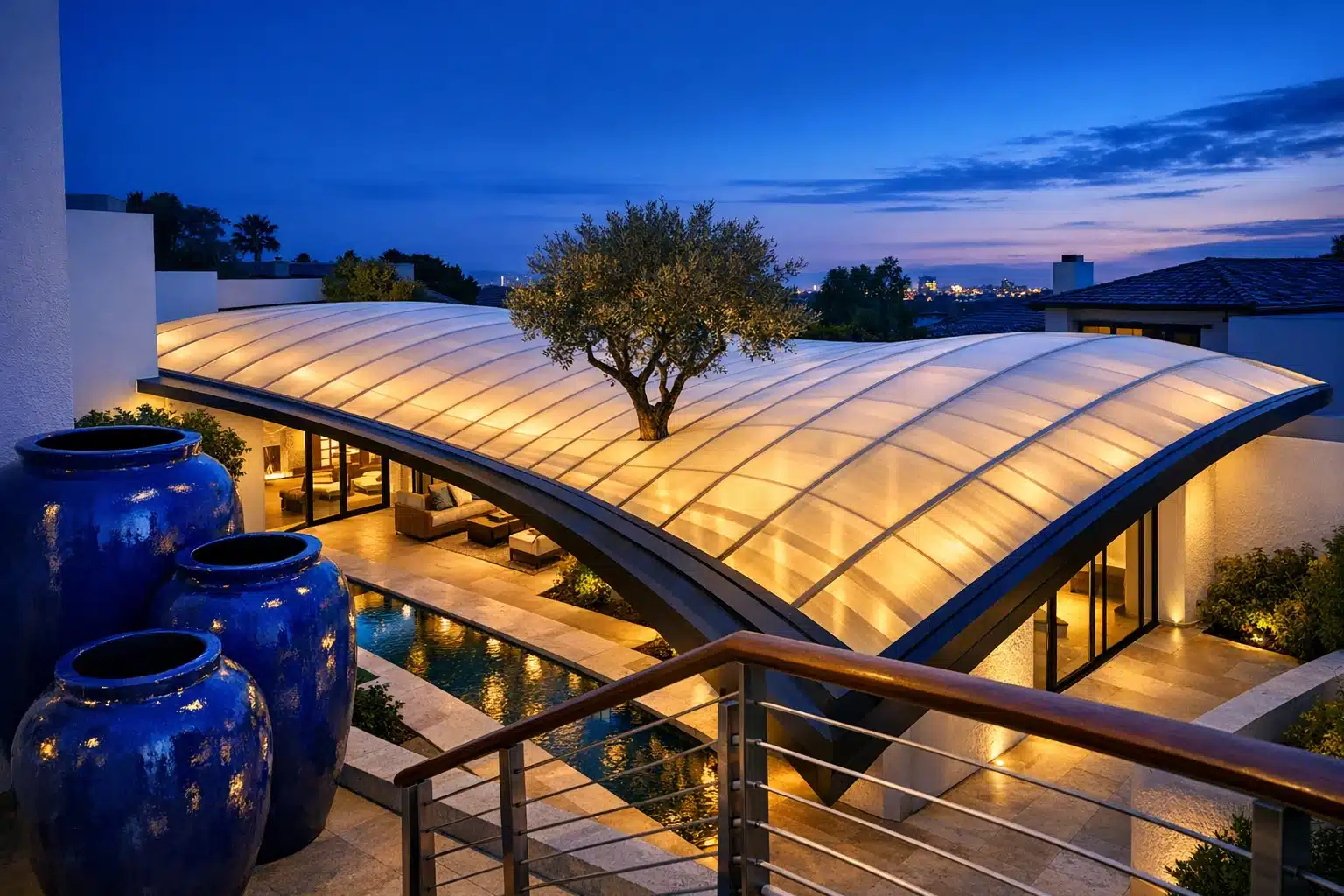
The material’s bendability and light weight open up forms that would be more complex with glass. Barrel vaults, gentle curves, and long canopy runs can often be executed with less structural burden. This helps architects and fabricators create shapes that feel airy instead of bulky. When done well, the roof becomes more than a cap on the building; it becomes part of the visual story. A simple walkway can feel brighter, a courtyard can gain a more welcoming atmosphere, and a modest backyard cover can start to feel like a deliberate outdoor room.
Color and finish choices are also more important than they first appear. Clear sheets maximize brightness but may expose dirt sooner and allow stronger glare. Opal sheets hide minor dust better and create a softer light quality. Bronze or gray tints can add visual depth and reduce solar intensity, though they also darken the space below. Textured or patterned surfaces may improve diffusion and reduce the visual harshness of direct sun. The best choice depends on use, orientation, and the mood a designer wants to create.
Style should never be treated as decoration alone. A roof that looks right but performs poorly quickly becomes disappointing. The sweet spot is a system that supports the architecture while still meeting practical demands for safety, weather resistance, and comfort. That balance is exactly why polycarbonate continues to attract both homeowners and professional specifiers. It can be quietly functional, surprisingly elegant, or both at the same time.
5. Cost, Installation, Maintenance, and How to Choose the Right System
The smartest roofing choice is rarely the cheapest sheet on day one. It is the system that fits the structure, climate, usage pattern, and maintenance expectations over time. Polycarbonate roofing can offer strong value, but buyers get the best results when they compare complete systems rather than isolated material prices. Sheet thickness, support spacing, coatings, accessories, warranties, and installer skill all affect long-term performance. A budget panel with poor detailing can become expensive through leaks, discoloration, or early replacement, while a well-specified product may provide years of dependable service with relatively modest upkeep.
Cost usually varies according to format and performance level. Corrugated sheets are often among the more economical options for simple shelters and utility applications. Solid sheets tend to cost more, especially when optical clarity, surface protection, or higher thickness is required. Multiwall products sit across a broad range, from straightforward residential grades to more advanced systems designed for demanding thermal performance. Framing materials also influence the budget. Aluminum framing is common because it is durable and compatible with clean modern detailing, but timber or steel may suit certain designs better.
Installation matters just as much as the sheet itself. Polycarbonate expands and contracts with temperature changes, so fixing points must allow movement. Holes that are too tight, incompatible sealants, poor edge support, or incorrect overlap details can shorten the life of the roof. Buyers should confirm that the installer understands:
• The orientation of UV-protected faces.
• Recommended support spacing for wind and snow loads.
• Correct use of glazing bars, washers, tapes, and seals.
• Ventilation and condensation control where relevant.
• Cleaning methods that do not scratch or chemically damage the surface.
Maintenance is usually straightforward. Routine care often involves washing with mild soap, soft cloths, and water rather than harsh solvents or abrasive tools. Leaves and debris should not be allowed to sit in channels or gutters for long periods. In many projects, the maintenance burden is lower than owners expect, especially when the roof pitch and drainage design are sensible. Opal or diffused finishes can also make dust and minor marks less noticeable than fully transparent sheets.
For buyers comparing options in 2026, a practical checklist can save time and money:
• Define the main goal first: clarity, shade, insulation, safety, or visual style.
• Match the sheet type to the project instead of choosing only by price.
• Ask for technical data on light transmission, UV protection, and thermal performance.
• Review warranty language carefully to understand coverage conditions.
• Consider local climate, orientation, and likely maintenance habits.
• Use experienced installers who can show similar completed work.
If there is one final lesson, it is this: polycarbonate roofing rewards precise decisions. The material itself is versatile, but versatility does not remove the need for thoughtful specification. When owners select the right panel, profile, finish, and fixing method, they can end up with a roof that looks clean, performs reliably, and delivers value far beyond its first impression.
Conclusion for Homeowners, Builders, and Project Planners
Polycarbonate roofing stands out in 2026 because it answers several modern building needs at once. It offers strong impact resistance, lower structural weight than glass, useful insulation options in multiwall forms, and a broad design range that suits both practical and visually refined projects. For homeowners, it can transform outdoor areas into brighter, more usable spaces. For builders and specifiers, it can simplify installation and support efficient performance targets when chosen carefully. The best results come from treating it as a system rather than a commodity sheet, comparing real technical data, and aligning the product with climate, use, and design intent.