How Airport Cleaning Work Is Described
Airports never really sleep, and that is exactly why cleaning work inside them must be described with unusual precision. A single task can affect passenger comfort, health standards, security rules, and the pace of aircraft turnaround. From terminals to restrooms, from gates to baggage halls, each duty has its own language, timing, and performance target. Understanding that description helps readers see airport cleaning as organized operational work rather than simple background labor.
Outline
This article explores five connected parts of the topic. First, it explains what airport cleaning work includes and why its description must be specific. Second, it looks at how roles, zones, shifts, and standards are defined in practice. Third, it examines the equipment, chemicals, and safety procedures used across different airport spaces. Fourth, it discusses how airport cleaning is measured through service levels, inspections, and response times. Fifth, it shows how the job is communicated to the public, contractors, and staff, revealing why wording matters in such a busy environment.
1. What Airport Cleaning Work Usually Includes
When people hear the phrase airport cleaning, they often picture a worker pushing a mop across a glossy terminal floor. That image is not wrong, but it is incomplete. Airport cleaning work is typically described as a broad facility service that supports hygiene, passenger experience, regulatory compliance, and operational continuity. In other words, it is not just about appearance. It is about keeping a transport environment usable, safe, and efficient for thousands or even hundreds of thousands of people moving through it.
The work usually covers many zones, each with different expectations. Public areas include entrance halls, ticketing counters, waiting zones, escalators, elevators, seating clusters, retail corridors, and food courts. Back-of-house areas may include staff offices, maintenance corridors, crew spaces, loading docks, and storage rooms. Sanitation-sensitive areas, such as restrooms, family rooms, and certain medical or security points, often require more frequent cleaning cycles than ordinary corridors.
In formal descriptions, airport cleaning work is often broken into task categories such as routine cleaning, periodic cleaning, reactive cleaning, and specialist cleaning. Routine cleaning includes repeated duties carried out throughout the day. Periodic cleaning refers to deeper work planned weekly, monthly, or seasonally. Reactive cleaning happens when there is an unexpected spill, weather-related mess, or heavy passenger surge. Specialist cleaning may involve high-level glass, carpets, hard floors, or biohazard response handled under stricter procedures.
A standard description may include tasks like:
- Sweeping, mopping, and machine-scrubbing floors
- Disinfecting high-touch surfaces such as handrails and kiosks
- Cleaning restrooms and replenishing consumables
- Managing waste collection and recycling streams
- Spot-cleaning glass, signage, and doors
- Responding to spills or contamination incidents
Airports are unusual because traffic patterns shift by the hour. A departure hall at dawn does not behave like a baggage reclaim area at midnight. For that reason, airport cleaning is described not only by what must be cleaned, but by when, how often, and under what conditions. A floor in a low-traffic corridor may be serviced on a schedule, while a food court near a bank of afternoon departures may require constant rotation by attendants. This operational context is what separates airport cleaning from simpler building maintenance descriptions.
Another important feature is the relationship between cleaning and other airport functions. A cleaner may need to work around security checks, retail deliveries, passenger queues, wheelchair routes, and emergency access paths. As a result, job descriptions often mention coordination, discretion, and awareness, not merely physical cleaning tasks. The wording used to describe the work reflects a simple truth: in an airport, cleanliness is part of the infrastructure, not an optional extra.
2. How Roles, Zones, and Shifts Are Described in Airport Operations
One of the clearest ways airport cleaning work is described is through division. Large airports are too complex for one general definition, so managers break the job into roles, zones, and time windows. This creates a practical map of responsibility. Instead of saying a team cleans the airport, operational documents specify who cleans which space, at what hour, using which standard, and with what reporting method. The language becomes precise because the environment demands it.
Role descriptions often separate frontline cleaning from supervisory and specialist duties. A general terminal cleaner may be assigned to visible public areas and routine upkeep. A restroom attendant may focus on inspection cycles, hygiene control, and stock replenishment. A waste operative may handle disposal streams, compactors, and recycling segregation. A floor-care technician may run ride-on scrubbers or polishing equipment. Supervisors, meanwhile, are often described as coordinating staffing, inspecting outcomes, logging incidents, and escalating urgent issues.
Zones also matter greatly. Airports are frequently split into landside and airside spaces. Landside refers to public areas accessible before security, such as check-in halls and transport links. Airside refers to controlled areas beyond security, including departure lounges, gate rooms, and some operational corridors. This distinction influences how cleaning work is described because access rules change everything. An airside cleaner may need security clearance, badge control, escort rules, and tighter equipment checks. Even the wording of task instructions can be more formal in controlled areas.
Shift structure adds another layer. Airport cleaning is often described across three broad operational rhythms:
- Day cleaning, which focuses on visible upkeep during passenger activity
- Night cleaning, which allows deeper work when foot traffic is lower
- Rapid response cleaning, which handles spills, weather debris, and unexpected incidents
These distinctions are practical. During the day, cleaners may prioritize speed, discretion, and hazard prevention. At night, they may perform machine scrubbing, carpet extraction, deep restroom sanitation, or detailed glass cleaning. During peak disruptions, such as flight delays or severe rain, teams may switch from fixed schedules to mobile response patterns. That means the work description must remain clear but flexible.
Service contracts often translate these realities into measurable language. A terminal zone may require inspection every 30 minutes, restroom touch-ups every 20 minutes, or spill response within a defined number of minutes. In a very busy airport, tens of thousands of passengers may pass through key areas daily, and during holiday peaks that figure can rise sharply. The cleaning role is therefore described in relation to passenger density, operational risk, and user expectation.
There is also a human side to these descriptions. Airport cleaning staff must often work in public view while staying calm, polite, and unobtrusive. A queue can form in seconds; a coffee spill can become a slip hazard even faster. So job descriptions may include communication skills, awareness of diverse travelers, and the ability to work in a multilingual, high-pressure environment. That is why the role sounds more like coordinated facility operations than basic janitorial labor when written in professional terms.
3. Equipment, Chemicals, and Safety Procedures Behind the Scenes
If the airport terminal is the stage, cleaning equipment is part of the backstage machinery that keeps the performance running. Descriptions of airport cleaning work usually devote careful attention to tools, chemicals, and safety procedures because these details affect both results and risk. A cleaner in a small office building might rely on a narrow set of supplies, but an airport team often works with a much wider range of machines and materials suited to large surfaces, continuous use, and strict public safety requirements.
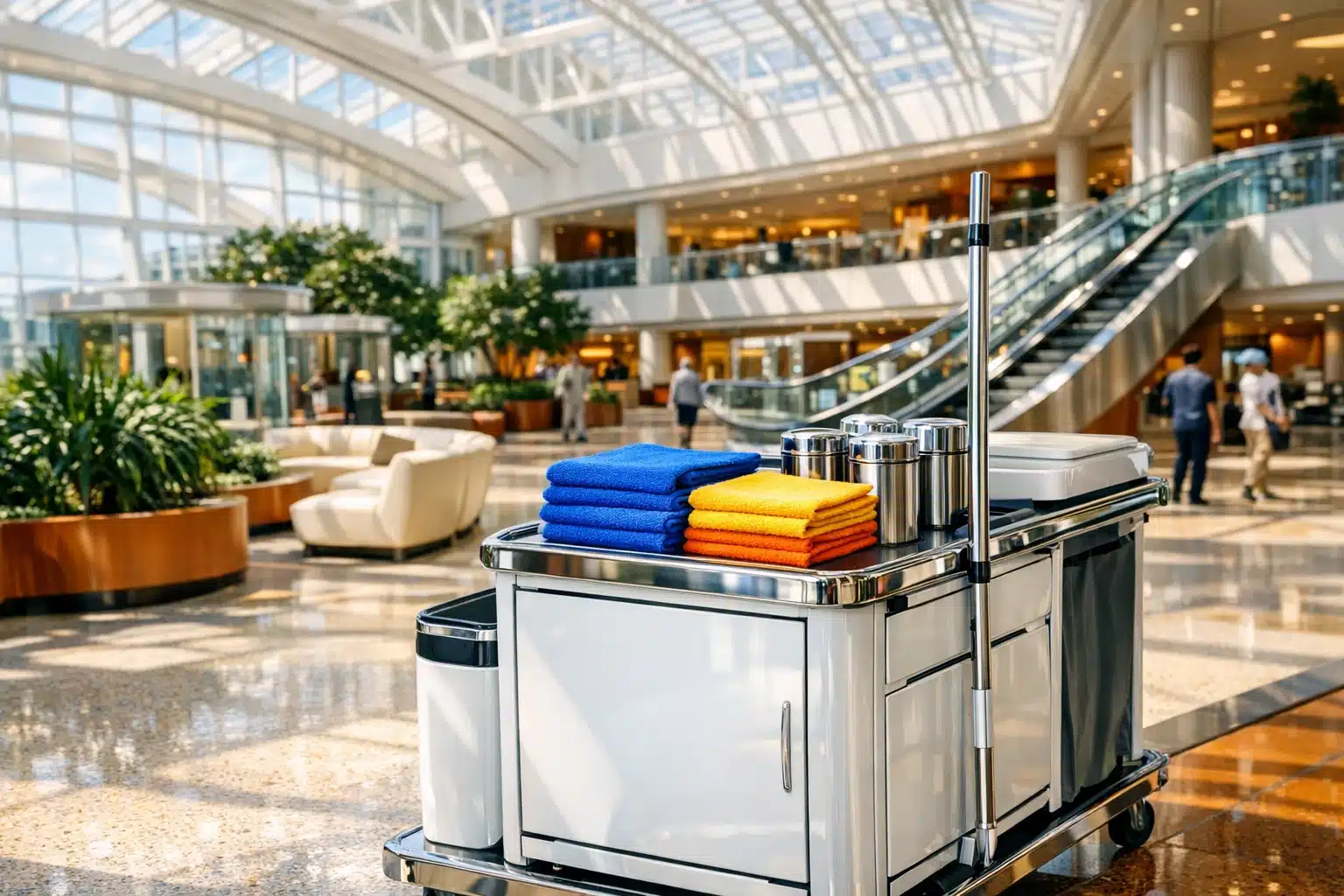
Common equipment includes manual tools such as microfiber cloths, mops, squeegees, waste carts, and warning signs. Beyond those basics, airports frequently use mechanized equipment such as walk-behind scrubbers, ride-on floor machines, vacuum systems for carpeted areas, high-reach tools for glass, and pressure or steam systems for selected maintenance tasks. Because terminals can span vast square footage, mechanization is often described as essential for consistency and speed. A concourse that appears spotless at 6 a.m. may require another full machine pass before noon if traffic is heavy.
Chemicals are described with equal care. The goal is not simply to clean but to clean appropriately. Different surfaces call for different products, and misuse can damage finishes or create hazards. For example, natural stone flooring, stainless steel fixtures, food-adjacent surfaces, and restroom ceramics may each require separate treatment. Many airports and contractors now emphasize low-odor or environmentally preferable chemicals, partly to reduce passenger discomfort and partly to align with sustainability goals.
Typical supply categories include:
- Neutral floor cleaners for daily maintenance
- Disinfectants for high-touch points and washrooms
- Glass cleaners for partitions, windows, and doors
- Degreasers for food service zones
- Absorbent materials and specialized kits for spill response
Safety is where descriptions become especially exact. Airports cannot afford preventable accidents in crowded spaces. Cleaning staff therefore work under procedures covering dilution, storage, labeling, personal protective equipment, machine use, and hazard communication. Wet floor signs, cord management, segregated waste handling, and biohazard protocols are not minor details; they are routine operational controls. In some facilities, incident-response procedures also include documentation requirements and immediate supervisor notification.
Security considerations shape cleaning descriptions too. Tools may need to be counted in and out of secure areas. Carts cannot block emergency exits or screening routes. Unattended equipment can trigger concern in a controlled environment, so placement and monitoring matter. In airside zones, even a bin liner or cleaning pole can fall under movement rules that would seem surprisingly strict in another building.
There is also increasing emphasis on infection prevention. Since the pandemic years, many public facilities have refined how they describe disinfection, touchpoint cleaning, and air-quality-related housekeeping practices. While routines vary by airport and local guidance, the language tends to be clearer now about frequency, contact time, and high-contact items such as elevator buttons, tray tables, armrests, and self-service kiosks.
So when airport cleaning work is described in full, it does not read like a vague list of chores. It reads more like a coordinated technical service, where chemistry, machinery, safety, and timing all have to move in step.
4. Standards, Inspections, and How Quality Is Measured
A clean airport is not defined by guesswork. It is defined by standards, and those standards are a major part of how airport cleaning work is described. In most professional settings, managers do not rely on general phrases such as keep the terminal tidy. Instead, they use service levels, checklists, inspection scores, photographic references, response targets, and audit systems. This structured language matters because cleanliness in an airport affects public perception, health confidence, and even movement efficiency.
One common method of description is the service level agreement, often abbreviated as SLA. This kind of document outlines the expected condition of specific areas and how often they must be serviced. A premium lounge restroom, for instance, may carry a much tighter inspection interval than a low-use staff corridor. A baggage belt area after an international arrival may require immediate litter removal, touchpoint disinfection, and floor checks because the flow of people and luggage creates rapid wear on the space.
Quality is often measured through visible criteria. Floors may be checked for dust, streaks, residue, and slip risk. Restrooms may be inspected for odor control, fixture cleanliness, supply levels, and waste overflow. Seating zones may be reviewed for litter, stains, and the cleanliness of charging points or side tables. Glass and metal surfaces may be assessed for fingerprints and smudging, especially in highly visible passenger spaces.
In practical terms, measurement can include:
- Scheduled inspections by supervisors
- Digital task logs completed by staff
- Random quality audits by airport management or contractors
- Passenger feedback and complaint tracking
- Time-based response metrics for urgent issues
Data increasingly shapes these systems. Some airports use sensor-equipped dispensers in restrooms, digital dashboards, or mobile apps for task assignment and proof of completion. A supervisor can see which washroom needs service, when a waste bin reached a threshold, or whether a cleaning round was delayed by an operational disruption. This moves the description of work away from static routines and toward evidence-based service management.
Yet quality in an airport is not only technical. It is also perceptual. Passengers form strong impressions from small details: a sticky table near a gate, a poorly maintained restroom before a long flight, or a spill left too long beside an escalator. Because airport travelers are often stressed, tired, or time-conscious, cleanliness becomes emotionally visible. That is why quality descriptions often mention presentation and readiness as much as sanitation.
There is a subtle art in these standards. The best airport cleaning is often the cleaning nobody notices because the environment simply works. Bins are emptied before they overflow. Floors stay safe without dramatic closures. Restrooms remain usable without long interruptions. Describing this work well means recognizing that its success lies in prevention, timing, and consistency rather than in showy moments. In a setting where every delay has consequences, measured cleanliness becomes part of operational reliability.
5. How Airport Cleaning Is Communicated to Staff, Contractors, and the Public
The final part of the picture is communication. Airport cleaning work is not only done; it is described to different audiences for different reasons. Staff need clear instructions. Contractors need detailed scope definitions. Managers need performance language. Passengers need reassurance, often without being overwhelmed by operational jargon. This makes the wording around airport cleaning especially interesting, because it must shift tone while preserving accuracy.
For internal staff, communication is usually practical and task-focused. Work orders, shift briefings, cleaning schedules, and incident logs describe who is assigned where, what standard is expected, and what problems must be reported immediately. A supervisor might issue instructions based on passenger loads, weather conditions, or an arriving wave of flights. In this context, the language is direct: clean, inspect, restock, report, isolate, reopen. Precision reduces confusion, and confusion is expensive in a live airport environment.
For contractors, the work is often described in formal specifications. These documents may define square meter coverage, approved products, staffing levels, machine types, service windows, escalation routes, security obligations, and reporting requirements. Contracts can include penalties for missed standards and bonuses for performance. This is where airport cleaning starts to sound like a blend of logistics, compliance, and customer service rather than a simple housekeeping function.
Public-facing communication, however, uses a different voice. Airports may refer to enhanced cleaning, regular sanitation, hygiene support, or around-the-clock maintenance. During public health concerns, signage may highlight disinfected touchpoints or encourage patience while a team services a facility. The language here is chosen carefully. It should reassure passengers without making inflated claims. Saying a space is maintained regularly is different from implying it is risk-free, and responsible communication keeps that distinction clear.
Descriptions may also reflect broader airport values:
- Sustainability, through reduced water use or greener products
- Accessibility, by keeping routes, lifts, and restrooms consistently usable
- Customer care, through visible upkeep in waiting and family areas
- Safety, through fast spill response and hazard prevention
There is a storytelling element too. The modern airport sells an experience: movement, efficiency, comfort, and trust. Cleaning teams support all four, even when they work quietly at the edge of the scene. The hum of a floor machine before sunrise, the quick replacement of a full bin, the subtle reset of a gate area after a departure, all of these are small acts that help the building regain its rhythm. Describing airport cleaning well means acknowledging that these workers manage transitions as much as surfaces.
For readers, this matters because words shape value. If cleaning is described vaguely, the work can seem invisible and undervalued. If it is described accurately, the public sees a skilled service tied to safety, operations, and traveler confidence. That fuller description does not romanticize the job. It simply gives the work its proper weight in one of the most demanding public environments there is.
Conclusion for Readers Interested in Airport Operations and Facility Services
Airport cleaning work is best understood as a structured operational service, not a background chore. Its description usually includes defined zones, timed routines, specialist tools, safety procedures, measurable quality standards, and clear communication for staff and passengers alike. For anyone studying travel infrastructure, facility management, or customer-facing operations, this topic offers a useful example of how language and logistics work together. Once you know how airport cleaning is described, the polished terminal around you no longer looks effortless; it looks expertly managed.