How Airport Cleaning Work Is Described
Airport cleaning rarely gets the spotlight, yet it shapes first impressions, supports safety, and helps every terminal keep moving without visible friction. Behind polished floors and tidy seating areas sits a carefully defined system of tasks, zones, timings, and standards that runs through the day and deep into the night. Learning how this work is described reveals the structure, skill, and coordination hidden inside what many passengers treat as background.
Outline
This article first explains what airport cleaning work usually means in practice and in job descriptions. It then looks at how tasks change by location, schedule, and risk level inside the airport. After that, it covers the tools, methods, and standards that shape the work, followed by the systems used to measure quality and coordinate teams. The final section explores the pressures of the job, its career value, and why a clear description matters to workers, managers, and travelers alike.
What Airport Cleaning Work Actually Means
When people hear the phrase airport cleaning, they often imagine a simple routine: sweeping floors, emptying bins, and wiping down surfaces. In real operations, the description is broader and much more layered. Airport cleaning work is usually presented as a combination of hygiene support, public presentation, risk control, and service continuity. In other words, the job is not only about making a place look clean. It is also about keeping heavy foot traffic manageable, reducing hazards such as spills, handling waste correctly, and helping the airport maintain a professional environment for thousands of different users every day.
A job description in this field often starts with the purpose of the role. It may say that the cleaner is responsible for maintaining cleanliness, sanitation, and safety across assigned airport areas. From there, the duties become more specific. Typical descriptions include public areas such as concourses, seating zones, restrooms, elevators, escalators, and baggage claim, as well as staff-only spaces like corridors, offices, break rooms, and service rooms. In some airports, cleaners may also support aircraft turnaround teams, though that is usually described separately because it involves tighter time limits and additional access rules.
Common duty statements often include items such as:
- Cleaning floors, glass, counters, and waiting areas
- Restocking soap, paper goods, and sanitation supplies
- Collecting and separating waste according to site rules
- Responding quickly to spills, litter, and unscheduled messes
- Reporting maintenance issues such as leaks, broken fixtures, or damaged flooring
What makes airport cleaning different from basic office cleaning is the environment. An office may slow down after business hours, but airports breathe around the clock. Their workload expands and contracts with flight banks, holiday peaks, delays, weather disruptions, and sudden crowd surges. For that reason, the work is often described using terms like high-volume, fast-paced, safety-sensitive, and customer-facing. That last phrase matters. Even when cleaners are not working in customer service roles, they are visible to passengers and contribute to the mood of the terminal. A spotless restroom can calm a rushed traveler more effectively than a polished slogan on a wall. The description of the work, then, reflects both physical labor and operational responsibility.
Zones, Schedules, and the Logic of the Shift
One of the clearest ways airport cleaning work is described is by zone and time. Airports are not cleaned as one giant room. They are divided into areas with different traffic patterns, security requirements, and cleaning priorities. That structure shapes everything from staffing levels to the wording of daily assignments. A cleaner may be assigned to a landside zone, such as check-in halls or arrivals, while another works airside in gate areas, secure corridors, or transit spaces accessible only after screening. These distinctions matter because the footfall, access rules, and response expectations are different in each zone.
Landside areas are often the first impression spaces. They include entrances, ticketing spaces, waiting areas, and baggage claim. These places may collect dirt from wheels, shoes, weather, and luggage at a faster rate than quieter interior sections. Airside areas, by contrast, tend to demand tighter coordination with security processes and operational timing. A cleaner entering a secure corridor may need a pass, a defined route, and awareness of nearby activity such as boarding, gate changes, or equipment movement. In larger airports, there can also be specialty spaces such as lounges, prayer rooms, family rooms, immigration halls, and premium restrooms, each with slightly different presentation standards.
The schedule is just as important as the location. Airport cleaning descriptions frequently separate work into three broad modes:
- Routine cleaning, done on a planned cycle during the shift
- Reactive cleaning, triggered by spills, overcrowding, or sudden incidents
- Deep cleaning, usually scheduled during quieter hours or overnight windows
This time-based approach explains why the same job title can look different from one shift to another. A day-shift cleaner may spend more time visible in public areas, moving quickly between restrooms, seating rows, and touchpoints. A night-shift cleaner may focus on machine scrubbing, more intensive floor care, detailed restroom restoration, or work that would be disruptive in peak passenger hours. There is also turnaround cleaning, where speed becomes the star of the show. During tight aircraft or gate-related windows, tasks are compressed into minutes, not hours.
Compared with a hotel, where rooms are cleaned after checkout, or a school, where classrooms empty on a predictable timetable, an airport behaves like a moving city. Flights run early, late, or all at once. Weather can redirect people from one side of the building to another. Security lines can swell without warning. The way airport cleaning work is described reflects that reality: it is flexible, zone-based, and paced by operational rhythm rather than by a simple daily checklist.
Tools, Techniques, and Standards Behind the Shine
If job descriptions tell you what needs to be done, the tools and methods explain how the work reaches an acceptable standard. Airport cleaning is often described with language borrowed from facilities management, hygiene practice, and health-and-safety procedures. A worker is not just expected to clean; they are expected to use correct equipment, suitable chemicals, and approved techniques for each surface and situation. This matters because airport environments include everything from polished stone and carpet tiles to stainless steel, glass, plastic seating, restroom fixtures, and food-court surfaces. One wrong product can damage a finish, create a slip risk, or leave residues in a high-touch area.
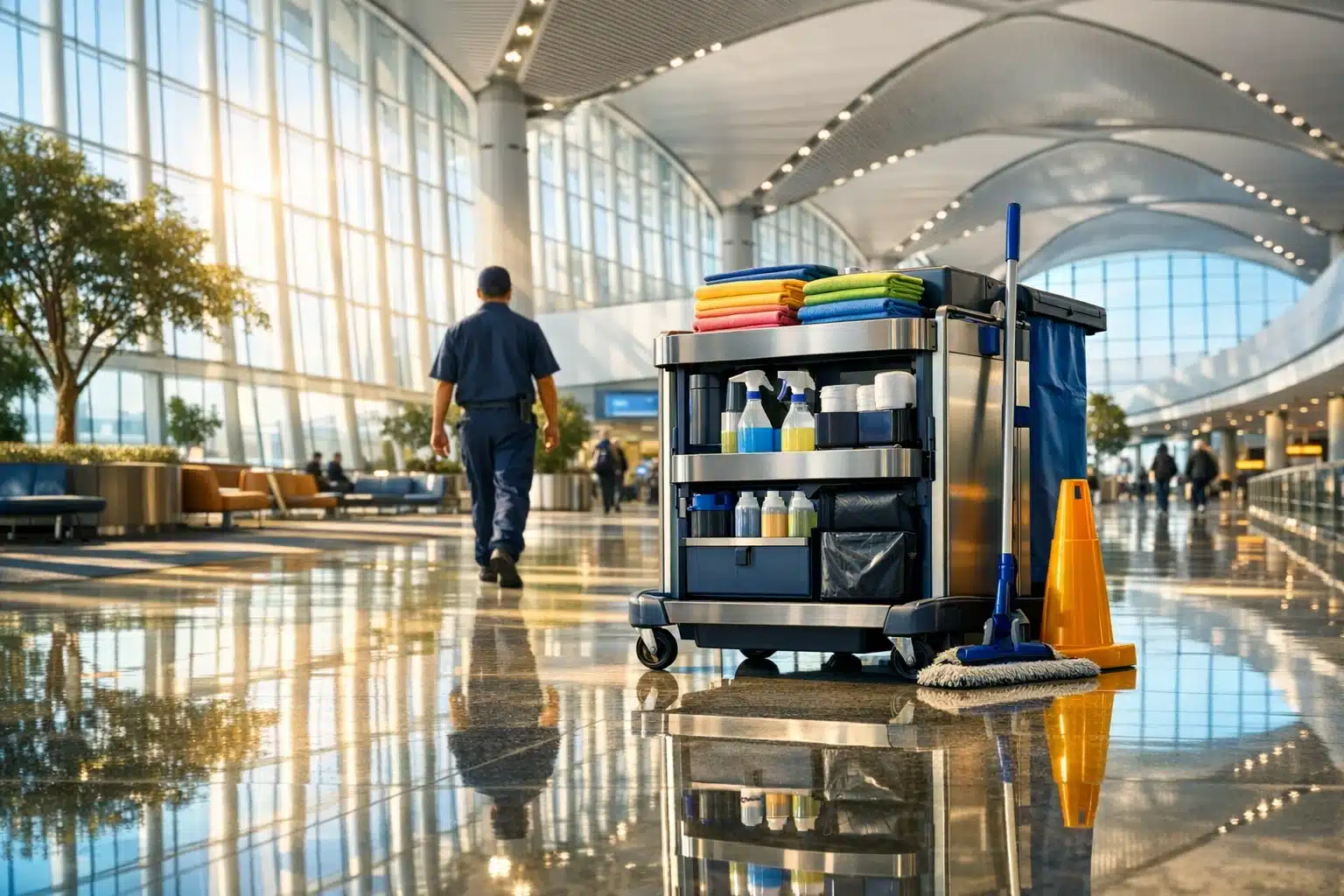
Typical equipment in airport cleaning may include microfiber cloths, mops, color-coded buckets, auto-scrubbers, wet vacuums, ride-on floor machines, HEPA-filter vacuums, litter pickers, and stocked cleaning carts. The methods are just as important as the tools. For example, many teams use color coding to reduce cross-contamination, especially between restrooms and general public areas. High-touch points such as handrails, lift buttons, counters, and seating arms may be cleaned on more frequent cycles than walls or windows because the risk profile is different.
Common standards often involve:
- Using dilution ratios correctly for cleaning chemicals
- Wearing personal protective equipment when required
- Placing warning signs before wet-floor work begins
- Following separate procedures for routine dirt, food waste, and bodily fluid incidents
- Documenting completed tasks in logs or digital systems
A useful comparison here is the difference between visible clean and hygienic clean. A floor may look spotless from ten feet away but still be sticky near a spill point or unsafe if residue remains. Likewise, a restroom can appear orderly while lacking stocked supplies or adequate disinfection on the surfaces people touch most. Airports need both presentation and performance. Travelers notice the shine, but operations depend on the less glamorous details: no overflowing bins, no slippery patches near a café, no empty soap dispensers during the morning rush.
Modern descriptions of airport cleaning also increasingly include sustainability. Some contracts mention water-efficient methods, low-odor products, refill systems, recyclable liners, or waste-stream separation. That does not make the work soft or decorative. If anything, it raises the skill requirement. Cleaners are expected to balance speed, safety, material care, and environmental targets all at once. The polished concourse may look effortless, but behind it sits a choreography of tools, training, and process control that would impress anyone who has ever tried to clean a crowded kitchen during dinner service.
How Quality Is Measured and Communicated
Describing airport cleaning work properly also means explaining how success is measured. In many workplaces, cleanliness is judged casually: does the place look fine, yes or no? Airports usually need a more structured system because the site is large, visible, and under constant public use. Cleaning teams often work within service-level agreements, internal quality benchmarks, or contract standards that define what acceptable cleaning looks like in each area. A restroom, for example, may have one inspection frequency, while a back corridor or storage room may have another. The job description may not list every metric, but it usually points to compliance with procedures, schedules, and supervisor instructions.
Quality checks can be formal or informal. Supervisors may carry out visual inspections during a shift. Some airports use digital task management systems where completed work is logged by zone and time. Others combine routine patrols with passenger complaints, facility reports, and trend analysis. If the same restroom repeatedly receives complaints about supplies, odor, or floor condition, that becomes operational feedback, not just a minor annoyance. In a place where thousands of people move through quickly, small failures scale up fast.
Typical quality measures may include:
- Response time to spills or urgent cleaning calls
- Completion rates for scheduled tasks
- Availability of consumables such as soap and paper products
- Visual presentation of public areas
- Safety compliance, especially around wet floors and waste handling
Communication is another major part of the work description. Cleaners often report to supervisors, team leaders, or facility coordinators, but they may also interact with security staff, maintenance teams, airline personnel, and front-line customer service employees. If a cleaner notices a leaking pipe, blocked toilet, damaged tile, or broken bin lid, the issue may need to be reported immediately rather than simply worked around. In that sense, cleaning staff are also observers of the building’s condition. They see the airport at ground level, minute by minute.
There is an important comparison here with invisible success. When airport cleaning works well, passengers barely think about it. That can make the role easy to underestimate. Yet in management terms, low complaint rates, quick recovery after crowd surges, and consistently usable public facilities are strong indicators of performance. The work is described not only by what cleaners do with their hands, but by how reliably they help the wider airport machine avoid friction. In a place where delays already test patience, a clean, functional space quietly protects the passenger experience.
Challenges, Career Value, and Why the Description Matters
The description of airport cleaning work becomes most revealing when it addresses the real challenges of the job. This is not a quiet, isolated role carried out in a stable setting. Airports are noisy, time-sensitive, and physically demanding. Staff may walk long distances, stand for extended periods, move equipment, work around crowds, and adapt to sudden changes without much warning. A single delayed flight can refill a gate area that was nearly empty ten minutes earlier. A rainstorm can drag water and grit across entryways. A food-court rush can transform tidy seating into a field of trays, crumbs, and abandoned cups before the clock has time to blink.
Because of these pressures, accurate work descriptions often highlight traits such as reliability, stamina, attention to detail, time management, and the ability to work independently or as part of a team. They may also mention background checks or access clearance for secure areas, depending on the airport and local rules. In some settings, cleaners need basic customer-facing confidence as well. Travelers ask for directions, point out issues, or simply watch how staff handle stressful moments. A calm, practical cleaner can steady the atmosphere more than people realize.
The job can also offer more career value than outsiders assume. Cleaning roles in airports may lead to senior cleaner positions, team leadership, supervisory work, quality inspection, facilities support, or specialist sanitation assignments. For some workers, the airport is a stable entry point into a larger operations environment. They learn shift discipline, compliance habits, equipment handling, reporting practices, and cross-team communication. Those are transferable skills in transport, hospitality, healthcare, and large-site facilities management.
Why does the wording matter so much? Because a vague description creates poor expectations on all sides. Applicants may think the role is lighter or narrower than it really is. Managers may struggle to train fairly if duties are not clearly defined. Passengers, too, often miss the complexity behind the work and assume clean spaces simply happen. A better description tells the truth: airport cleaning is visible labor supported by planning, discipline, and constant adjustment. It is part caretaker role, part logistics function, and part quiet crisis prevention.
For anyone considering the field, that clarity is useful. It shows where the effort goes, why standards matter, and what kind of mindset fits the role. For anyone managing contracts or teams, it helps set realistic staffing, training, and quality goals. And for the ordinary traveler hurrying toward a gate, it offers a simple reminder: the smoothest journeys are often supported by work that stays almost invisible on purpose.
Conclusion for Readers, Job Seekers, and Airport Managers
Airport cleaning work is best described as a structured operational service, not a loose set of chores. It combines hygiene, presentation, safety, timing, reporting, and coordination across zones that never fully sleep. If you are a job seeker, understanding that description helps you judge whether the pace, expectations, and physical demands match your strengths. If you manage people or contracts, it clarifies why staffing plans, training standards, and realistic quality checks matter so much. And if you are simply curious about how airports function, the takeaway is clear: cleanliness in a terminal is not an accident, but the result of disciplined work carried out with more precision than most people ever see.