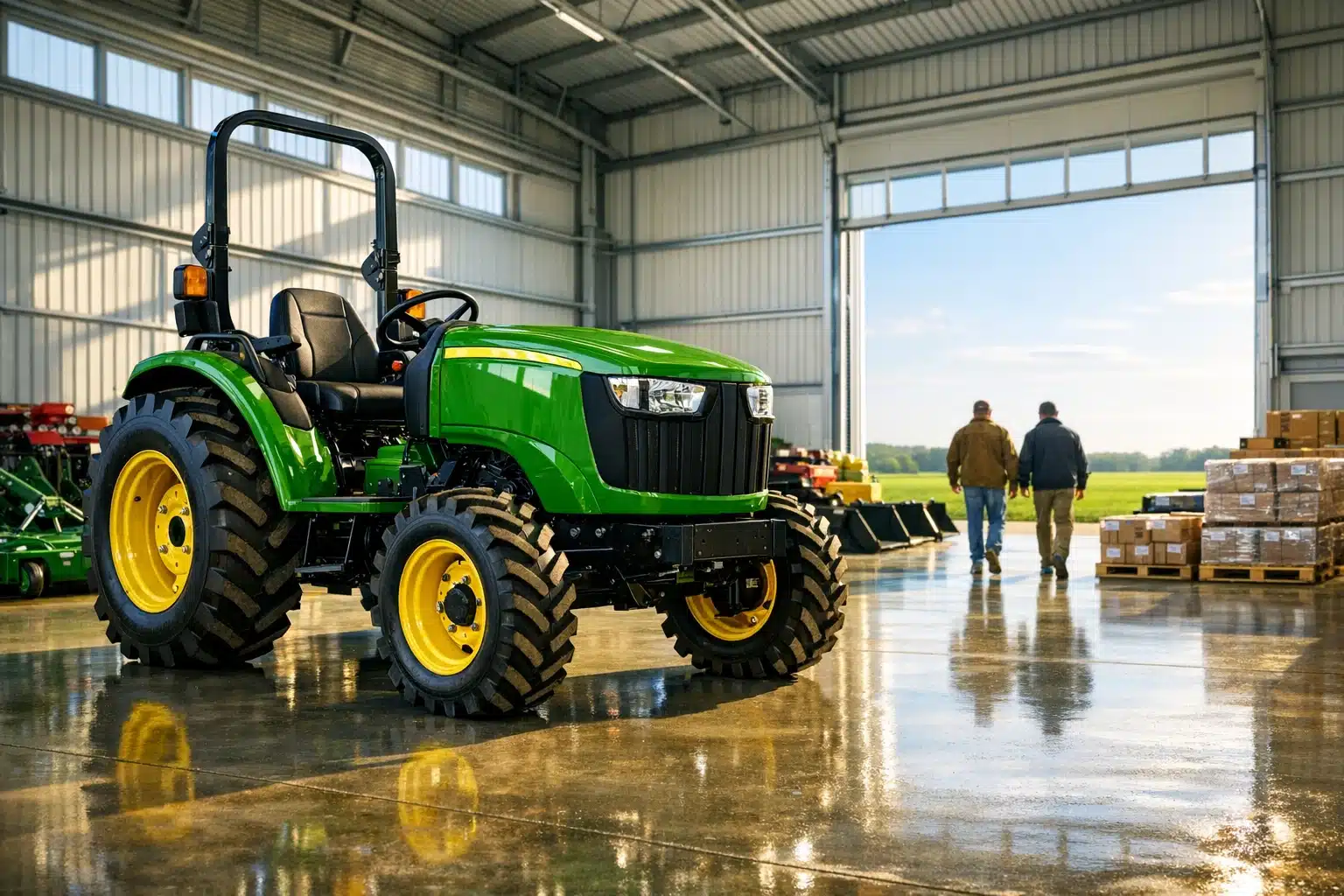
 Artificially generated image
 John Deere Warehouse Clearance: What Buyers Should Know
The phrase John Deere warehouse clearance can spark instant interest because it hints at lower prices on equipment, parts, or attachments many buyers already trust. Still, a discounted tag means very little unless you know who is selling, why the item is being cleared, and what condition it is actually in. Warranty status, transport cost, machine hours, and paperwork often decide whether a bargain stays a bargain. This guide shows how to read those signals before you commit your money.
The article follows a simple outline so you can move from curiosity to practical judgment without getting lost in sales language. First, it explains what a clearance offer usually means in this market. Next, it compares the most common places where buyers encounter these listings. It then covers inspection basics, breaks down the true cost beyond the asking price, and closes with a buyer-focused strategy for avoiding mistakes while choosing equipment or parts that genuinely fit the job.
Understanding What “John Deere Warehouse Clearance” Usually Means
When buyers hear the words warehouse clearance, they often imagine one giant official event with rows of discounted machines rolling out under bright lights. In reality, the term is much looser than that. It can describe several different situations: an authorized dealer reducing overstock, a reseller liquidating acquired inventory, an auction house moving repossessed or retired equipment, or a parts distributor clearing older stock that no longer turns quickly. That difference matters because the source of the inventory affects price, condition, return rights, and support after the sale. This article is an independent informational guide, not an official John Deere sale announcement, and that distinction is important for anyone trying to separate marketing language from real buying conditions.
In business terms, clearance inventory usually exists because holding stock costs money. Dealers and resellers pay for storage space, financing, insurance, labor, and inventory management. Machines that sit too long tie up working capital. Parts that fit older models may move slowly. Seasonal products such as mower attachments or snow-related accessories can become harder to sell once demand shifts. A clearance sale is often less about a product being bad and more about a seller wanting to free space and cash. Common sources include: • prior-year models • demo units with low operating hours • discontinued attachments • opened but unsold boxed parts • trade-ins that do not match a dealer’s preferred retail mix • fleet or municipal equipment being rotated out.
That said, “clearance” does not automatically mean “cheap,” and it definitely does not guarantee “best value.” A new attachment sold at a moderate discount by a local dealer with full paperwork may be the safer choice than a much cheaper unknown listing with missing hardware. A compact tractor with a clear service record may outperform a lower-priced unit that has cosmetic shine but hidden hydraulic issues. Buyers should also remember that brand reputation alone does not protect them from bad listings. A respected name can attract serious sellers, but it can also attract vague ads designed to create urgency. The smartest mindset is simple: clearance should be treated as a pricing condition, not a quality verdict. Once you see it that way, the category becomes easier to evaluate with a calm, methodical eye.
Where Clearance Deals Appear and How Different Sales Channels Compare
Not every clearance listing is created equal, and where you find the offer often tells you as much as the price itself. Buyers usually encounter John Deere-related clearance inventory through five main channels: authorized dealers, independent equipment resellers, online auctions, local classified marketplaces, and estate or retirement sales. Each channel has strengths, and each comes with trade-offs that deserve attention before money changes hands. Think of the marketplace like a field after harvest: from a distance it looks uniform, but once you walk it row by row, the differences become obvious.
Authorized dealers are often the most straightforward option when the inventory is legitimate overstock, aging floor stock, demo equipment, or discontinued parts. Prices may not be the absolute lowest, yet buyers often gain meaningful advantages: documented history, access to compatible parts, a clearer explanation of what is included, and sometimes limited warranty support. Independent resellers can offer wider price variation, especially when they buy mixed lots or surplus inventory. That can create opportunity, but it also raises the need for verification. Ask for details that narrow the fog: • exact model number • serial number • engine or operating hours • service notes • included accessories • return terms • loading and shipping arrangements. If a seller avoids these basics, the low price stops looking attractive very quickly.
Online auctions deserve special caution because they can compress decision time. Auctions may offer strong value on attachments, turf equipment, or used machinery, but the final bill can climb with buyer’s premiums, transport, taxes, and limited inspection windows. Local classifieds sometimes hold genuine finds, especially from owners who maintained their equipment well and simply want a direct sale. However, private listings also carry higher risk if records are incomplete or the description is vague. Estate and retirement sales can be worthwhile for patient buyers, particularly in agricultural communities, because the equipment may have stayed on one property for years and have a traceable story. In practical terms, dealer clearance is often the safest path, auctions can be the fastest-moving path, and peer-to-peer listings can be the most uneven path. Choosing well depends on how much uncertainty you are willing to manage.
How to Inspect Equipment, Parts, and Attachments Before You Buy
A clearance deal starts to become real the moment you move past the advertisement and inspect what is actually being sold. For complete machines, the first essentials are identity, history, and visible condition. Verify the model designation and serial number, then compare them with any paperwork, maintenance records, and seller description. If a seller says a unit is lightly used, operating hours should broadly support that claim. A mower with extremely worn controls, a polished footwell, and uneven deck rust may tell a different story than the listing suggests. On tractors and utility vehicles, pay close attention to leaks, cold-start behavior, steering response, tire condition, weld repairs, lighting, hydraulic operation, and attachment points. A machine can look tidy in photos and still reveal fatigue once it starts, idles, lifts, or turns under load.
Inspection also changes depending on the product category. For parts and accessories, the question is less about hours and more about completeness and fit. New old stock can be a great buy if the part number matches your equipment and packaging damage has not affected the item. Missing brackets, pins, belts, or harnesses can turn a discount into a frustrating scavenger hunt. Attachments deserve especially close attention because wear often hides where metal meets metal. A loader bucket with stretched mounting holes, a tiller with worn tines, or a mower deck with weak spindles can demand repair costs that erase the apparent savings. A practical checklist helps: • confirm compatibility with your specific model • inspect for cracks, rust-through, or modifications • ask whether manuals and hardware are included • test moving components if possible.
Documentation matters almost as much as condition. Service logs, ownership history, and receipts can reveal patterns that appearances cannot. A compact tractor with 900 honest hours and regular maintenance may be a stronger purchase than one with fewer hours but no clear record. If the sale is remote, ask for a cold-start video, close-up photos of wear areas, a shot of the serial plate, and a walkaround under natural light. Buyers should also confirm whether software updates, emissions components, or electronic modules have been altered improperly. You do not need to inspect like a mechanic in every case, but you should inspect like a person who expects the equipment to work after the excitement fades. Clearance rewards careful eyes far more often than quick clicks.
Looking Beyond the Price Tag: Total Cost, Value, and Real Comparison
The most common clearance mistake is treating the asking price as the whole story. In heavy equipment, turf equipment, and branded parts, the visible number is only the beginning. A lower initial figure can be overtaken by freight, loading fees, assembly, taxes, auction premiums, repair work, replacement hardware, or the cost of making an incompatible item usable. Buyers should calculate total acquisition cost before deciding whether an offer is genuinely attractive. One practical way to do this is to compare not just item versus item, but outcome versus outcome: what will you actually have, fully delivered and ready to work, after every necessary expense is included?
Consider a simple hypothetical example. Suppose one seller lists a compact tractor at a noticeably lower price, but the machine is several states away, has no recent service record, and includes no implement. Another seller offers a similar model at a somewhat higher price through a nearby dealer, with inspection access, known history, and a short support window for correcting disclosed issues. Once you add shipping, travel time, possible fluid changes, filters, and the risk of immediate repairs, the “cheaper” machine may no longer be cheaper in any meaningful sense. The same applies to attachments and parts. A discounted mower deck that needs spindles, belts, and paint can still be worthwhile, but only if the full rebuild cost keeps the final number below a comparable ready-to-use option.
Buyers should compare value using a short scoring method. Ask: • Is the item ready for work today? • Are maintenance records available? • Does it include essential hardware or accessories? • Is warranty coverage active, expired, or unclear? • How much will transport add? • What is the likely resale appeal if your needs change later? Branded equipment often retains buyer interest better than obscure alternatives, but resale strength depends heavily on condition and documentation. Financing can also shift the equation. A private clearance deal may require immediate cash, while a dealer sale may offer payment options that preserve working capital. For business owners, downtime has a cost too. A machine that starts work tomorrow can be worth more than a slightly cheaper one that spends the first month in diagnosis. Smart comparison is less glamorous than bargain hunting, yet it is what prevents a discount from becoming an expensive detour.
Conclusion: A Smart Clearance Purchase Matches the Work, the Budget, and the Risk
For the right buyer, a John Deere warehouse clearance listing can be useful, practical, and financially sensible. The key is to match the opportunity to your actual workload instead of your excitement. A homeowner maintaining a few acres may benefit most from a clean, documented mower or compact utility machine from a nearby seller. A landscaper may value uptime, easy parts support, and predictable service more than squeezing out the lowest possible price. A farm buyer may be comfortable evaluating used equipment more aggressively, especially if in-house repair capability lowers the risk of taking on an imperfect machine. In every case, the right purchase is the one that fits the job with the fewest surprises.
It also helps to know the classic warning signs before they pull you in. Be cautious when a listing shows only stock-style photos, omits the serial number, refuses inspection, pushes immediate payment, or describes condition in broad glowing language while avoiding specifics. Another red flag appears when the discount is dramatic but the seller cannot explain why the item is being cleared. Good sellers usually have ordinary reasons: too much seasonal stock, a trade-in they do not plan to keep, discontinued inventory, or equipment rotated out of service. Weak sellers often rely on urgency, vagueness, and the assumption that the brand name will carry the entire pitch. A short defensive checklist can protect you: • confirm seller identity • verify the item details • estimate transport and repair cost • compare at least two alternative offers • walk away if the story does not hold together.
The bottom line for buyers is refreshingly simple. Treat clearance as a chance to investigate, not a command to rush. If the machine, part, or attachment is correctly identified, fairly priced, suitable for your equipment, and supported by honest information, the deal may be worth pursuing. If any of those pieces are missing, the lower price is only bait on the hook. Buyers who slow down, ask better questions, and compare full value rather than headline savings usually end up with equipment that earns its place instead of draining time and money. That is the real win hidden inside a clearance search.