 Artificially generated image
 Plunge Pools for Small Backyards: A Practical Guide
In a compact backyard, every square foot has to earn its place, which is why plunge pools have become such a smart option for homeowners who want water, comfort, and style without surrendering the whole garden. Smaller than a standard swimming pool but far more immersive than a simple spa, a plunge pool can cool a patio, sharpen the look of an outdoor room, and create a daily retreat that fits real suburban lots. This guide explains how they work, what they cost, and when they make practical sense.
Outline
1. Define what a plunge pool is, how it differs from a full-size pool or hot tub, and why it suits small backyards. 2. Compare common shapes, materials, features, and design directions so homeowners can match the pool to their lot and lifestyle. 3. Explain the planning stage, including measurements, access, permits, utilities, privacy, drainage, and safety concerns. 4. Break down cost, installation timelines, and long-term upkeep with realistic ranges and trade-offs. 5. Conclude with practical guidance on who benefits most from a plunge pool and when another small-yard water feature may be the better choice.
1. What a Plunge Pool Is and Why It Works in Tight Spaces
A plunge pool is a compact pool designed more for soaking, cooling off, and casual recreation than for lap swimming. In many residential projects, the footprint lands somewhere between about 6 by 10 feet and 10 by 16 feet, although custom versions can run smaller or larger depending on the site. Water depth often ranges from around 4 to 5.5 feet, enough to feel immersive without requiring the long lane of a traditional swimming pool. In volume, many plunge pools hold only a fraction of what a standard backyard pool does. A conventional family pool may carry 15,000 to 30,000 gallons or more, while a plunge pool can fall closer to roughly 2,000 to 7,000 gallons. That difference changes everything: excavation, heating time, chemical demand, and the amount of yard still available for seating, planting, or play.
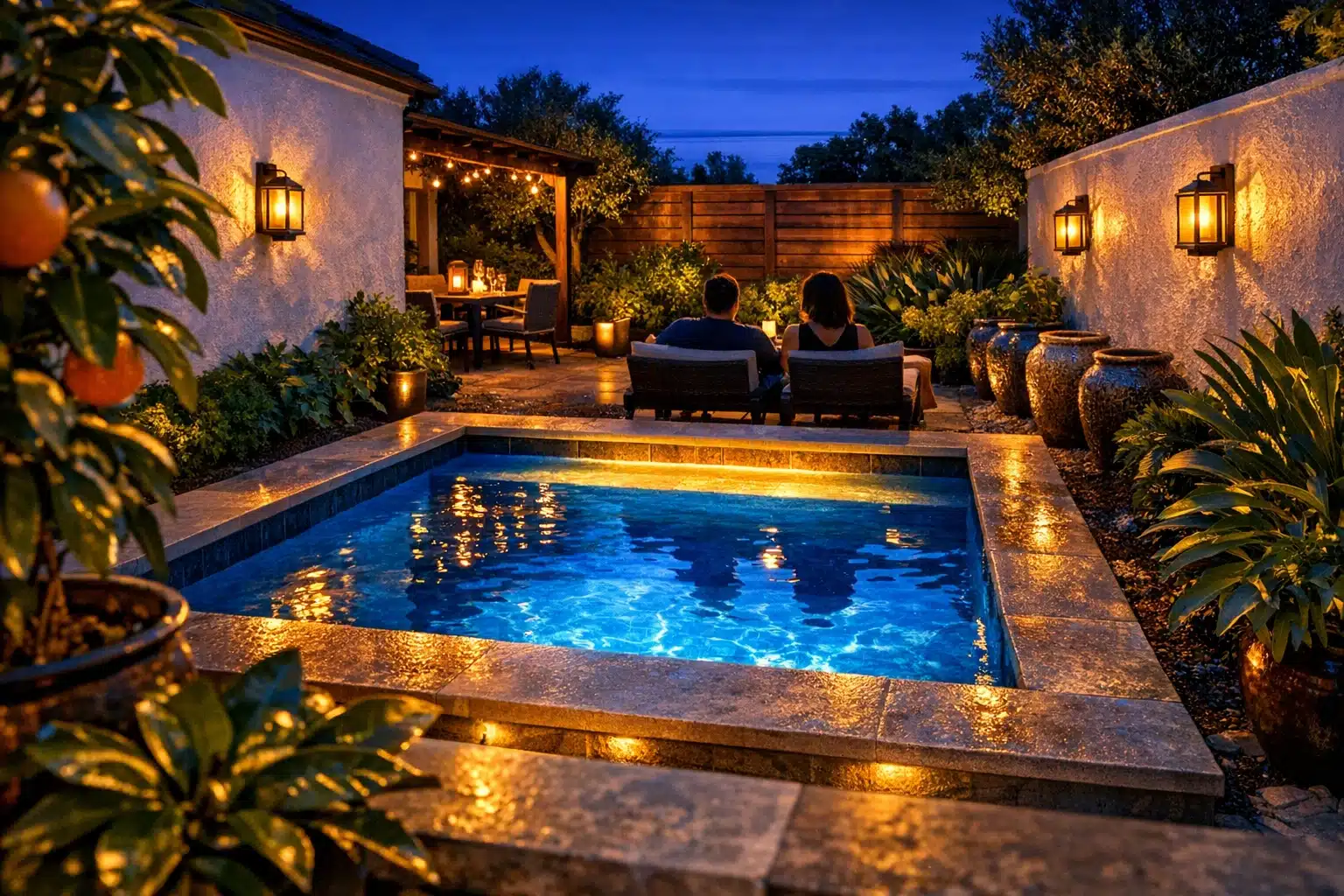
The reason plunge pools fit small backyards so well is not only size, but function. Homeowners on compact lots often want the emotional benefits of water without giving up outdoor circulation. A long pool can dominate a narrow yard, leaving little room for dining, storage, or even a clear path from the house to the gate. A plunge pool, by contrast, can be integrated into a courtyard, tucked beside a deck, or framed by built-in benches so the whole backyard still feels usable. It becomes less of a sports facility and more of a micro-retreat. On a hot afternoon, that difference feels almost architectural: the pool is there to change the mood of the space as much as the temperature.
That said, a plunge pool is not simply a smaller full-size pool, and it is not exactly a hot tub either. A spa usually emphasizes heated water, bench seating, and hydrotherapy jets in a compact shell. A plunge pool can include those features, but it also offers more room to float, stand, or sit with several people. For some households, that balance is ideal. For others, there are trade-offs to accept:
• It is excellent for cooling off, conversation, and light exercise.
• It is less suitable for dedicated swimming training.
• It often costs less to build and maintain than a larger pool, but premium finishes can still push the budget upward.
• It can extend seasonal use when paired with heating, though heating costs depend heavily on climate and insulation.
If your goal is backyard enjoyment rather than athletic performance, a plunge pool often meets the brief with surprising efficiency. It is the sort of feature that says, quietly rather than loudly, that comfort does not always need a large footprint.
2. Design Options, Materials, and Features That Shape the Experience
Once the basic idea makes sense, the next question is design. A plunge pool can look sleek and urban, soft and garden-like, or resort-inspired with clean paving and layered lighting. In small backyards, the visual character matters almost as much as the dimensions because the pool will sit close to seating areas, doors, and windows. Every line is easier to notice. Rectangular forms remain the most common because they use space efficiently, align neatly with fences and homes, and make cover systems simpler. However, square layouts, rounded corners, and freeform shells can soften a hardscape-heavy yard. In narrow sites, a slim rectangle can create the illusion of length, while a compact square can feel like an outdoor room anchored by water.
Material choice affects cost, installation time, customization, and maintenance. The three most common categories are concrete, fiberglass, and prefabricated composite or modular systems. Each has a distinct profile:
• Concrete offers the highest level of customization in shape, depth, edge detail, and integrated seating. It is a strong option when the yard has unusual geometry or when the pool must blend precisely with architecture. The trade-off is usually higher cost and a longer construction timeline.
• Fiberglass pools arrive as preformed shells. They are often quicker to install, smoother underfoot, and easier to clean because the non-porous surface resists algae better than rougher finishes. The limitation is that you choose from existing molds.
• Prefabricated or modular plunge pools, including some steel or composite systems, can reduce site disruption and shorten installation. They are especially appealing where access is tight and crane placement is feasible.
Features can dramatically change how the pool is used. Built-in benches encourage conversation and hydrotherapy. Wide entry steps double as seating ledges. Jets blur the line between plunge pool and spa. Heating expands the usable season, and in some warm climates, chillers are added so the water stays refreshing in peak summer. Lighting is more than decoration; it improves safety and turns a small yard into an evening destination. An automatic cover may not be glamorous, but it can reduce evaporation, improve safety, and help retain heat.
Even finishes deserve practical thought. Dark interiors absorb heat and create a reflective, dramatic look, while lighter finishes give the water a brighter appearance and may reveal debris more clearly, which can actually make cleaning easier. Surrounding materials matter too. Slip-resistant pavers, drainage-friendly decking, and privacy planting often have as much impact on satisfaction as the pool shell itself. The best plunge pool designs are rarely about excess. They work because every detail pulls in the same direction, like a small stage set where nothing can hide and everything has a job.
3. Planning for Space, Permits, Utilities, Privacy, and Safety
The planning stage is where a plunge pool either becomes a smart investment or a frustrating construction story. Small backyards are less forgiving than large ones because there is little spare room for adjustments once excavation begins. Start with a measured site plan, not a rough guess. Homeowners should know fence lines, property setbacks, existing patios, trees, utility easements, drainage patterns, and how people move through the yard. A plunge pool that technically fits can still feel awkward if it blocks a back door, crowds outdoor dining, or leaves no place for maintenance access. As a practical example, a 20-by-30-foot backyard may still accommodate a plunge pool quite well, but only if circulation around the pool remains comfortable and equipment placement is planned early.
Local rules are equally important. Many municipalities require permits for excavation, electrical work, plumbing, and pool barriers. Some also regulate setbacks from property lines, distance from utility easements, and maximum lot coverage. Homeowners associations may impose additional design constraints related to fencing, noise, or visibility from neighboring properties. Because rules vary widely by location, no online dimension chart can replace a conversation with local building officials or a licensed contractor. Skipping that step may save time at the beginning and cost much more later if the project has to be altered.
Access is another common surprise. Even a small pool can be difficult to install if the shell or equipment cannot reach the backyard. Ask early:
• Is there enough side-yard width for machinery?
• Will a crane be needed for a prefabricated shell?
• Are there overhead wires, tree canopies, or rooflines that complicate delivery?
• Where will excavated soil go during construction?
Utilities deserve careful placement. Pumps, filters, and heaters need space, service access, and sensible noise management. In a compact yard, putting equipment directly outside a bedroom wall is a mistake people remember every night. Drainage also matters more than many buyers expect. Splash-out, backwashing where applicable, rainfall runoff, and overflow water all need a route that does not threaten the house foundation or create muddy edges.
Then there is privacy and safety. Because plunge pools sit close to homes and fences, sightlines are immediate. Screens, slatted fencing, pergolas, and layered planting can make the water feel calm rather than exposed. Safety measures are not optional. Codes commonly require barriers, self-latching gates, and sometimes alarms or approved covers. If children or pets use the yard, those protections become even more essential. A good plan does not treat safety as an afterthought; it builds it into the first sketch so the finished space feels natural, orderly, and easy to live with.
4. Costs, Installation Timelines, and the Reality of Maintenance
Cost is often the turning point in the plunge pool conversation, and it helps to approach it with realistic ranges rather than wishful headlines. In the United States, professionally installed plunge pools can vary widely by region, soil conditions, access difficulty, and chosen features. A simpler fiberglass or modular setup may begin around the low tens of thousands, while many finished projects land somewhere between roughly $20,000 and $50,000. Custom concrete installations with premium coping, heating, automation, upgraded decking, and landscaping can move beyond $60,000 or even higher in expensive markets. Those numbers can sound broad because they are broad. A compact shell is only one line item. The true budget often includes excavation, hauling, permits, electrical work, plumbing, equipment pads, fencing adjustments, drainage solutions, and surface restoration around the site.
Timelines also vary by construction method. A prefabricated shell can sometimes be installed far faster than a fully custom concrete basin, especially when weather cooperates and access is straightforward. Fiberglass projects may move from excavation to a visible pool shell in days, while concrete builds generally take longer due to forming, steel reinforcement, plumbing, gunite or shotcrete application, finishing, and curing. In practical terms, a simple project might be measured in weeks, whereas a custom backyard transformation can stretch into several months once inspections, weather delays, and finish work are included.
Maintenance is one of the strongest arguments in favor of a plunge pool, but it should not be confused with no maintenance. Smaller water volume usually means less chemical demand and less time skimming compared with a larger pool. At the same time, small bodies of water can change temperature faster and become chemically imbalanced quickly if neglected. Owners still need to test water, clean filters, monitor sanitizer levels, and remove leaves or debris. A cover can reduce evaporation, heat loss, and dirt buildup, which is especially helpful when the pool sits near trees or receives windblown dust.
Typical recurring expenses may include:
• Electricity for pumps, automation, and lighting
• Heating fuel or electric heating costs if used regularly
• Water replacement due to evaporation and splash-out
• Chemicals for sanitation and pH balance
• Seasonal service, repairs, or professional cleaning if the owner does not self-manage
Compared with a standard pool, the long-term burden is usually lighter, but not trivial. If the pool includes jets, heaters, or smart controls, convenience increases along with the number of systems that may eventually need service. The key financial question is not just “Can I build it?” but “Will I still enjoy owning it after the novelty fades?” For many small-yard homeowners, the answer is yes, especially when the pool is sized honestly and equipped sensibly rather than overloaded with expensive features they will rarely use.
5. Should You Choose a Plunge Pool? Final Thoughts for Small-Backyard Homeowners
For the right homeowner, a plunge pool is one of the most balanced upgrades available. It delivers the sensory appeal of water, a place to unwind, and a strong design focal point without demanding the land area or operating profile of a full swimming pool. That makes it especially attractive in urban and suburban neighborhoods where lot sizes are modest, privacy is limited, and outdoor space must multitask. If your backyard needs to accommodate dining, container gardening, a grilling area, and a path for everyday movement, a plunge pool often fits the real pattern of use better than a large basin built around an idealized version of summer.
It helps to compare it with the main alternatives. A hot tub is usually warmer, smaller, and more hydrotherapy-focused, but it does not offer the same cooling benefit or visual openness. A swim spa provides jets for exercise in a compact footprint, though it may look more like equipment than landscape architecture. A stock tank pool can be inexpensive and charming for casual cooling, yet it typically lacks the finish, durability, and integrated feel many permanent backyard projects aim for. A fountain or reflecting pool adds atmosphere but not immersion. In other words, the plunge pool occupies a useful middle ground: more architectural than a portable spa, more livable in a tight yard than a traditional pool.
The best candidates are homeowners who answer yes to a few honest questions:
• Do you want a place to cool off and relax more than a place to swim laps?
• Are you willing to maintain water chemistry and equipment regularly?
• Does your yard need a feature that shares space rather than consumes it?
• Would year-round or extended-season use justify heating costs in your climate?
If the answer is mostly yes, a plunge pool can be deeply satisfying. It turns a compact yard into a destination rather than a leftover strip behind the house. Morning coffee feels quieter beside water. Evening gatherings feel more complete even when nobody swims. That is part of the appeal: the pool becomes both utility and atmosphere.
For small-backyard homeowners, the smartest path is to plan carefully, choose features with discipline, and design the surrounding space with the same care as the pool itself. A well-executed plunge pool is not about shrinking an oversized dream. It is about building the right dream for the space you actually have, and enjoying it often enough that the decision keeps making sense long after installation day.