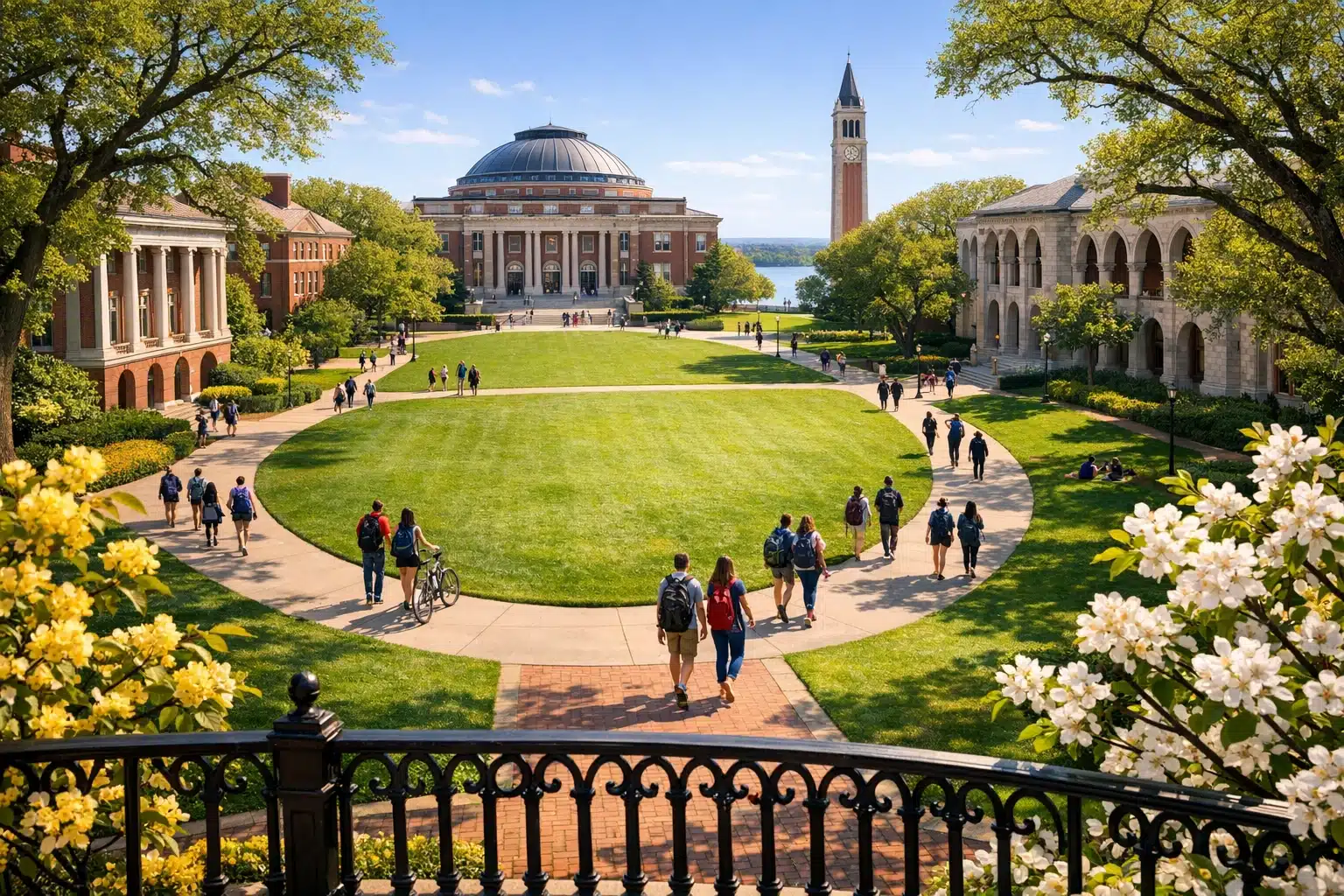
Top 10 State Universities in the USA
Introduction and Article Outline
Choosing a public university in the United States can feel a little like standing in front of a giant map with too many promising routes. Costs, academic strength, campus culture, research opportunities, and career outcomes all matter, yet the best option depends on what kind of student you are becoming. This guide ranks ten standout state universities and explains why each one earns serious attention. Instead of tossing around prestige alone, it looks at substance, value, and the kinds of experiences students actually live.
Public universities occupy a special place in American higher education. They are often large enough to support world-class laboratories, libraries, hospitals, arts programs, and athletic traditions, yet their public mission keeps questions of access and affordability close to the center. For many students, especially in-state applicants, these institutions offer the rare combination of high academic quality and comparatively manageable tuition. Even for out-of-state students, the best flagships can justify the cost because they provide strong alumni networks, serious internship pipelines, and reputations that travel well across industries.
This ranking is best understood as an editorial assessment rather than a fixed scientific law. Any top-10 list depends on the weight given to research, undergraduate teaching, selectivity, value, campus culture, and program breadth. Some students will rank Georgia Tech much higher because of engineering. Others may prefer North Carolina or Virginia because they want a more classic undergraduate experience. In other words, the order matters, but fit matters more.
The article is organized in five parts so readers can move from the big picture to the individual campuses with ease.
- Section 1 explains why public universities matter and how this list is framed.
- Section 2 covers ranks 10 through 8 and focuses on breadth, research, and rising academic power.
- Section 3 examines ranks 7 through 5, where specialized strength and flagship energy come into sharp view.
- Section 4 explores ranks 4 through 2, a tier defined by national prestige and unusually strong undergraduate outcomes.
- Section 5 turns to the number-one institution and closes with practical advice for students and families.
To build this list, the most important factors are academic reputation, research intensity, undergraduate opportunity, career outcomes, faculty strength, and long-term value. Campus life also matters, because four years is not a spreadsheet. It is mornings in crowded lecture halls, late-night study sessions, unexpected mentors, and the first real glimpse of the adult world. With that in mind, here is a thoughtful ranking of ten of the best state universities in the USA.
Ranks 10 to 8: University of Wisconsin-Madison, University of Illinois Urbana-Champaign, and University of California San Diego
At number 10, the University of Wisconsin-Madison remains one of the most complete public universities in the country. It is the kind of place that does many things well rather than one thing loudly. The university is especially respected in the sciences, economics, political science, agriculture, journalism, and public policy, and it supports this range with the scale of a true flagship. Madison itself helps the institution enormously. Built between lakes, animated by Big Ten spirit, and friendly to students without feeling manufactured, the city gives the campus a strong sense of place. Wisconsin may not always dominate internet conversations about elite colleges, but it quietly produces excellent researchers, professionals, and public servants year after year.
Number 9 goes to the University of Illinois Urbana-Champaign, a campus that would rank even higher for students centered on engineering, computer science, data science, physics, or business analytics. Illinois has long been one of the most technically formidable public universities in America. Recruiters know it, graduate schools know it, and ambitious students in quantitative fields know it. The atmosphere is often more practical than romantic: big research labs, high-level coursework, and a student body that takes problem solving seriously. Compared with Wisconsin, Illinois feels more explicitly tilted toward technical and computational strength, although it also maintains strong programs in architecture, economics, and the liberal arts.
At number 8, the University of California San Diego represents one of the clearest success stories in modern public higher education. UC San Diego rose quickly by building powerful programs in biology, medicine, oceanography, engineering, economics, and computer science. Its location in La Jolla places students near biotech, health research, and Pacific-facing scientific work that feels both literal and symbolic. The campus does not always project the traditional college-town warmth of Madison, and its social life has sometimes been described as more academically focused than theatrical. Still, for students who want a research-intensive environment with strong STEM pathways, it is a remarkably compelling choice.
These three universities sit close together because each excels in a slightly different way:
- Wisconsin-Madison offers broad flagship balance and a classic campus experience.
- Illinois Urbana-Champaign stands out for technical rigor and employer recognition.
- UC San Diego shines as a fast-rising research powerhouse with exceptional science depth.
If your priority is a lively traditional college setting, Wisconsin may feel strongest. If you want engineering prestige with deep recruiting power, Illinois has a persuasive case. If you are aiming at biomedical research, data-heavy science, or California industry connections, UC San Diego may be the smartest bet of the three.
Ranks 7 to 5: University of Texas at Austin, Georgia Institute of Technology, and University of North Carolina at Chapel Hill
Number 7, the University of Texas at Austin, is a university with the confidence of a capital city and the scale of a small world. UT Austin combines flagship breadth with standout strength in business, engineering, computer science, communication, government, and the arts. It benefits from Austin’s role as a technology hub, startup center, and cultural magnet. Students interested in internships often find the city itself functioning like an extra classroom. The campus has energy, visibility, and a strong sense that important things are happening nearby. UT is also one of those rare institutions that can attract future engineers, filmmakers, policy analysts, and entrepreneurs all at once. That breadth is not easy to build, and even harder to sustain.
At number 6, Georgia Tech enters with a different kind of force. If UT Austin is broad and bustling, Georgia Tech is intensely focused and famously rigorous. It is one of the best public institutions in the nation for engineering, computer science, industrial design, and applied research. Employers consistently value its graduates because the curriculum is demanding and the problem-solving culture is real. Atlanta adds another advantage. Students gain access to a major urban economy with serious opportunities in technology, logistics, consulting, public infrastructure, and corporate innovation. Georgia Tech does not offer the same all-around liberal arts profile as some other universities on this list, but within its strongest fields it performs at an elite national level.
Number 5, the University of North Carolina at Chapel Hill, brings a very different flavor to the top tier. UNC is one of the country’s most admired public universities because it pairs strong academics with a well-rounded undergraduate experience. It is especially respected in public health, journalism, political science, business, medicine, and the social sciences, but its broader appeal lies in balance. Chapel Hill feels collegiate in the best sense of the word: walkable, tradition-rich, intellectually active, and socially alive without becoming overwhelming. For in-state students, its value can be extraordinary. For out-of-state applicants, its selectivity reflects just how attractive the package has become.
The comparison among these three is revealing:
- UT Austin offers powerful breadth and direct links to a growing innovation economy.
- Georgia Tech is the strongest choice here for deeply technical students who want a high-intensity environment.
- UNC Chapel Hill provides one of the best overall undergraduate experiences in public higher education.
If you imagine college as a launchpad into tech, startups, and a dynamic city, UT Austin is easy to love. If you want hard-edged technical training with national respect, Georgia Tech may fit best. If you want a campus where excellent academics meet classic college atmosphere and strong public value, UNC makes a convincing argument for its place in the top five.
Ranks 4 to 2: University of Virginia, University of Michigan-Ann Arbor, and University of California Los Angeles
At number 4, the University of Virginia stands as one of the most distinctive public universities in the country. UVA carries an unusual blend of history, selectivity, undergraduate focus, and professional polish. It is widely respected in economics, government, commerce, public policy, history, and pre-law pathways, and its alumni network is especially influential in fields tied to leadership, consulting, finance, and public service. The campus, shaped by Jeffersonian architecture, gives the place an identity that feels deliberate rather than accidental. There is an intellectual seriousness at Virginia, but also a social confidence that many students find appealing. Compared with larger research giants, UVA can feel more intimate at the undergraduate level, which is part of its advantage.
Number 3, the University of Michigan-Ann Arbor, is one of the most formidable public universities anywhere in the world. If a student wants massive academic breadth without sacrificing prestige, Michigan is difficult to beat. It is strong in engineering, business, economics, political science, public health, psychology, music, and countless other areas. Few campuses match its combination of scale, academic reputation, school spirit, and alumni reach. Ann Arbor also contributes a great deal. It offers a true college-town atmosphere while still feeling nationally connected. Michigan’s size can mean large introductory classes, but it also means extraordinary resources, from research centers to student organizations to athletic tradition. It often feels like a city built around curiosity and ambition.
At number 2, UCLA earns its position by combining selectivity, academic breadth, research activity, and cultural influence in a way that few public universities can match. UCLA is strong across the sciences, humanities, social sciences, engineering, film-related fields, business economics, and health disciplines. Its Los Angeles location gives students access to media, healthcare, technology, public policy, entertainment, and global cultural networks. The campus has a brightness to it, not just in weather but in momentum. Students often describe UCLA as academically demanding while still energetic and socially alive. For many applicants, it represents the ideal public university dream: prestigious, vibrant, multidisciplinary, and deeply connected to opportunity.
Why does UCLA edge out Michigan and Virginia here? In this ranking, the answer comes down to the rare combination of global name recognition, undergraduate demand, research strength, and the breadth of industries surrounding the campus. Still, these three institutions are close enough that personal priorities should decide the order for any individual student.
- Choose Virginia if you want a selective, tradition-rich campus with a strong undergraduate identity.
- Choose Michigan if you want maximum scale, academic variety, and a powerhouse alumni network.
- Choose UCLA if you want elite public status paired with exceptional location and broad modern opportunity.
At this level, there are no weak choices. There are only different versions of excellence.
Rank 1: University of California, Berkeley, and Conclusion for Prospective Students
The number-one spot goes to the University of California, Berkeley. That ranking will surprise no one who has watched American higher education closely. Berkeley is one of the defining public universities in the world, a place whose reputation rests not on marketing but on decades of serious achievement. It is exceptional in computer science, engineering, mathematics, economics, political science, environmental science, chemistry, and many humanities fields as well. Just as important, Berkeley has shaped the larger culture of research, debate, entrepreneurship, and civic engagement. It is a campus where ideas do not sit quietly on shelves. They tend to escape the building, start companies, influence governments, or redefine academic disciplines.
Part of Berkeley’s power comes from its setting. The Bay Area surrounds students with technology firms, venture-backed startups, national laboratories, nonprofit institutions, legal organizations, and a constant current of intellectual exchange. Yet Berkeley is not simply a pipeline to Silicon Valley. That would be too narrow for a university with this much historical depth. It also excels in philosophy, literature, sociology, public policy, and environmental thought. The best version of Berkeley is not a machine that stamps out coders. It is a demanding ecosystem for students who want their education to be both rigorous and consequential.
Of course, the university has tradeoffs. Berkeley can feel intensely competitive, housing in the region is expensive, and large classes are a reality in some introductory courses. Students who want a more insulated or gently paced experience may prefer Virginia or UNC. Those who want a more polished residential feel may find UCLA more immediately comfortable. But Berkeley’s academic ceiling is astonishingly high, and the institution remains one of the clearest examples of what public higher education can achieve at its best.
For students and families trying to use this ranking wisely, a final point matters more than the numbering itself: do not choose a university only because it is ranked higher. Choose it because it matches your ambitions, learning style, finances, and daily preferences. A university becomes excellent in personal terms when its strengths line up with your needs.
- If you want the strongest all-around academic reputation with historic influence, start with Berkeley.
- If location and balanced prestige matter most, compare Berkeley with UCLA and Michigan.
- If undergraduate atmosphere matters more than raw scale, look closely at Virginia and UNC.
- If technical intensity drives your search, focus on Georgia Tech, Illinois, Berkeley, and UC San Diego.
- If you need strong value as an in-state applicant, your home flagship may become the smartest choice of all.
In the end, the top state universities in the USA are not impressive merely because they are large or famous. They matter because they open doors for enormous numbers of students while still competing with the finest institutions anywhere. That is a rare achievement. If you are building a college list, use this top 10 as a sharp starting point, then dig deeper into majors, campus life, cost, and fit. The right public university can be more than a place to earn a degree. It can be the landscape where your future first becomes visible.