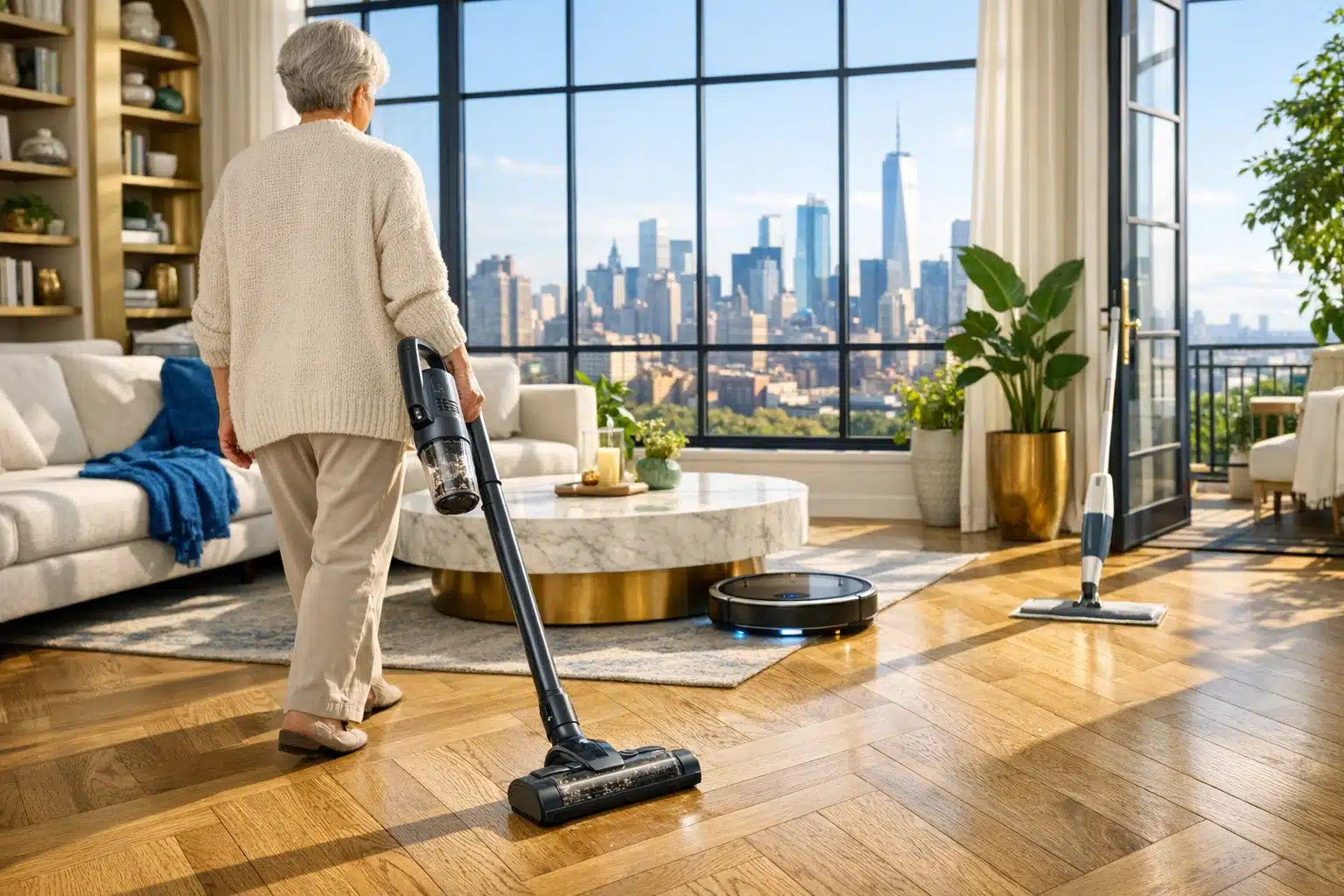
Top 5 Cleaning Gadgets That Make Cleaning Easier for Seniors
Keeping a home tidy should not mean strained shoulders, risky step stools, or long sessions bent over the sink. For many seniors, the challenge is not motivation but the physical effort that traditional tools demand, especially when grip strength, balance, or stamina change with age. The good news is that modern cleaning gadgets can take over much of the heavy work. This guide explores five practical options that save energy, reduce awkward movement, and make everyday cleaning feel far more manageable.
Article Outline
• Why easier cleaning matters for seniors and how the right tool can support safer independent living.
• Gadget 1: Lightweight cordless stick vacuums for fast floor cleaning without heavy lifting.
• Gadget 2: Robot vacuum and mop combos for automatic daily maintenance.
• Gadget 3: Electric spin scrubbers for tubs, tiles, grout, and other hard-to-reach surfaces.
• Gadget 4: Spray mops with washable pads for easier hard-floor care without buckets.
• Gadget 5: Telescopic microfiber dusters for ceiling fans, blinds, shelves, and baseboards.
• Final takeaway: how to choose based on weight, grip comfort, reach, charging needs, floor type, and home layout.
1. Lightweight Cordless Stick Vacuums: A Smarter Alternative to Heavy Uprights
For many seniors, the vacuum cleaner is the first household tool that starts to feel less like a helper and more like a stubborn piece of gym equipment. Traditional upright vacuums often weigh anywhere from about 12 to 18 pounds, and canister models may require pulling a rolling body behind you while managing a hose and cord at the same time. By contrast, many cordless stick vacuums weigh roughly 4 to 6 pounds, which is a meaningful difference when wrists, shoulders, or lower backs are easily irritated. That lower weight can make a routine clean-up feel less like a project and more like something you can finish before the kettle boils.
What makes these vacuums especially useful is how many chores they simplify at once. There is no cord to wrap, unplug, drag around furniture, or accidentally trip over. Most models stand or dock neatly, so they are easier to store in a hallway closet or laundry area. Many also convert into a handheld unit, which means the same machine can clean kitchen crumbs, sofa cushions, car seats, and stairs. LED floor lights, once considered a flashy extra, are genuinely helpful for seniors because they reveal dust along baseboards and under tables without requiring anyone to crouch down for inspection.
When comparing stick vacuums, seniors should look beyond advertising phrases and focus on daily comfort. Useful features often include:
• A total weight under 6 pounds
• A large, easy-to-press power button rather than a constant trigger
• A dustbin that empties with one motion
• A swivel head that turns smoothly around chair legs
• A removable battery, which is easier to charge than moving the whole vacuum
• Washable filters or clearly replaceable parts
There are trade-offs, of course. Stick vacuums usually have smaller dustbins than uprights, and battery life commonly ranges from around 20 to 60 minutes depending on the power setting. High-pile carpet may still challenge lighter models, especially if a home has pets. Still, for seniors who mostly need fast cleaning on hardwood, tile, low-pile rugs, or small apartments, the convenience is hard to ignore. Compared with sweeping, a stick vacuum also stirs up less dust into the air. Compared with a robot vacuum, it gives immediate control over spills and crumbs. In short, it is one of the most flexible choices for someone who wants less effort without giving up the feeling of doing the job properly.
2. Robot Vacuum and Mop Combos: Daily Cleaning Without the Daily Work
If the cordless stick vacuum is the quick and agile helper, the robot vacuum is the quiet little worker that keeps going while you do something more pleasant. For seniors, that shift matters. A robot vacuum reduces the need for frequent sweeping and lowers the number of times someone has to bend down, push a machine across rooms, or carry cleaning tools from one space to another. Many models can run on a schedule, which means the floors can be cleaned while the homeowner reads, cooks, talks to family, or simply rests. For older adults managing fatigue, arthritis, or balance concerns, that kind of automation is more than convenient. It can protect energy for tasks that truly need human attention.
Robot vacuums are especially effective for maintenance cleaning. They are good at collecting dust, pet hair, crumbs, and lint before those small messes become larger ones. Combo models add a light mopping function, which helps on sealed hard floors such as vinyl, laminate, and tile. Many devices operate for around 60 to 180 minutes per charge, depending on size and cleaning mode, and several newer options return to their docks automatically. Some even empty their own dustbins into a base station, reducing direct contact with dirt. That can be useful for seniors with allergies or reduced hand strength.
Still, robot vacuums are not magic carpets. They work best in homes with fairly open floors and limited clutter. Cords, tassels, low table legs, and scattered magazines can interrupt a cleaning cycle. Before buying one, it helps to compare:
• Basic random-navigation robots, which are usually cheaper but less efficient
• Mapped-navigation robots, which learn room layouts and clean more systematically
• Vacuum-only models, which are simpler to maintain
• Vacuum-and-mop combos, which add convenience but may require more setup
• Self-empty dock systems, which cost more upfront but reduce handling
Another practical point is control. Some robot vacuums are managed mainly through smartphone apps, while others offer straightforward buttons on the unit or remote controls. For seniors who do not want a complicated digital setup, simpler controls matter just as much as suction power. It is also worth knowing that robot mops are generally designed for light maintenance rather than heavy scrubbing. They are best viewed as steady helpers, not replacements for every floor-cleaning job. Yet that steady help adds up. A home with less daily dust feels fresher, and the person living in it spends less time wrestling with a broom. In many households, a robot vacuum becomes the gadget that quietly changes the whole cleaning rhythm for the better.
3. Electric Spin Scrubbers: Less Kneeling, Less Scrubbing, Better Reach
Bathrooms are often the most physically demanding rooms to clean. Tubs, shower walls, tile corners, and grout lines all seem to conspire against comfortable posture. Cleaning them the old-fashioned way usually means kneeling on a hard floor, bending over a tub edge, or twisting awkwardly to reach soap scum hiding in corners. That is where an electric spin scrubber can make a real difference for seniors. These tools use a rotating brush head to do much of the scrubbing motion automatically, and many have long extension handles so the user can stay standing for most of the job.
In practical terms, this solves several problems at once. First, it reduces the repetitive arm motion that can aggravate shoulder pain or arthritis in the hands. Second, it limits time spent kneeling or crouching, both of which can be uncomfortable or risky for someone with reduced balance. Third, it helps apply pressure more evenly across surfaces. Many models spin several hundred times per minute, which is often enough to loosen soap residue, light mildew staining, and everyday bathroom buildup without the same amount of manual force required by a standard brush. On a tired Saturday morning, that matters. A task that once felt like a workout can start to feel like a manageable routine.
When comparing scrubbers, seniors should pay attention to comfort more than raw power. Helpful features often include:
• An adjustable handle for tubs, shower walls, and even baseboards
• Multiple brush heads for wide surfaces, corners, and grout lines
• A lightweight body, ideally under about 3 pounds if possible
• Water resistance suitable for bathroom use
• A simple charging method and battery indicator
• Grip surfaces that do not become slippery when damp
It is also useful to compare electric spin scrubbers with other options. A manual scrub brush is cheaper, but it demands more effort. A drill-brush attachment can be powerful, but many drills are heavy, noisy, and less comfortable to control on wet surfaces. A steam cleaner can help sanitize, but it may still require wiping and can be bulkier to use. The spin scrubber sits in a practical middle ground: lighter than a drill, easier on joints than a hand brush, and often more direct for bathroom cleaning than a steam device. The main caution is that not every surface needs aggressive scrubbing, so delicate finishes should always be tested carefully. Even so, for seniors who want to keep bathrooms clean without turning the task into a wrestling match, this gadget can be one of the most noticeable upgrades in the home.
4. Spray Mops with Washable Pads: Easier Hard-Floor Cleaning Without Buckets
Few cleaning tools look more innocent than a bucket and mop, yet together they create several challenges for older adults. Buckets are heavy when filled, awkward to carry, and easy to spill. Traditional string mops can also become waterlogged, making them harder to push and wring. For seniors, especially those who want to avoid slippery floors or repeated lifting, a spray mop with washable microfiber pads is often the more practical choice. It combines a refillable liquid reservoir, a lightweight handle, and a flat swiveling head in a tool that feels much easier to maneuver through kitchens, bathrooms, and hallways.
The appeal is straightforward: no bucket, less water, and better control. With a spray mop, the user applies just enough cleaning solution for the area being cleaned, which helps floors dry faster and reduces slip risk. That is particularly helpful on laminate, luxury vinyl, sealed wood, and tile. The flat head slides more easily under tables and beds than a bulky string mop, and microfiber pads tend to capture fine dust and everyday grime efficiently. In many homes, this means one tool can handle both quick touch-ups and regular floor maintenance. It is the kind of gadget that quietly removes friction from a chore people do again and again.
Not all spray mops are built equally, though. Seniors should compare:
• Handle weight and grip comfort
• How easy it is to pull the trigger or spray button
• Whether pads attach and remove without a lot of bending
• Pad availability and washability
• Reservoir size, since larger tanks mean fewer refills but slightly more weight
• Head flexibility for tight corners and narrow spaces
Compared with steam mops, spray mops are often lighter and simpler. Steam units can be effective, but they may require more setup time, more weight in hand, and closer attention to floor compatibility. Compared with disposable wet pads, washable microfiber pads are typically more economical over time and create less waste. The spray mop does have limits: it is not designed for deep grout cleaning, large sticky spills, or badly neglected floors. Yet for day-to-day upkeep, it is wonderfully sensible. Many seniors do not need a dramatic machine with ten settings. They need a tool that works without fuss, stores easily, and does not ask them to haul a sloshing bucket across the kitchen. In that role, the spray mop earns its place on this list.
5. Telescopic Microfiber Dusters: Safer Cleaning for High and Low Spaces
Dust has a talent for settling exactly where it is least convenient: on ceiling fans, upper shelves, blinds, lamp shades, behind furniture, and along baseboards that require an awkward bend to reach. For seniors, these zones can turn into small hazards. Climbing on a chair to dust a fan or crouching repeatedly to wipe trim may not seem dramatic, but falls and strains often happen during everyday tasks, not heroic moments. A telescopic microfiber duster with a pivoting or bendable head is one of the simplest gadgets for reducing those risks. It extends reach upward and downward, allowing many jobs to be done while standing in a steadier, more natural position.
Microfiber itself is useful because it traps dust rather than just pushing it around. That makes it better than many feather-style dusters, which can sometimes scatter debris into the air. Washable dusting sleeves are another advantage, since they can be reused many times and are usually easy to clean. Some telescopic models extend from roughly 30 inches to well over 70 inches, enough to reach fan blades, curtain rods, or the back of a bookshelf without dragging out a step stool. A flexible head is equally important because it wraps around edges and corners more effectively than a rigid straight wand.
When comparing dusters, look for features that make routine use easier:
• A secure locking extension that does not collapse while in use
• A cushioned or non-slip handle
• Removable microfiber heads that can be washed
• A slim profile for blinds and narrow gaps
• Enough reach for ceiling fans without making the tool too heavy
• Bendable construction for tops of cabinets, picture frames, and moldings
This type of duster compares favorably with both disposable dusters and vacuum attachments, depending on the job. Disposable tools are convenient but often less sturdy and cost more over time. Vacuum attachments can remove dust well, but dragging out a full vacuum for a few fan blades or shelves is not always realistic. The telescopic microfiber duster sits in the sweet spot: light, quick, inexpensive to maintain, and easy to store. It may not be the flashiest gadget on the list, but it solves a problem that matters deeply to seniors who want to avoid unnecessary climbing or bending. Sometimes the best cleaning invention is not the loudest one. Sometimes it is the quiet wand in the closet that saves a person from one risky reach too many.
Conclusion: Choosing the Right Cleaning Help for Senior Living
For seniors, the best cleaning gadget is rarely the one with the most features. It is the one that reduces strain, feels comfortable in the hand, and fits the home’s real cleaning habits. A cordless stick vacuum is excellent for quick, controlled floor cleaning. A robot vacuum helps maintain cleanliness automatically. An electric spin scrubber takes much of the hard work out of bathroom care. A spray mop simplifies hard-floor cleaning without the burden of a bucket, and a telescopic microfiber duster makes high and low spaces safer to reach.
If possible, it helps to choose tools by asking a few practical questions first: Is the gadget light enough to lift easily? Can it be used without kneeling, twisting, or climbing? Are the buttons simple to press? Is maintenance straightforward? A well-chosen cleaning tool can support independence, conserve energy, and make the home feel easier to manage from week to week. That is the real goal here. Cleaner floors and dust-free shelves are nice, but the bigger win is a home routine that respects the body instead of wearing it down.