Warehouse Events in Montana: Exploring Local Opportunities
Montana’s warehouse events are gaining attention because they turn practical industrial spaces into places where business, culture, and community can meet. In a state where distance shapes nearly every plan, a well-chosen warehouse can gather vendors, employers, artists, and buyers under one roof. These events matter to entrepreneurs seeking affordable visibility, to residents looking for local discovery, and to property owners trying to activate underused buildings. From Billings to Missoula, the format opens doors to fresh partnerships that feel grounded, flexible, and distinctly regional.
Article Outline
- Why warehouse venues fit Montana’s economy, geography, and event culture
- How major Montana cities compare when planning industrial-space events
- Which event formats tend to perform best in warehouse settings
- What organizers should know about logistics, compliance, and seasonal conditions
- How local businesses, property owners, and community groups can move forward
Why Warehouse Events Make Sense in Montana
Warehouse events fit Montana unusually well because the state rewards practicality. Space matters here, weather matters here, and travel time matters here. A warehouse can answer all three issues better than many traditional venues. Instead of squeezing a regional market, job fair, maker showcase, or equipment demonstration into a hotel ballroom, organizers can use a building designed for movement, loading, storage, and flexible layout. That sounds almost too simple, yet simplicity is often the advantage.
Montana’s economy is broad rather than uniform. Agriculture, construction, outdoor recreation, manufacturing, logistics, tourism, small retail, and creative businesses all have a presence, but they do not always share the same event calendar or venue needs. Warehouses help bridge those differences. One weekend, an industrial space can host a local artisan market with coffee carts and live music. Another week, the same site can hold a workforce hiring event, a farm equipment preview, or a wholesale inventory sale. The walls do not dictate the format, and that freedom is a major asset.
There is also a cost argument. In many markets, warehouse rentals can be more economical than polished event venues, especially when the event concept benefits from a stripped-back, adaptable environment. Organizers can allocate budget toward heating, lighting, staging, security, or promotion rather than paying purely for decorative finishes. That does not mean every warehouse is cheap or ready to use, but it often means the organizer has more control over where the money goes.
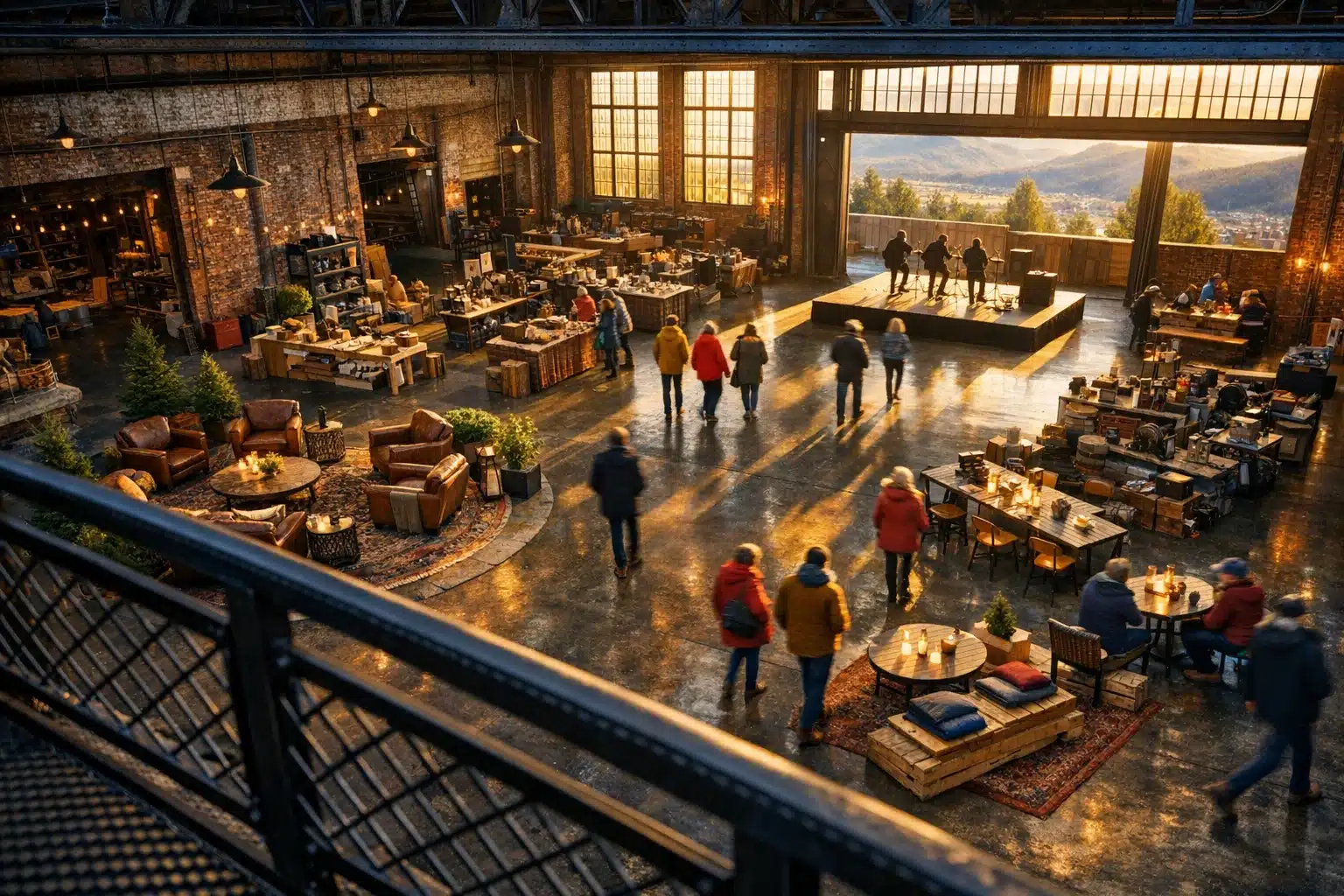
The setting itself carries a certain appeal. When the big rolling door rises and daylight cuts across a concrete floor, the venue immediately tells a story of work, movement, and possibility. For Montana audiences, that tone can feel honest rather than staged. It pairs well with brands that want to appear local, durable, and useful. Outdoor gear sellers, food producers, restoration specialists, trades employers, furniture makers, and community nonprofits can all benefit from that atmosphere.
Several practical traits make warehouse events especially relevant in Montana:
- Large open floor plans make reconfiguration easier
- Loading access supports vendor setup and equipment displays
- Industrial districts may offer fewer noise conflicts for busy events
- Ample square footage can improve circulation during winter months
- Underused buildings can generate new activity for property owners
Montana communities also tend to value events that feel useful, not just fashionable. A warehouse event can combine commerce with service: shopping plus demonstrations, networking plus hiring, local food plus education, or arts programming plus neighborhood revitalization. That hybrid quality is one of its strongest features. Rather than copying a coastal trend, Montana organizers can shape warehouse events around local habits and local demand. The result is often more resilient, more approachable, and more relevant to people who want a clear reason to show up.
Comparing Opportunity Hubs Across Montana
Not every Montana city offers the same kind of warehouse event opportunity, and that is good news rather than a problem. It means organizers can match the event style to the place instead of forcing one formula across the entire state. Billings, Missoula, Bozeman, Great Falls, Kalispell, Helena, and Butte each bring a different mix of audience behavior, industrial inventory, and business culture.
Billings is often the strongest candidate for large-format warehouse events tied to trade, logistics, construction, automotive services, wholesale goods, and workforce recruitment. Its role as a commercial center and its transportation connections make it practical for events that draw attendees from a wide radius. A vendor expo, industrial auction preview, home services showcase, or multi-employer hiring fair can make particular sense there. Organizers looking for truck access, broader regional reach, and business-to-business traffic usually place Billings high on the list.
Missoula offers a different flavor. Its event audience often responds well to creative, community-oriented, and mixed-format programming. A warehouse in or near a walkable district can support art markets, design fairs, vintage sales, local maker events, nonprofit fundraisers, and music-adjacent gatherings. The presence of students, small creative firms, and a strong local identity can help these events feel energetic without becoming chaotic. In Missoula, storytelling and curation matter; people often want a reason, a vibe, and a sense of place.
Bozeman tends to reward polished execution. The local business climate includes startups, outdoor brands, tech-adjacent firms, construction activity, and a customer base that often expects strong presentation. A warehouse event in Bozeman can succeed with premium local retail, product launches, business networking, design-oriented expos, or seasonal markets, but costs may be higher and competition for attention can be sharper. The upside is that a well-run event can attract a highly engaged crowd with spending power and professional curiosity.
Great Falls deserves more attention than it sometimes gets. Its central location and connections to agriculture, trades, and regional services create room for practical event models. Warehouses there may work especially well for equipment displays, supplier showcases, training sessions, or events that aim to pull attendees from several surrounding communities. Kalispell and the Flathead area can be strong for seasonal retail, home improvement, tourism-adjacent vendors, and lifestyle events, though organizers should account for fluctuating traffic patterns across the year.
Helena and Butte bring their own strengths. Helena can support government-adjacent professional events, civic fairs, and small business gatherings. Butte, with its industrial legacy and architectural character, can be compelling for heritage-minded markets, fabrication showcases, and culture-meets-commerce formats.
A simple comparison helps clarify the landscape:
- Billings: scale, freight access, business density
- Missoula: creative energy, local loyalty, mixed-use audiences
- Bozeman: presentation value, growth sectors, premium positioning
- Great Falls: central reach, practical industries, regional draw
- Kalispell: seasonal momentum, lifestyle retail, tourism crossover
- Helena and Butte: civic connection, history, niche event identity
The best city is not automatically the biggest or the trendiest. It is the one where the audience, venue type, and event purpose line up cleanly. That alignment is what turns a warehouse from a blank shell into a real local opportunity.
Event Types That Perform Well in Montana Warehouse Spaces
A warehouse is not just a venue category; it is an event engine. Its usefulness depends on what you ask it to do. In Montana, the most successful warehouse events usually share one quality: they make smart use of open space rather than treating the building like a rough substitute for a ballroom. That distinction matters. When the event concept fits the venue, people notice the difference the moment they walk in.
Vendor markets are the most obvious format, and for good reason. Local makers, food producers, vintage sellers, outdoor brands, furniture builders, and specialty retailers often benefit from the industrial backdrop. Booths can be spaced generously, loading is simpler, and the setting encourages browsing. A warehouse market also allows organizers to layer in extras such as coffee carts, live demonstrations, repair stations, and short workshops. Instead of becoming a row of tables with little personality, the event can feel like a temporary district built inside four walls.
Job fairs and workforce events are another strong match. Montana employers in construction, transportation, manufacturing, agriculture support, healthcare operations, and skilled trades often need hiring formats that are direct and efficient. A warehouse can provide room for interview corners, training demos, equipment displays, and resume stations without the stiffness of a conference center. For job seekers, that layout can be less intimidating and more informative. Seeing tools, vehicles, or product lines in person often creates a clearer impression of the work than a brochure ever could.
Trade shows and supplier showcases also perform well, particularly in cities where contractors, ranch suppliers, mechanics, and service firms overlap. A warehouse can handle machinery, oversized samples, palletized displays, and live demonstrations more comfortably than a carpeted venue. That practical capacity is not a small detail; it can be the feature that makes the event viable at all.
Several formats are especially promising in Montana:
- Seasonal craft and gift markets before winter holidays
- Home, ranch, and shop improvement expos
- Outdoor gear swaps and recreation brand showcases
- Food halls, tasting events, and regional producer meetups
- Nonprofit fundraisers with auction or maker components
- Film, photography, or content-creation pop-ups
Arts programming can work too, but it needs thoughtful pacing. A warehouse gallery night, mural event, or live performance can be memorable, especially in cities with strong creative communities. Still, the event should respect acoustics, heating, restrooms, and crowd flow. The romance of raw space fades quickly if guests cannot hear, park, or stay warm.
The strongest warehouse events usually combine transaction with experience. People come to buy something, learn something, meet someone, test something, or solve a problem. That is why the format can feel so alive in Montana. It is not spectacle for its own sake. It is usefulness with atmosphere, commerce with personality, and local energy housed in a space sturdy enough to handle both boots and ambition.
Planning Logistics, Compliance, and Seasonal Realities
Excitement can fill a room, but logistics keep the doors open. Anyone exploring warehouse events in Montana should treat planning as part of the creative process, not as the dull paperwork that happens afterward. Warehouses differ wildly in readiness. One building may have clean restrooms, heating, modern electrical service, parking, and fire exits already in place. Another may look appealing in photos while hiding expensive limitations. A practical walkthrough is worth more than a dozen optimistic emails.
Start with zoning and permitted use. Some industrial properties can host public events with minimal friction, while others need temporary approvals, occupancy review, or added safety measures. Local requirements vary, so organizers should speak early with city officials, fire authorities, and insurance providers. That is not bureaucracy for its own sake. It protects the event, the venue owner, the vendors, and the audience. If the event includes food service, alcohol, amplified music, temporary stages, or large attendance, the checklist grows quickly.
Montana’s climate deserves special respect. Winter events need reliable heating, snow removal plans, safe entry paths, and contingency thinking around storms. Shoulder-season events should consider mud, runoff, and shifting daylight. Summer programming may require ventilation, shade at entrances, and dust control in certain industrial areas. The weather does not have to be an enemy, but it should never be treated like a minor detail.
Several operational questions should be answered before promotion begins:
- How many vehicles can the site handle without causing neighborhood strain?
- Is there enough power for vendors, sound, lighting, and food equipment?
- Are restrooms adequate for the expected crowd?
- Can attendees with mobility needs enter and move around safely?
- Is the lighting sufficient for evening hours and winter conditions?
- Does the lease or use agreement clearly assign responsibility for cleanup and damage?
Budget discipline matters just as much as vision. A lower rental rate can be misleading if the organizer must bring in portable restrooms, temporary heating, fencing, generators, or security staff. Conversely, a slightly more expensive venue may save money by already having compliant infrastructure. Compare total event cost, not just base rent.
Promotion should fit the audience. A trade-heavy event may benefit from direct outreach, employer networks, local chambers, industry associations, and radio. A creative market may perform better through social media, local press calendars, neighborhood posters, and partnerships with shops or cafes. In Montana, word of mouth still carries weight, especially when the event serves a clearly defined local need.
The final planning lesson is simple: test the experience from the attendee’s point of view. Imagine arriving after a thirty-minute drive in cold weather. Is the entrance obvious? Is parking easy? Is the space welcoming within the first two minutes? A warehouse event succeeds when its rough edges feel intentional and its practical details feel effortless.
Conclusion: Turning Local Potential Into Real Opportunity
For organizers, property owners, vendors, and community partners, the opportunity around warehouse events in Montana is not abstract. It is tangible, local, and highly adaptable. The state has the right ingredients: underused industrial spaces, a practical business culture, strong regional identities, and audiences that respond well to events with a clear purpose. The challenge is not whether the model can work. The challenge is whether the event is designed with the place, the season, and the audience in mind.
If you are a property owner, a warehouse event can be more than a one-off rental. It can be a way to introduce your building to local businesses, test new uses, and create momentum around a site that may otherwise sit quietly between leases. If you are a small business, these events can offer direct exposure that feels more human than digital advertising alone. If you are part of a nonprofit, arts group, workforce board, or neighborhood coalition, an industrial venue can give your programming room to breathe without losing its local roots.
The smartest next move is usually a modest one. Rather than launching a giant festival immediately, begin with a focused format and a measurable goal. That could mean a one-day hiring event, a curated maker market, a trade demo afternoon, or a seasonal community sale. Learn from the first edition. Track attendance, vendor feedback, setup challenges, weather impact, and spending patterns. Then refine the concept instead of reinventing it.
A useful action plan might look like this:
- Choose one audience first, rather than trying to attract everyone
- Select a city whose strengths match the event purpose
- Walk multiple properties and compare total operating costs
- Build partnerships with local sponsors, vendors, and service providers
- Create a promotion plan tied to how people in that region actually discover events
- Review what worked and what did not within a week of closing day
Montana does not need warehouse events that imitate somewhere else. It needs events that understand local distances, local industries, local seasons, and local expectations. When that happens, a plain industrial building can become a place of exchange, momentum, and new connection. For readers exploring this space, that is the real opportunity: not simply hosting an event, but creating a gathering that fits Montana so well that people leave thinking it should have existed all along.