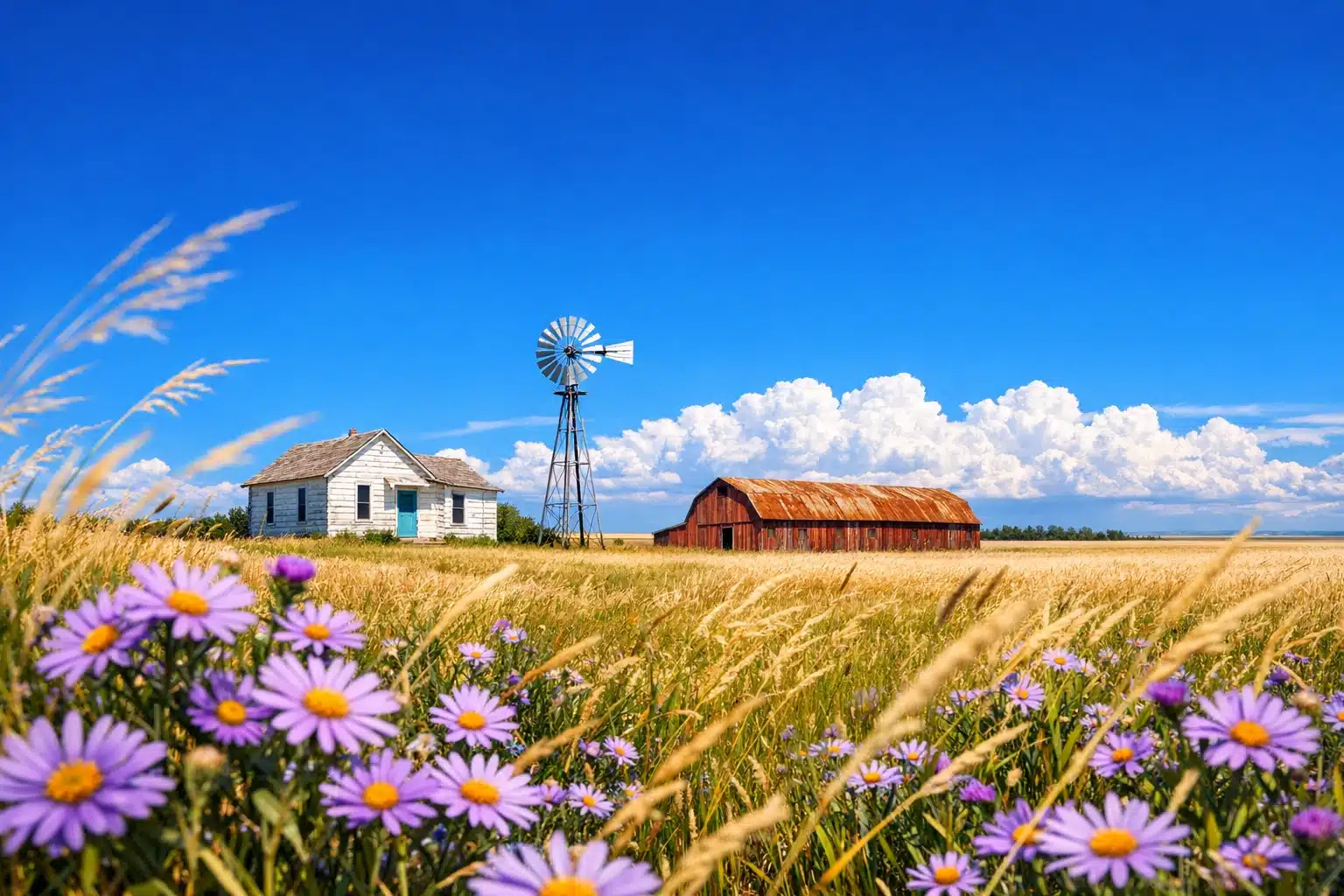
 Artificially generated image
 Abandoned Farms Across America: An Overview
Across the United States, abandoned farms tell a quiet story about changing markets, aging communities, shifting technology, and the hard math of land ownership. A weathered barn or empty farmhouse may look like a relic, yet each site also reflects decisions about labor, debt, migration, and survival. Understanding why these properties were left behind helps readers see how rural America has been reshaped over generations. It also opens a wider conversation about preservation, redevelopment, and the future of working landscapes.
Outline: 1. What abandoned farms are and how they emerged. 2. Why owners leave or lose them. 3. How regional geography changes the pattern. 4. What deserted farmsteads mean for communities, ecology, and reuse. 5. What readers, planners, and future land stewards can take from this broader picture.
The Long Story Behind Empty Farmsteads
When people picture an abandoned farm, they often imagine a complete disappearance of agricultural life: a leaning barn, a farmhouse with broken windows, rusting machinery half-sunk in weeds, and fields surrendered to brush. That image is real, but it is also incomplete. In many parts of America, what has been abandoned is not the land itself but the farmstead as a family home and operational center. The acreage may still be planted by a neighboring operator, leased to a larger business, enrolled in conservation programs, or converted to pasture, timber, or development. This distinction matters because it shows that abandonment is not always a clean stop. Often, it is a transfer, a shrinking, or a slow fading out.
The broader history helps explain the pattern. In 1935, the United States had nearly 6.8 million farms. Today, the total is a little above 2 million, according to federal agricultural counts. That decline did not happen because food production vanished. It happened because farming changed. Mechanization reduced the need for labor. Tractors replaced teams of horses. Combines consolidated harvesting work. Refrigeration, highways, and national distribution networks made it easier for fewer, larger operations to serve wider markets. At the same time, rural populations thinned as younger generations left for factory work, military service, college, and later for careers in suburbs and cities.
Older farm landscapes still carry the imprint of those shifts. A small dairy that once supported one family, a hired hand, and a route to a local creamery may no longer make sense in a market dominated by larger, more efficient systems. A hill farm in New England that struggled in rocky soil could not compete indefinitely with flatter, more productive land in the Midwest. A Southern tenant farm might have unraveled after mechanized cotton harvesting reduced labor demand. In each case, abandoned structures became physical evidence of economic restructuring.
Several clues commonly appear in these places:
• separate outbuildings for livestock, feed, and storage, showing an older mixed-farm model;
• narrow fields or odd lot lines, reflecting hand labor and premodern equipment;
• houses positioned close to roads, churches, schools, or rail spurs that once anchored rural life;
• neglected wells, silos, and windbreaks that hint at a time when the site functioned as a self-contained world.
Seen this way, abandoned farms are not simply ruins. They are records of an agricultural nation that learned to produce more with fewer people, fewer farms, and much larger operating scales. The empty porch, the silent milking parlor, and the swallowed fence line all belong to that longer national story.
Why Farms Are Abandoned: Economics, Demographics, and the Pressure of Change
No single cause explains why farms are abandoned across America. More often, several forces arrive at once and narrow a family’s choices until staying becomes harder than leaving. The most obvious pressure is economic. Farming has always been risky, but modern agriculture can be especially unforgiving for small and midsize operators. Prices for milk, grain, cattle, cotton, or specialty crops move up and down with global markets, weather events, fuel costs, and trade conditions. Meanwhile, expenses for seed, fertilizer, machinery, veterinary care, repairs, land taxes, and insurance keep rising. One bad year may be survivable. A sequence of bad years, especially when paired with debt, can push a farm into insolvency.
Scale also matters. A larger operation can often spread equipment costs across more acres, negotiate better contracts, and absorb market shocks more easily. A family running 80 acres, an aging barn, and one tractor from the 1990s may be competing indirectly with businesses farming thousands of acres using precision guidance, specialized storage, and far more capital. The contest is not always fair, and the result is often consolidation. In those situations, the land may remain active, but the original farm house and buildings are left behind because the new operator already has another home base.
Demographics are just as important. The average age of American producers is now above 58, based on recent USDA census data. That number alone does not mean farms are doomed, but it does highlight a succession problem. Many older farmers do not have children who want, or are financially able, to continue the operation. Off-farm careers may offer steadier pay, better health coverage, and less physical risk. If the next generation lives in another state and the estate is divided among several heirs, the simplest outcome can be a sale, a lease, or a gradual abandonment of buildings no one wishes to maintain.
Environmental stress adds another layer. Drought can drain the viability of dryland farming on the High Plains. Repeated flooding can make investment feel futile in river regions. Hurricanes, wildfires, salinity, and groundwater decline all change the cost of staying put. Even when the farm survives on paper, damage to roads, barns, fences, or irrigation systems can make a family step away.
Some of the most common drivers are easy to summarize:
• volatile commodity prices and high operating costs;
• heavy debt tied to land or equipment;
• aging owners and a lack of heirs willing to take over;
• environmental damage or long-term climate stress;
• local service decline, such as fewer feed stores, schools, clinics, and processors nearby.
Abandonment, then, is rarely a dramatic moment with one clear cause. More often, it is the end of a long negotiation between hope and arithmetic.
Regional Patterns: Why an Empty Farm in Maine Is Not the Same as One in Kansas
Abandoned farms appear across the country, yet their causes and meanings vary sharply by region. Geography, soil, weather, transport, labor history, and local crops all shape what gets left behind and why. A deserted dairy in Vermont, a tobacco farm in Kentucky, a cotton place in Mississippi, and a homestead in eastern Montana may all be called abandoned farms, but they belong to very different historical chapters.
In the Northeast, many farm abandonments trace back to a long arc of change that began well before the late twentieth century. As agriculture moved westward in the nineteenth century, New England’s rocky soils and short growing seasons lost ground to the more productive Midwest. Later, industrial jobs in mill towns and cities pulled labor away from small upland farms. Some properties were not redeveloped at all; instead, forests reclaimed them. That is why stone walls now run through woods in states like Massachusetts, New Hampshire, and Connecticut. They were once field boundaries. In that region, abandonment often led to reforestation rather than endless open ruin.
Appalachia tells another story. Many farms there were small, steep, and difficult to mechanize. Families often balanced agriculture with mining, timber, or seasonal work. As those local economies changed and younger residents moved away, farmsteads were left with fewer caretakers. In parts of eastern Kentucky, West Virginia, and Tennessee, the problem is less about giant commercial consolidation and more about isolation, limited services, and a shrinking population. The land may still support gardens, cattle, or hay, but a full-time family farm model has become harder to sustain.
In the Midwest, especially the Corn Belt, the picture can be deceptive. Fields may remain highly productive even when the farmhouse sits empty. Consolidation is a major theme here. One operator may rent and work acreage that once belonged to several neighboring families. The result is a working agricultural landscape dotted with dormant buildings. The land is alive; the older settlement pattern is not. This is one reason rural roads in states such as Iowa, Illinois, and Indiana can pass active grain fields alongside collapsing sheds and silent homes.
The Great Plains and parts of the Mountain West often show a starker emptiness. Long distances, fewer services, drought risk, and population decline combine to hollow out entire local areas. A farmstead there may be miles from the nearest town, school, or equipment dealer. When the family leaves, reuse can be difficult simply because so few people are nearby. Wind, sun, and open space take over quickly, and the loneliness can feel almost architectural.
The South reflects yet another pattern shaped by plantation history, tenancy, mechanization, and crop shifts. The decline of labor-intensive cotton systems, the restructuring of tobacco, and the movement of rural workers into cities left many structures behind. In some counties, abandoned tenant houses became symbols of a larger social transformation: fewer farm jobs, fewer resident families, and more land under centralized management.
Regional comparison matters because it prevents easy conclusions. America does not have one abandoned-farm story. It has many, each written in a different soil.
What Abandoned Farms Mean for Communities, Landscapes, and Possible Reuse
An abandoned farm is never only a private property issue. It can affect the broader community in visible and subtle ways. When a farm family leaves, the loss may ripple outward through schools, churches, grain elevators, volunteer fire departments, diners, veterinary offices, and local repair shops. Rural places depend on webs of participation, not merely on land ownership. One empty house does not break that web, but repeated vacancies can thin it until a town loses some of the social energy that once held it together. This is why abandoned farms often symbolize more than economic change; they point to shrinking civic life.
There are also practical concerns. Old farm structures can become dangerous when maintenance stops. Roofs fail. Wells may remain uncovered. Fuel tanks can leak. Asbestos, lead paint, unsecured silos, and rotting floors create hazards for trespassers, neighbors, firefighters, and future buyers. Counties and heirs sometimes inherit difficult questions: Who is responsible for demolition, cleanup, taxes, access, or legal liability? In remote areas, these issues can sit unresolved for years because the site has little immediate market value.
Yet abandonment is not always a purely negative condition. Nature responds in complex ways. In some regions, former cropland becomes habitat for birds, pollinators, deer, and small mammals. In the Northeast, many old fields returned to forest over time. Elsewhere, unmanaged land may support invasive species, increase fire risk, or erode without proper cover. The outcome depends on ecology, climate, and whether anyone actively stewards the site. A fallow landscape can become either an environmental asset or a growing management problem.
Adaptive reuse offers a middle path in some cases, though not every property is suited to it. Some farmhouses are restored as rural homes. Some barns become storage, workshops, event spaces, or community landmarks. Some acreage is protected through conservation easements. Other parcels transition into specialty farming, agroforestry, grazing, or solar projects where local zoning and infrastructure allow it. Still, the leap from abandonment to renewal usually requires money, legal clarity, and a realistic reading of the land.
Before any reuse plan, several questions deserve attention:
• Are only the buildings abandoned, or has the agricultural function truly ended?
• What condition are the well, septic system, access roads, and utility connections in?
• Are there liens, inheritance disputes, boundary issues, or easements attached to the property?
• Does the site have historic value that could support preservation funding?
• What does the soil, water supply, and flood history suggest about future use?
The most useful lesson is this: abandoned farms are not empty of meaning. They are active intersections of memory, risk, land management, and opportunity.
Conclusion for Readers: How to Understand These Places and Why They Still Matter
For readers interested in rural America, abandoned farms are worth looking at closely because they reveal both loss and continuity. They show where families once built livelihoods, but they also show how the countryside adapts when economics, demographics, and technology move on. The most important insight is that abandonment seldom means simple failure. Sometimes it reflects consolidation rather than collapse. Sometimes it signals a town’s decline. Sometimes it marks the point where one form of land use ends and another begins. The site may be silent, but it is still part of an ongoing story.
If you are a curious traveler, local historian, planner, preservation advocate, or potential buyer, a thoughtful approach matters more than romantic assumptions. The peeling paint and wind-bent grass can stir the imagination, yet good questions are more useful than nostalgia alone. Ask who lived there, what was grown, what changed in the market, and whether the land around the buildings is still productive. Ask what local records show. Ask what neighbors remember. In many places, oral history explains as much as any deed book.
For practical readers, several takeaways stand out:
• do not assume abandoned structures mean abandoned acreage;
• view empty farmsteads within a regional pattern, not as isolated curiosities;
• consider age, succession, debt, climate, and service decline together rather than separately;
• recognize that preservation, cleanup, and redevelopment each require different tools and budgets;
• remember that rural change is often slow, cumulative, and deeply personal for the people involved.
For communities and decision-makers, the challenge is to respond before neglect hardens into permanent damage. Mapping vacant farmsteads, supporting farm succession planning, expanding rural broadband, preserving historically significant buildings, and helping owners navigate cleanup or transfer can all make a difference. None of these steps will reverse every trend, and they should not be presented as quick fixes. Still, informed action can keep more properties from slipping from disuse into hazard.
In the end, abandoned farms across America are not merely scenes of disappearance. They are classrooms without walls, teaching lessons about resilience, migration, land use, and the price of change. If this topic draws you in, look past the weathered boards and empty windows. What stands there is not just a ruin. It is a map of how the nation fed itself, moved its people, and remade its rural world over time.