Top 5 Colleges in California
Picking a college in California is exciting for one simple reason: the state packs world-famous research universities, creative campuses, and powerful alumni networks into one competitive landscape. That abundance is also what makes the choice tricky, because prestige alone does not tell you how a school feels, what it teaches best, or where its graduates tend to land. This article looks closely at five standout institutions and compares their strengths in academics, campus culture, research, and career value. Think of it as a practical map for students who want more than a glossy brochure.
Outline
No single ranking can perfectly capture what makes a college right for every student, so this list uses a broader lens. It considers academic reputation, research output, selectivity, student experience, program breadth, alumni influence, and overall opportunity after graduation.
- Stanford University: private prestige, innovation, and interdisciplinary strength
- California Institute of Technology: elite science and engineering in a very small setting
- University of California, Berkeley: public power, research scale, and global reputation
- University of California, Los Angeles: academic balance, campus life, and professional reach
- University of Southern California: private-network advantage in the heart of Los Angeles
Stanford University
Stanford University is often the first name that enters the conversation when people talk about the very top colleges in California, and it earns that position for more than brand recognition. Located in the heart of Silicon Valley, Stanford combines elite academics with an atmosphere that encourages curiosity, experimentation, and ambitious thinking. It is one of those rare institutions where engineering, business, computer science, humanities, medicine, law, and the arts all hold serious weight. The result is a campus that feels less like a single-lane road and more like a busy crossroads where ideas from different fields constantly meet.
What separates Stanford from many other highly ranked schools is the way it blends rigorous scholarship with a culture of practical invention. Students are not only encouraged to study ideas in theory; they are pushed to test them in labs, startups, policy centers, design studios, and research groups. That matters because college is not just about collecting credits. It is about finding places where learning can turn into something tangible. Stanford’s location gives it a natural edge here. Internship pipelines, venture capital access, startup culture, and direct proximity to major technology firms create opportunities that are difficult to replicate elsewhere.
At the same time, Stanford is not simply a technology factory. That is an easy stereotype, but it misses the university’s real breadth. Strong programs in political science, biology, international relations, English, psychology, and economics mean students with very different goals can still find top-tier mentorship and resources. Compared with Caltech, Stanford is broader and less narrowly focused on STEM. Compared with Berkeley, it offers a more private-campus experience, smaller classroom access in many settings, and extensive institutional resources. Compared with UCLA and USC, it generally carries greater global prestige in research and faculty distinction.
- Best known for: innovation, entrepreneurship, engineering, business, and interdisciplinary study
- Ideal for: students who want elite academics plus strong research or startup exposure
- Possible trade-off: a highly selective admissions process and an intense achievement culture
There is also a distinct energy on campus that helps explain Stanford’s appeal. Palm-lined walkways, open space, and a residential model give the university a polished but active feel. For some students, it can seem like a place where every conversation starts with an idea and ends with a plan. That can be thrilling if you enjoy initiative and momentum. For others, it may feel demanding. Either way, Stanford remains one of the strongest all-around choices in California because it offers rare depth, major flexibility, and a level of opportunity that extends far beyond graduation.
California Institute of Technology
If Stanford is broad and expansive, the California Institute of Technology is precise, compact, and intensely focused. Caltech, located in Pasadena, is one of the smallest schools on this list, yet its influence in science and engineering is enormous. This is a college for students who do not just like STEM subjects but genuinely want to live inside them. Physics, mathematics, chemistry, biology, computer science, and engineering are not side attractions here; they are the central language of campus life. For the right student, that can feel exhilarating. For the wrong one, it can feel narrow very quickly.
One of Caltech’s greatest strengths is scale. Because the institution is small, students often gain unusually close access to faculty, labs, and advanced research opportunities. That intimacy is valuable. At larger universities, undergraduates may need time to find their way into serious research settings. At Caltech, the path can be more direct, especially for students who are ready to handle a demanding academic environment. The school’s connection to world-class scientific work, including its long-standing relationship with the Jet Propulsion Laboratory managed for NASA, gives its reputation unusual weight in technical fields. When Caltech speaks, scientific communities listen.
Compared with Stanford, Caltech is more specialized and less socially broad in terms of disciplines. Compared with Berkeley and UCLA, it offers far less variety in majors and student life, but a far tighter academic community for STEM-focused learners. Compared with USC, it is less professionally diversified but far more concentrated in fundamental science and high-level engineering. Students considering Caltech should be honest with themselves about fit. A campus can be extraordinary on paper and still be wrong for a person whose interests are spread widely across disciplines.
- Best known for: physics, engineering, mathematics, chemistry, and scientific research
- Ideal for: students who want a small, deeply analytical, research-heavy environment
- Possible trade-off: limited breadth outside STEM and a famously challenging workload
Caltech also has a personality all its own. It does not chase flash. It does not depend on size. It wins through intellectual intensity, problem-solving culture, and a kind of quiet academic confidence. The campus atmosphere can feel like a workshop for the future, where whiteboards matter as much as lecture halls and questions tend to get more interesting, not easier, the deeper you go. For students who want close-knit scientific training at the highest level, Caltech is not just one of the top colleges in California. It is one of the most distinctive institutions anywhere.
University of California, Berkeley
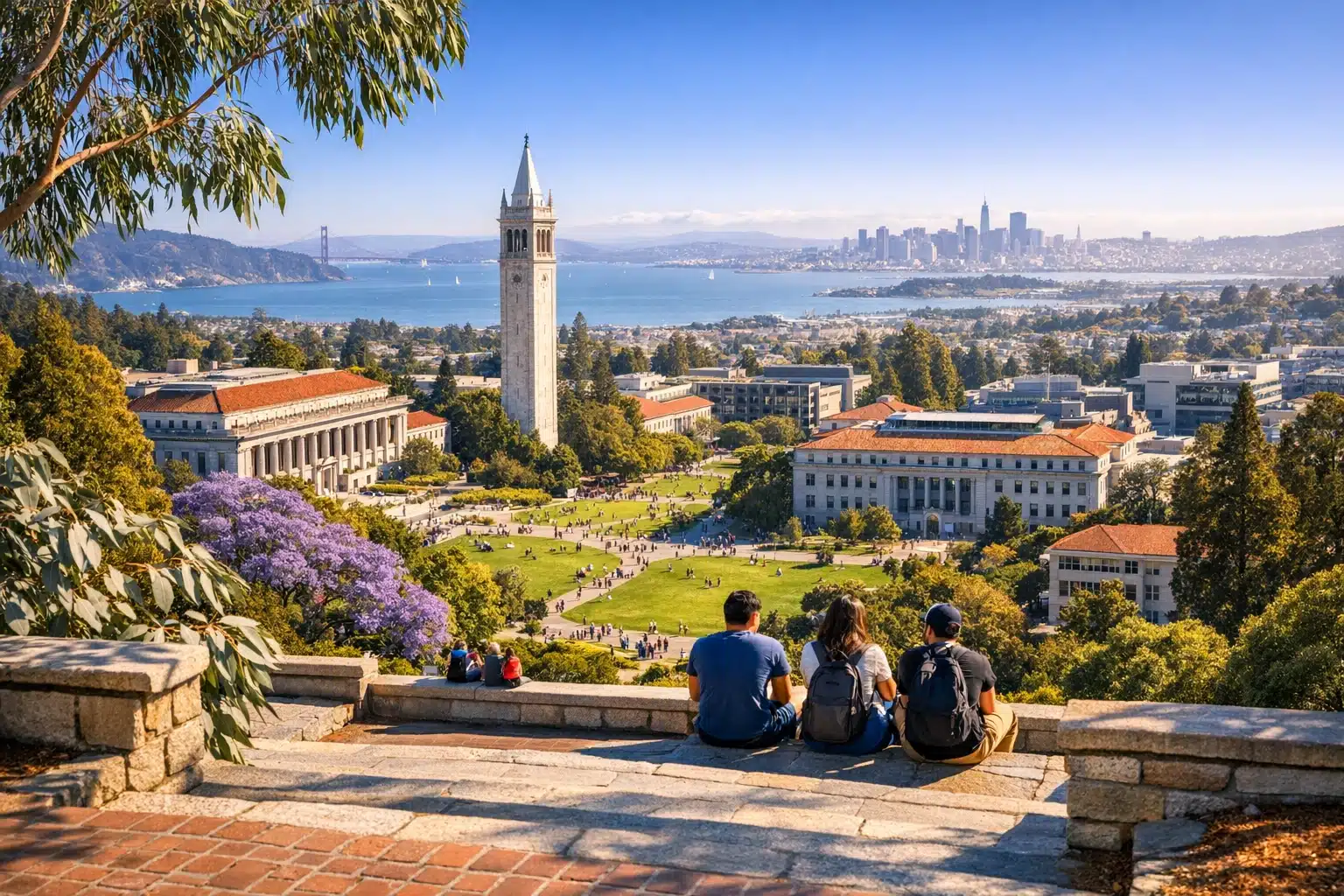
The University of California, Berkeley stands as proof that a public university can compete with the most celebrated private institutions in the country. Berkeley has long held a place among the top academic names in California because it combines research power, faculty distinction, public mission, and a remarkably broad range of programs. It is large, energetic, occasionally chaotic, and deeply influential. If Stanford feels curated and Caltech feels concentrated, Berkeley feels expansive, civic-minded, and intellectually alive in every direction at once.
Berkeley’s academic strength is not limited to one or two standout departments. It is widely respected across engineering, computer science, economics, business, environmental science, chemistry, public policy, sociology, mathematics, and many humanities fields. That depth matters because it gives students room to grow or pivot. A first-year student may arrive interested in coding and leave drawn toward public-interest technology, climate policy, or data science. Berkeley is built for those kinds of shifts. Its size can make the university feel overwhelming at first, but it also creates a scale of opportunity that few campuses can match.
What really sets Berkeley apart is the combination of excellence and public access. It carries world-class prestige while serving as a flagship public institution. For California residents especially, that can make Berkeley one of the strongest value propositions in higher education. The university is also tied closely to research impact. From Nobel Prize connections to groundbreaking work in science and social thought, Berkeley has shaped fields rather than simply participated in them. It is the sort of place where major discoveries and major debates often happen at the same time.
- Best known for: engineering, computer science, business, economics, environmental fields, and public research
- Ideal for: students who want elite academics in a large, diverse, public university setting
- Possible trade-off: big classes, competitive enrollment in some majors, and a fast-moving campus environment
Compared with UCLA, Berkeley often has a slightly more intense academic reputation and a stronger image in certain technical and research-heavy disciplines. Compared with Stanford, it may offer less individualized luxury but a powerful public-university identity and broader socioeconomic mix. Compared with USC, it leans more heavily toward research scale and public mission than private-network polish. Berkeley’s campus culture also carries a historic edge. It has long been associated with activism, debate, and independent thinking, which still colors the atmosphere today. Students who want a polished experience with fewer rough edges may prefer another campus. Students who like ambition with a little grit often find Berkeley unforgettable.
University of California, Los Angeles
UCLA occupies a sweet spot that many students find extremely appealing: it offers high-level academics, major research opportunities, a vibrant campus experience, and one of the most attractive locations in American higher education. Sitting in Westwood, with easy access to the cultural and professional energy of Los Angeles, UCLA has become a favorite for students who want both rigor and range. It consistently attracts a huge number of applicants, and that popularity is not just about sunshine. UCLA delivers serious academic quality across a wide spectrum of fields while maintaining a campus life that feels unusually full and dynamic.
Academically, UCLA is remarkably balanced. It is strong in the sciences, social sciences, business-related fields, arts, humanities, education, public health, and medicine. That balance is important because not every top school is equally strong across different academic styles. A future filmmaker, economist, biologist, or psychologist can all make a persuasive case for UCLA. Its research presence is substantial, and its medical and health-related connections add even more depth. Students interested in interdisciplinary study often benefit from this broad ecosystem, where one campus can support both traditional scholarship and career-oriented exploration.
Compared with Berkeley, UCLA is often seen as slightly more socially balanced and campus-life oriented, though both institutions are academically elite and highly competitive. Compared with USC, UCLA gives students the advantages of a top public university, often at a lower cost for in-state residents. Compared with Stanford, it may offer less exclusivity and fewer private-school resources per student, but it counters with scale, strong public reputation, and a campus environment many students find more grounded and communal. There is a rhythm to UCLA that feels both serious and energetic, as if lectures, lab work, performances, athletics, and city life are all moving in parallel.
- Best known for: broad academic excellence, student life, health sciences, arts, and Los Angeles access
- Ideal for: students who want a top public university with strong academics and a lively campus atmosphere
- Possible trade-off: large classes in some subjects and strong competition for selective programs
UCLA also benefits from something harder to measure but easy to notice: it feels aspirational without feeling remote. For many students, that matters. The campus is beautiful, the network is wide, and the opportunities in entertainment, healthcare, research, media, and public service are unusually close at hand. In practical terms, UCLA is one of the top colleges in California because it does not force students to choose between academic prestige and a rich everyday college experience. It gives them both, and that combination is powerful.
University of Southern California
The University of Southern California earns its place among California’s top colleges by offering a distinctive private-university experience shaped by professional opportunity, strong alumni loyalty, and a strategic location in Los Angeles. USC is often described through its famous programs, and for good reason. Its strengths in cinema, business, communication, engineering, journalism, design, and international affairs have made it especially attractive to students who want an education that connects quickly to real industries. If some universities feel built primarily around scholarship, USC often feels built around scholarship plus movement. Things happen fast there, and students who like momentum tend to notice that right away.
One of USC’s biggest advantages is its network. Alumni connections are frequently mentioned by students and graduates, and that reputation is not accidental. In entertainment, media, entrepreneurship, business, and certain technology spaces, USC has a visible and active presence. That can make internships, mentorship, and job leads more accessible, especially for students who are proactive. The university also benefits from being in Los Angeles, where multiple industries overlap. The city becomes part of the classroom, not just a backdrop beyond it.
Compared with UCLA, USC offers a more private-campus structure and often a more direct professional branding in certain programs. Compared with Berkeley, it is less defined by public research identity and more by private-network advantage and career-facing culture. Compared with Stanford, USC does not usually match the same overall research prestige, but it competes strongly in selected professional fields and often provides a more urban, industry-linked student experience. It is also worth noting that USC has expanded its research ambitions over time, making it more than a purely pre-professional destination.
- Best known for: film, media, business, communication, engineering, and alumni reach
- Ideal for: students who want strong academic programs tied closely to major industries and city-based opportunity
- Possible trade-off: high cost, an urban campus setting, and a culture that may feel career-driven
USC has an unmistakable personality. It is polished but busy, ambitious but social, and deeply connected to the professional world around it. For students interested in turning classroom work into internships, portfolios, productions, startups, or industry contacts, that atmosphere can be a major advantage. The school may not be the perfect fit for every learner, especially those who prefer a quieter or more traditional environment, but it remains one of California’s strongest colleges because it translates education into access with unusual effectiveness. In a state where opportunity is everything, USC knows how to keep doors open.
Conclusion: Which California College Makes the Most Sense for You?
The best college in California is not automatically the highest-ranked one on a national list. It is the one that matches your academic interests, preferred campus environment, budget, learning style, and long-term goals. Stanford is a superb choice for students seeking broad elite prestige and innovation-rich opportunity. Caltech is a sharper fit for those who want a small and deeply technical research environment. Berkeley offers public-university excellence on a global scale, UCLA blends academic strength with a vibrant student experience, and USC stands out for industry access and alumni power.
If you are building your college list, use this top-five guide as a starting point rather than a finish line. Compare majors, visit campuses if possible, look at class size, research access, housing, financial aid, and where graduates actually go. A college can be impressive in headlines and still feel wrong in daily life. The goal is not to chase prestige for its own sake. The goal is to choose a place where your ambition has room to grow, your interests can deepen, and the next four years will move you forward with confidence.