 Artificially generated image
 Water Aerobics Classes for Seniors in 2026
In 2026, water aerobics classes for seniors are no longer a niche option tucked into therapy pools; they are a mainstream way to build strength, protect joints, and stay socially connected. As communities place more focus on healthy aging, these classes offer a rare mix of exercise and confidence for people who want movement without punishing impact. The pool changes the rules in a helpful way, turning resistance into support and effort into something that feels surprisingly possible. For many older adults, that difference is what keeps fitness from becoming another plan on paper.
Outline: This article first explains why water aerobics has become especially relevant for seniors in 2026. It then compares common class formats, equipment, and safety features found in today’s pools. Next, it shows how to evaluate programs by instructor quality, accessibility, and cost. After that, it explores exercise adaptations for typical age-related concerns such as arthritis, balance changes, and reduced stamina. Finally, it offers practical advice for getting started and staying consistent, ending with a conclusion aimed directly at older adults who want a realistic and enjoyable fitness routine.
Why Water Aerobics Matters for Seniors in 2026
Water aerobics has earned its place in senior fitness because it solves a problem many older adults know too well: staying active can be beneficial, but land-based exercise often comes with sore joints, fear of falling, or discouraging fatigue. In 2026, the appeal is even stronger because healthy aging is no longer framed only as disease prevention. It is also about maintaining independence, preserving confidence, and making daily life easier, from climbing stairs to carrying groceries to getting up from a chair without hesitation.
The science behind water exercise is simple but powerful. Water provides buoyancy, which reduces stress on weight-bearing joints. Depending on water depth, a person can feel significantly lighter than on land. At about waist depth, the body carries much less of its usual weight, and at chest depth the load drops further. For seniors with knee osteoarthritis, hip discomfort, or lower back stiffness, that shift can turn an activity that feels punishing on land into one that feels manageable in the pool. Water also creates resistance in every direction, so movements strengthen muscles without the jarring impact of jumping or pounding.
Public health guidance continues to encourage older adults to aim for regular aerobic activity plus strength and balance work each week. Water aerobics can contribute to all three. A well-designed class often includes steady cardiovascular movement, simple resistance patterns using the water itself or light equipment, and balance challenges that feel safer because the pool reduces the consequences of a wobble. For many participants, this is not just exercise. It is reassurance in motion.
There is also a social reason water aerobics matters. Loneliness and inactivity can feed each other. A scheduled class gives structure to the week and adds something quietly valuable: familiar faces. Many senior participants keep returning because the pool becomes part fitness room, part neighborhood square. A little conversation before the warm-up and a few smiles during the cool-down can be just as motivating as any fitness app.
Several trends have helped water aerobics expand in 2026:
• More recreation centers now offer senior-specific time slots.
• Hospitals and rehabilitation networks increasingly partner with community pools.
• Instructors receive better training in age-friendly programming.
• Transportation support and online registration have become easier to use.
That broader access matters. Exercise is most useful when people can actually continue it. Water aerobics succeeds because it meets seniors where they are, not where a fitness advertisement imagines they should be. It respects limitations without defining people by them. In that sense, the pool is more than a place to move. It is a place to keep momentum in life itself.
What Modern Senior Water Aerobics Classes Look Like
If someone has not visited a pool program in years, the 2026 version of water aerobics may come as a pleasant surprise. Today’s classes are more structured, more inclusive, and often more adaptable than the old stereotype of “splashing to music” suggests. There is still fun in the room, certainly, but there is usually a clearer purpose behind the routine. Most programs are designed around specific outcomes such as improving mobility, supporting heart health, increasing leg strength, or helping participants return to exercise after a long break.
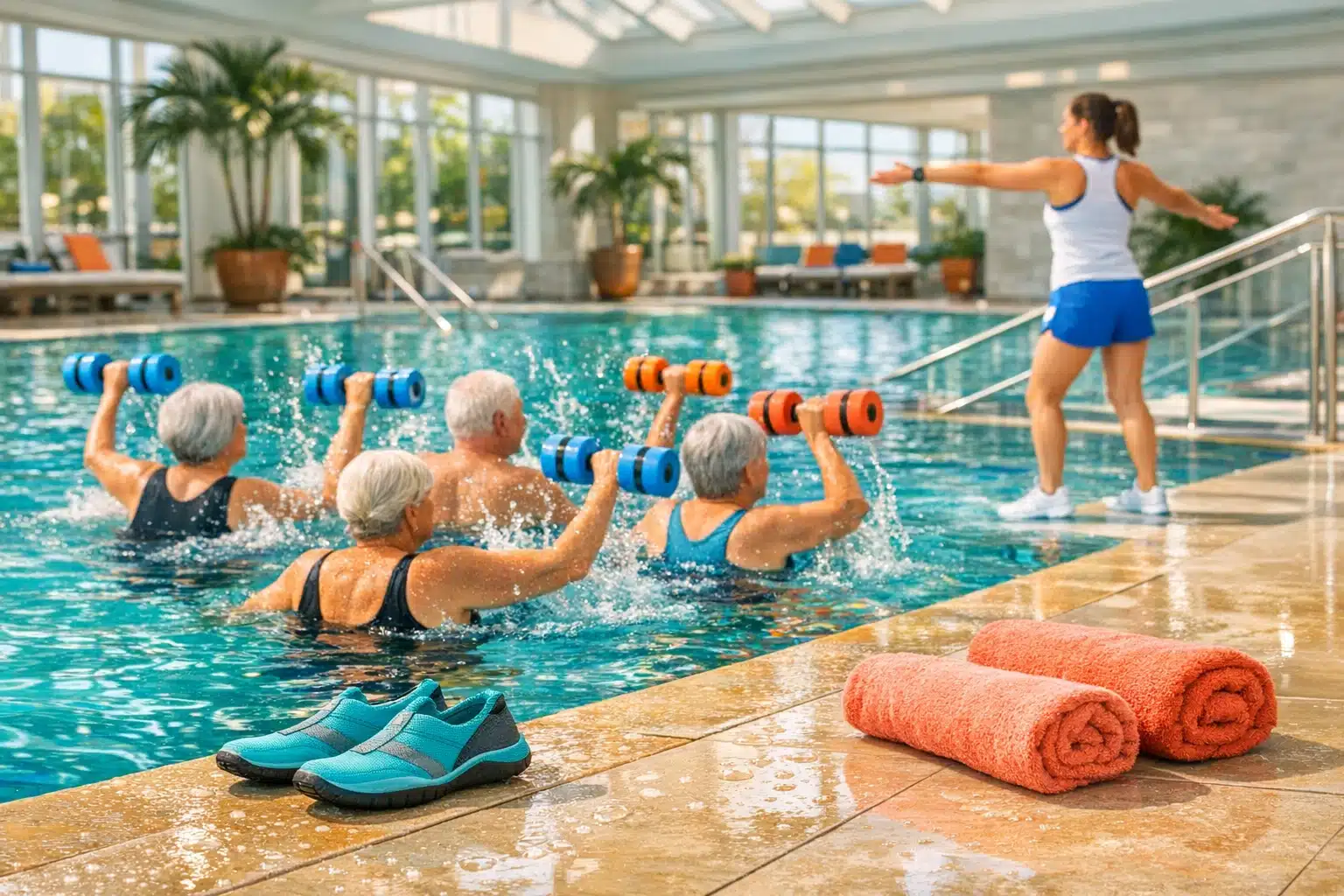
A typical class lasts between 30 and 60 minutes. It often begins with a gradual warm-up: walking through the water, shoulder rolls, arm sweeps, and gentle range-of-motion patterns. The middle portion may include marching, side steps, knee lifts, heel kicks, light jogging, or coordinated arm movements that raise the heart rate. Instructors frequently add tools such as foam dumbbells, resistance gloves, kickboards, or noodles. These are not heavy gym devices dressed for the pool; they are buoyant tools that change how the body works against water resistance. The class usually ends with slower movement and stretches, often focused on calves, hips, shoulders, and the upper back.
One noticeable shift in 2026 is the variety of class formats. Seniors can now choose options that match their comfort level rather than trying to fit into a one-size-fits-all session. Common formats include:
• Gentle mobility classes for beginners or those recovering from inactivity.
• Cardio-focused shallow-water sessions for participants who want a stronger workout.
• Deep-water classes using flotation belts for those who prefer non-weight-bearing exercise.
• Arthritis-friendly or therapeutic sessions in warmer pools.
• Mixed-purpose classes that blend strength, endurance, and balance practice.
Technology has also improved the experience, although the best programs use it quietly. Some community centers offer easier online booking, class reminders by text message, and digital health questionnaires completed before the first visit. A few facilities use waterproof microphones so instructions remain clear without shouting across echoes. Others track attendance patterns to add sessions when demand rises. These are small changes, but together they reduce friction, and less friction usually means better consistency.
Safety standards have become more intentional as well. Better classes clearly state water depth, temperature range, entry options, and intensity level. Many pools now provide handrails, zero-entry ramps, aquatic wheelchairs, or chair lifts. Lifeguards and instructors are more likely to be trained in working with older adults who have hypertension, joint replacements, neuropathy, or mild balance concerns. That does not mean every class is equal, but it does mean seniors in 2026 have more ways to find a program that feels designed for real life.
In short, modern water aerobics classes are less about keeping up and more about participating well. The goal is not flashy athleticism. It is functional progress delivered in a setting that feels safer, steadier, and much more inviting than many people expect.
How to Choose the Right Class: Pool Features, Instructor Quality, and Cost
Choosing a water aerobics class is a bit like choosing walking shoes: the right fit matters more than the label. A class that works beautifully for one senior may frustrate another, not because one is better and one is worse, but because needs differ. In 2026, there are enough program variations that a thoughtful choice can save time, money, and motivation.
The first thing to assess is the pool itself. Water depth affects comfort and exercise style. Shallow-water classes are often easier for beginners because feet stay grounded, which helps people who are uneasy in the water. Chest-deep pools usually provide a helpful balance between support and resistance. Deep-water classes reduce joint loading even further, but they often require more confidence and sometimes a flotation belt. Temperature matters too. Standard activity pools may feel brisk and energizing, while warmer therapy pools can be kinder to stiff joints, especially for participants with arthritis.
Accessibility is equally important. A beautiful class schedule is not useful if entering the pool feels like a wrestling match with gravity. Seniors should ask practical questions:
• Are there stairs with sturdy rails, a ramp, or a mechanical lift?
• Is the changing area close to the pool deck?
• Are benches, lockers, and showers easy to use?
• Is parking available nearby, and is public transportation realistic?
• Are there times of day when the facility is less crowded and quieter?
Instructor quality may be the most important factor of all. A good instructor does more than demonstrate movements. They watch posture, offer simpler and harder variations, explain intensity clearly, and notice when someone looks uncertain. They understand that older adults are not a single fitness category. One participant may be managing a knee replacement, another may want a stronger cardiovascular challenge, and a third may simply need reassurance during the first two visits. Certification in aquatic fitness is useful, but experience with seniors is especially valuable. If a program allows observation, sitting by the pool for ten minutes can reveal a lot. Is the instructor attentive? Do participants seem confused or comfortable? Does the pace feel rushed or well controlled?
Cost in 2026 varies widely. Municipal pools may offer affordable classes through senior centers or recreation departments. Private health clubs often charge more but may include extra amenities such as warmer water, smaller class sizes, or easier scheduling. Healthcare-related programs can sometimes be part of rehabilitation pathways, though coverage depends on local systems and the nature of the class. It is worth comparing:
• Drop-in pricing versus monthly memberships.
• Class bundles versus single-session rates.
• Transportation costs, not just tuition.
• Cancellation flexibility.
• Trial classes or introductory discounts.
The best choice is rarely the most intense or the most polished on paper. It is the class a person can reach, enjoy, and repeat. Consistency beats ambition when building fitness later in life. If a pool feels welcoming, the instructions make sense, and the body leaves tired but not battered, that program is doing something right.
Exercises, Benefits, and Smart Adaptations for Common Senior Concerns
One reason water aerobics works so well for older adults is that the pool allows familiar movements to be scaled intelligently. A person does not need to master complex choreography to benefit. In fact, the most effective routines often rely on simple patterns repeated with purpose: water walking, knee lifts, leg curls, side steps, arm pushes, heel raises, and gentle core work. The magic, if the word may be borrowed for a moment, is not in novelty. It is in the way water changes the effort.
Take cardiovascular fitness. On land, brisk movement may aggravate knees or trigger fear of falling. In the pool, steady marching or walking against water resistance can raise the heart rate with much less impact. Participants who are ready for more challenge can add directional changes, larger arm swings, or interval bursts. Because water resists motion from every angle, even modest-looking movements can become surprisingly effective. Many seniors discover that they are working harder than they expected while still feeling more comfortable than they would on a treadmill.
Strength benefits are equally meaningful. Water resists both pushing and pulling, so muscles engage through the full movement. Foam dumbbells, paddles, and gloves increase that resistance without requiring heavy loads. This is useful for seniors who want better shoulder endurance, stronger legs, or improved core stability but do not enjoy standard weight rooms. Balance can improve too, especially when classes include controlled single-leg stance work, marching patterns, or directional stepping. The water gives feedback and support at the same time, creating a safer practice space.
Adaptation is where skilled teaching becomes essential. Common examples include:
• For arthritis: reduce speed, use a warmer pool if available, and emphasize range of motion before resistance.
• For osteoporosis concerns: focus on upright posture, controlled leg work, and physician-guided limits if there is fracture history.
• For balance issues: stay in shallower water near a rail or wall until confidence improves.
• For reduced stamina: shorten intervals, extend recovery, and treat consistency as progress.
• For shoulder limitations: keep arm movements within a pain-free range and avoid aggressive overhead patterns.
It is also important to be realistic about what water aerobics can and cannot do. It can improve movement, mood, endurance, and strength. It can help some people return to exercise after a period of inactivity. It may reduce the barrier of pain during activity. However, it is not a cure-all, and not every condition responds the same way. Seniors with heart disease, uncontrolled blood pressure, open wounds, severe dizziness, or recent surgery should seek medical guidance before starting. A cautious beginning is not a sign of weakness; it is a sign of wisdom.
When a class is tailored well, the pool becomes a place where limitations are acknowledged without becoming the entire story. Each movement says something subtle but encouraging: there is still room to build capacity, still room to practice, and still room to feel stronger than yesterday.
Getting Started in 2026: A Practical Plan and Final Thoughts for Seniors
Beginning water aerobics does not require a dramatic reinvention of life. In fact, the most successful starts are usually modest. One or two classes per week can be enough to build familiarity, reduce anxiety, and let the body adapt. Seniors who try to do too much too soon often confuse soreness with progress and then quietly disappear from the schedule. A steadier approach works better. Think less about launching a fitness crusade and more about building a routine that can survive ordinary weeks, changing weather, family obligations, and the occasional low-energy day.
Preparation helps. Comfortable swimwear, water shoes with grip, a towel, and a bottle of water are the basics. Some participants like a lightweight robe or cover-up for walking to and from the changing area. It is smart to arrive early on the first day to look at the pool layout, ask where to enter, and mention any health conditions to the instructor. That simple conversation can shape the entire experience. Instructors are far more helpful when they know whether someone is managing a replaced joint, shortness of breath, limited shoulder range, or simple first-day nerves.
For seniors who want a realistic starting plan, this structure often works well:
• Week 1 to 2: attend one gentle class each week and focus on learning movements.
• Week 3 to 4: add a second session if recovery feels good.
• Month 2 onward: choose a consistent weekly pattern and track how daily tasks feel.
• Every few weeks: note changes in balance, stamina, sleep, or confidence rather than obsessing over the scale.
Progress in water aerobics is often subtle before it becomes obvious. A participant may first notice easier breathing during class, then realize a month later that carrying laundry feels simpler or getting out of a low chair takes less effort. These are not flashy milestones, but they are deeply relevant ones. Functional gains are what allow people to keep living on their own terms.
There are also emotional rewards. Many seniors approach the first class with understandable hesitation, imagining they will be the slowest person there or that everyone else already knows the routine. Usually, neither fear holds up under daylight. Most groups include a mix of abilities, and many regulars remember exactly what it felt like to begin. Before long, the pool often becomes familiar territory: a place where movement feels possible, where names become recognizable, and where exercise stops feeling like punishment.
For older adults considering water aerobics in 2026, the message is simple. You do not need to be a strong swimmer, a lifelong athlete, or unusually brave to benefit. You need a suitable class, a little patience, and the willingness to start where you are. If walking has become uncomfortable, if gym machines feel intimidating, or if motivation has faded under the weight of too many false starts, the pool offers another path. It is practical, adaptable, and often far more enjoyable than expected. For many seniors, that combination is exactly what turns good intentions into lasting action.