GMC’s New Sierra Denali Model Is Absolutely Stunning
Luxury trucks used to ask buyers to choose between visual drama and workday usefulness, but the latest GMC Sierra Denali argues that a modern pickup can deliver both with unusual confidence. It arrives at a moment when premium trucks are expected to serve as commuters, family haulers, and serious towing machines. That makes the Sierra Denali more than a style update; it is a signal of how the full-size segment keeps evolving.
Why the New Sierra Denali Matters and What This Article Will Cover
The Sierra Denali sits in a very interesting place within today’s truck market. A full-size pickup is no longer judged only by payload figures and towing charts, even though those numbers still matter. Buyers now expect a truck to do several jobs at once: look polished in an office parking lot, feel comfortable on a long highway trip, and still haul equipment, tow a trailer, or survive a rough workweek. GMC has spent years shaping Denali into its premium signature, and the newest Sierra Denali shows how far that idea has grown. It is not simply a dressed-up work truck. It is a serious attempt to blend capability with a more upscale ownership experience.
That relevance becomes clearer when you look at the broader market. Full-size trucks have moved steadily upward in price, features, and ambition. Many premium trims from GMC, Ford, and Ram now operate in territory once reserved for luxury SUVs. Buyers spending that much money want substance, not just chrome. They want smart packaging, useful technology, durable materials, and a driving experience that feels calmer than the trucks of a decade ago. The Sierra Denali enters that conversation with strong brand recognition, a distinct visual identity, and a feature list that places it near the top of the premium pickup discussion.
This article follows a clear path so readers can judge the truck from several angles:
• first, the Sierra Denali’s overall role in the modern pickup landscape
• next, the exterior design choices that give it its road presence
• then, the interior, infotainment, materials, and comfort features
• after that, the engines, ride quality, towing potential, and daily drivability
• finally, a comparison-minded conclusion focused on the buyers most likely to appreciate it
That structure matters because the Sierra Denali is easy to admire from a distance, yet the real story lives in the details. A luxury truck has to do more than make a strong first impression under dealership lights. It needs to hold up when the road gets long, the weather turns ugly, and the trailer behind it is fully loaded. In that sense, the Sierra Denali is worth attention not because it looks expensive, but because it represents where modern trucks are headed: broader in purpose, richer in features, and more intentional in how they combine comfort with function.
Exterior Design: Bold Presence Without Losing Practical Character
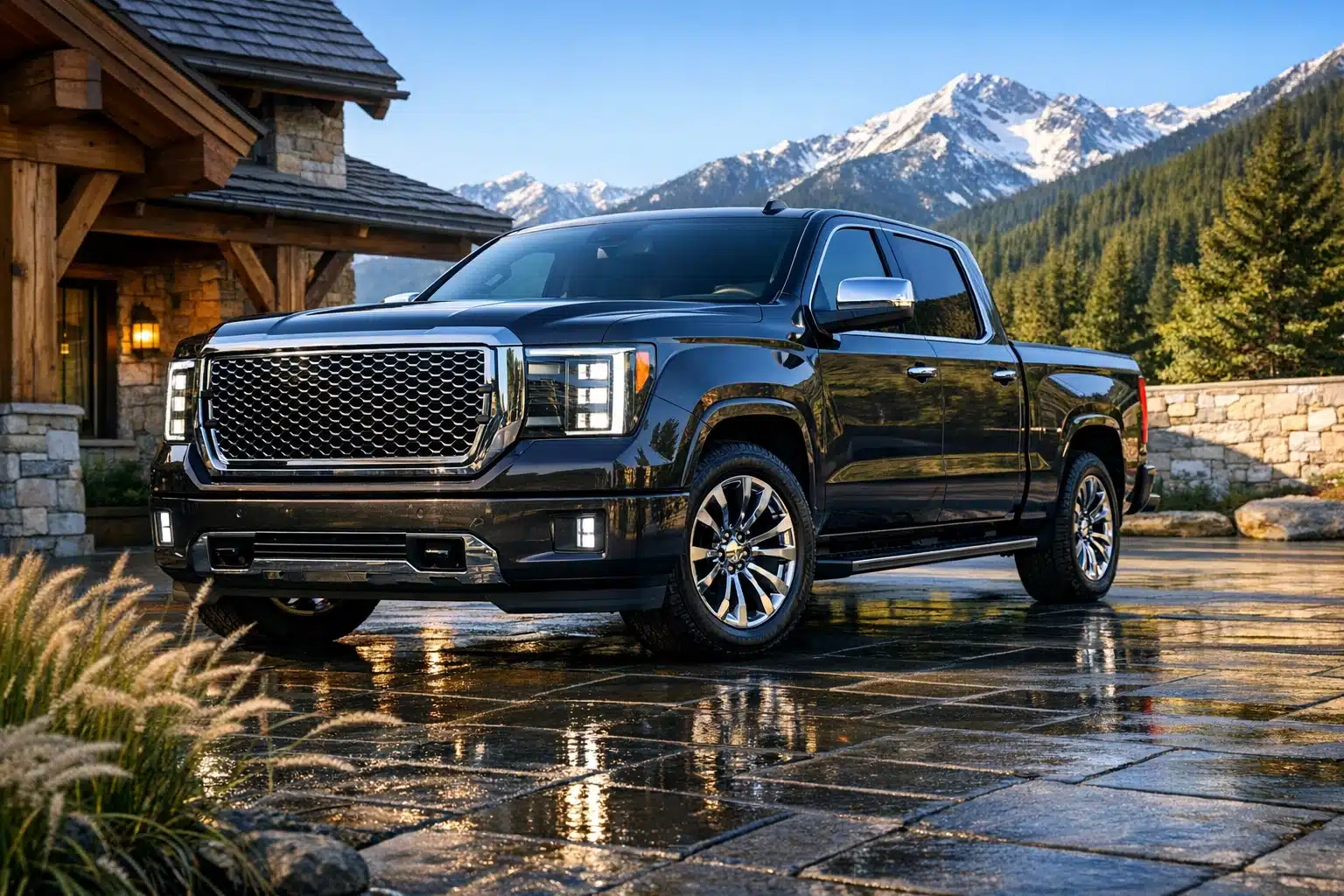
The new Sierra Denali’s styling succeeds because it understands proportion. Many modern trucks chase attention by stacking on visual noise, yet the Denali usually feels more controlled than chaotic. Its front end is large, upright, and unmistakably American in scale, but the detailing tends to separate it from more utilitarian trims. The grille treatment, signature lighting elements, and carefully placed brightwork create a premium look without turning the truck into a rolling display case. Parked at the curb, it has the calm confidence of tailored outerwear rather than flashy costume jewelry.
One reason the design works is that GMC avoids hiding the Sierra’s size. Instead, it organizes that size in a way that feels deliberate. The hood line appears strong and squared-off, the fenders carry enough visual weight to match the cabin, and the bed does not look like an afterthought attached to a luxury front half. That balance is harder to achieve than it sounds. On some rivals, the cabin feels elegant while the rest of the truck still reads like a fleet vehicle. The Sierra Denali looks cohesive, which is important when buyers are paying for a premium badge.
Several practical design choices also reinforce the truck’s appeal:
• LED lighting improves visibility and gives the truck a modern signature at night
• wheel options, often in the 20- to 22-inch range depending on configuration, help fill the body with a more upscale stance
• the MultiPro tailgate adds versatility for loading, access, and bed-side use
• large mirrors and a tall seating position improve outward awareness in traffic and while towing
The Denali’s appearance also benefits from restraint in the right places. Chrome is still present, because this is a luxury full-size truck and not a minimalist concept sketch, but newer executions tend to be cleaner and more integrated than older luxury pickups that relied on shine alone. On darker paint colors especially, the Sierra Denali can look remarkably sophisticated. It projects size and strength, yet it does not seem eager to shout.
Compared with a Ford F-150 Platinum, the Sierra often feels more upright and formal. Compared with a Ram 1500 Limited, it leans less toward sleek softness and more toward traditional truck presence. That difference matters. Some buyers want their premium pickup to look almost SUV-like. Others want it to retain a square-shouldered, mechanical honesty. The Sierra Denali lands firmly in the second camp, and that is part of its charm. It manages to be handsome, imposing, and genuinely useful all at once.
Inside the Cabin: Technology, Comfort, and the Denali Identity
If the exterior sells the idea of a premium truck, the cabin has to prove it every mile. Here the Sierra Denali makes one of its strongest cases. Recent Sierra Denali interiors have become far more convincing than older truck cabins that merely added leather and called it luxury. The dashboard layout is cleaner, the screens are better integrated, and the material choices do a better job of justifying the price. In upper trims, especially Denali Ultimate versions, the mix of leather, contrast stitching, wood accents, and metallic trim can feel closer to a luxury SUV than a traditional pickup.
The technology package is a major part of that improvement. A large center touchscreen, commonly 13.4 inches on current Sierra 1500 models, gives the truck a modern focal point without overwhelming the cabin. The digital instrument cluster, generally 12.3 inches, lets drivers monitor navigation, towing information, and vehicle data more effectively than old analog-heavy layouts. Wireless smartphone integration, available Google-based services, multiple USB ports, and premium audio options all help the Sierra fit naturally into daily life. For many buyers, that matters just as much as horsepower. A truck used every day should not feel a generation behind in its interface.
Comfort is not just about soft surfaces. It is about how the truck organizes space and reduces fatigue. The Sierra Denali performs well here:
• front seats are typically wide, supportive, and designed for long-distance use
• heated and ventilated seating helps in both winter and summer climates
• a head-up display on certain trims reduces the need to look away from the road
• available Super Cruise on select models adds a high-tech edge for mapped highway travel
• properly equipped trucks can offer numerous camera views, including helpful towing perspectives
The Crew Cab configuration is especially important because it turns the truck into a family-capable vehicle rather than a two-row compromise. Rear-seat room is generous, and that changes how the Sierra is used. It becomes road-trip transportation, airport shuttle, pet carrier, hardware-store hauler, and weekend escape machine in the same week. A premium truck should make that flexibility feel easy, and the Denali generally does.
Compared with the Ram 1500, which is often praised for interior warmth and refinement, the Sierra Denali feels a bit more architectural and technical. Compared with the Chevrolet Silverado High Country, it tends to present a clearer premium identity through trim-specific design and a stronger sense of separation from lower models. That distinction is valuable. Buyers shopping this class are not simply counting cupholders. They are asking whether the cabin feels special enough to justify its place near the top of the range. In the Sierra Denali, the answer is often yes, especially when the truck is configured with the richest materials and most advanced convenience features.
Powertrains, Ride Quality, and Capability: Beauty Backed by Useful Numbers
A luxury truck that cannot perform soon reveals itself as costume rather than tool, and this is where the Sierra Denali benefits from the depth of GMC’s full-size platform. Recent Sierra 1500 Denali models have offered several meaningful engine choices depending on trim and model year. The familiar 5.3-liter V8 has typically delivered about 355 horsepower and 383 lb-ft of torque. The 6.2-liter V8 raises the emotional temperature with roughly 420 horsepower and 460 lb-ft, giving the truck stronger acceleration and a richer sound. For buyers who value low-end torque and long-distance efficiency, the 3.0-liter Duramax turbo-diesel has become especially compelling, producing around 305 horsepower and 495 lb-ft in current form.
Those figures matter because they shape the Denali’s personality. The 5.3-liter is a sensible all-rounder, the 6.2-liter feels like the enthusiast’s choice, and the diesel suits drivers who tow regularly or spend long hours on the highway. A 10-speed automatic transmission, common in these configurations, helps keep the truck responsive without making it feel frantic. On light throttle, the Sierra Denali can feel impressively relaxed for such a large vehicle. Press harder, particularly with the 6.2-liter, and the truck answers with easy passing power.
Capability remains central to the Sierra’s appeal:
• when properly equipped, the Sierra 1500 family can tow roughly 13,000 pounds, though exact Denali figures vary by setup
• four-wheel-drive availability improves traction in bad weather and on loose surfaces
• trailer brake controls, towing camera functions, and integrated guidance reduce the stress of pulling larger loads
• bed utility features still make the truck useful even when owners buy it primarily for comfort
Ride quality is where premium trucks win or lose many buyers. The Sierra Denali generally aims for composure rather than sportiness. It is still a body-on-frame pickup, so no one should expect the isolation of a large German luxury sedan. Still, road manners are much improved compared with older generations. The steering is manageable, the seating position inspires confidence, and highway cruising can feel pleasantly settled. On good pavement, the truck has that broad-shouldered, effortless character that makes long distances disappear a little faster than expected.
Against rivals, the picture is nuanced. The Ram 1500 often feels softer and more supple in ride comfort. The Ford F-150 can feel more overtly high-tech in some configurations. The Sierra Denali’s advantage is that it pairs credible numbers with a polished personality that never forgets it is still a truck. It does not abandon utility in the pursuit of luxury; instead, it wraps real capability in a more refined driving experience. That balance is exactly what many premium pickup buyers are shopping for.
Conclusion: Who Should Buy the Sierra Denali and How It Stacks Up
The new Sierra Denali makes the most sense for buyers who want one vehicle to cover a remarkably wide range of duties without feeling ordinary in any of them. It is well suited to the owner who commutes during the week, tows a boat or trailer on weekends, carries clients or family in genuine comfort, and still wants the visual authority that only a full-size pickup can deliver. That audience is larger than it once was. Premium trucks are no longer niche purchases for a small luxury-minded crowd. They are mainstream choices for people whose lives mix work, recreation, travel, and image in equal measure.
When viewed against direct competitors, the Sierra Denali holds its ground by leaning into a distinctive formula. The Ford F-150 Platinum or higher-end variants often appeal to shoppers who prioritize innovation breadth and a vast menu of configurations. The Ram 1500 Limited attracts those who value interior softness and a more plush ride. The Chevrolet Silverado High Country offers similar underlying hardware, but the GMC version usually presents a more focused premium personality. The Sierra Denali splits the difference neatly: it is luxurious without losing its truck identity, sophisticated without becoming delicate, and technologically current without feeling overdesigned.
For the right buyer, its strengths are easy to define:
• a commanding exterior that looks upscale while remaining functional
• an interior that now feels convincingly premium rather than merely upgraded
• strong engine choices, including a muscular V8 and an efficient torque-rich diesel
• modern towing aids and available advanced driver assistance features
• enough daily comfort to serve as a primary family and travel vehicle
Of course, no truck is perfect. A buyer focused purely on maximum softness may prefer the Ram. Someone chasing a very specific feature set might find a Ford configuration that better matches a personal checklist. And shoppers who rarely use a bed or tow anything may still be better served by a large SUV. Yet those caveats do not weaken the Sierra Denali’s core appeal. They simply clarify its mission.
In the end, the Sierra Denali stands out because it feels intentional. It does not ask customers to pretend that chrome alone equals luxury, nor does it forget that a pickup should remain capable and durable. It offers presence, comfort, and usefulness in a package that understands modern expectations. For buyers who want a truck that looks expensive, feels refined, and still earns its keep, the new Sierra Denali is not just attractive. It is one of the clearest expressions of what a contemporary premium pickup is supposed to be.